ZZZ- Old Home Page & Posts Page

Want to Feel Happier Every Day? Just Talk to Someone

Feeling a little off lately? There’s a surprisingly simple—and free—way to boost your mood: have a good conversation.

According to a recent study, just one quality interaction a day can significantly improve your well-being. Researchers found that meaningful communication helps reduce stress and anxiety, while also increasing feelings of connection and overall happiness.

But what counts as a “quality conversation”? The researchers pinpointed seven types that make the cut:

  • Joking around: Light-hearted banter that makes you laugh.
  • Catching up: Reconnecting with someone you haven’t seen or talked to in a while.
  • Deep, meaningful talks: Conversations that go beyond small talk and get into real emotions or ideas.
  • Showing care: Expressing concern, empathy, or support.
  • Valuing someone’s opinion: Asking for and appreciating someone’s perspective.
  • Sincere compliments: Genuinely praising someone for something they’ve done or who they are.
  • Just listening: Being present and fully hearing someone out, without interrupting or judging.

Even a brief moment of connection in one of these forms can do wonders. And while just one solid chat is enough to feel better, the study found that multiple conversations throughout the day amplified the effect even more.

So whether it’s a quick laugh with a coworker, a check-in with a friend, or a heart-to-heart with someone close, making space for meaningful interactions isn’t just good social etiquette—it’s scientifically proven self-care.

Think of it as mental health maintenance that doesn’t require a gym membership, meditation app, or even leaving your house. Just talk. Listen. Connect. Repeat.

Hammer Alley Is the Best New Comedy Podcast of the Year

Hammer Alley is a comedy podcast that takes us on a laugh out loud journey of an ’80s rock band that could have made it but failed miserably. It begins with Alice Cooper touting how great the band was. Then the big question. Whatever happened to Hammer Alley?  The band may be fictional, but the podcast is really funny.

It takes place in 2019, but flashes back a lot to 1987; the year they should have released their debut album. Through several missteps, as Alice Cooper says, “It was not to be.” It takes us back to what rock radio and MTV were like back then. (In fact, I heard about the podcast on the radio recently.) 

The band and the podcast are made up of a cast of characters that includes Slim Jimmy Simmons, the egomaniacal lead singer (was there any other kind in the ’80s?). He’s not only your narrator for the two-season, ten-episode podcast; he’s also the guy who’s never given up on his dream of being a rock star. No matter how many years have gone by.

There’s also lead guitarist Denny Steele, bassist Dash Wilcox, drummer Stixx, and keyboardist Glenn Canyon. The rock songs they perform are actually good. A call from a big-time movie producer gives Jimmy hope that Hammer Alley will finally get its due. This leads to Slim Jimmy’s internal monologues, and a couple of songs about what’s going on in his “imagination”. (Including the band’s British manager, Miles Bloodstain.)

No ’80s band would be complete without petty arguments, and there’s no lack of the tension when you get to eavesdrop on their humorous recording sessions. 

What makes Hammer Alley even more enjoyable are the outtakes after each episode. It becomes apparent that most of the scenes were improvised. The professional voice actors are clearly surprised by each other’s responses to the silly scenarios. All of the quick-moving episodes are fully produced with music and sound effects. 

You didn’t have to live through the ’80s to enjoy Hammer Alley. But if you did, or you love classic rock, or were ever in a band, you’ll love jumping on the tour bus with Hammer Alley. 

A trailer and a couple of their lyric videos are available on YouTube.

Brick Taylor has covered radio, television, and film for decades. Now he’s getting paid for walking around listening to funny podcasts.

Do You Clean Your House for Your House Cleaner?

If you’ve ever tidied up before your house cleaner arrived––and felt a little silly about it––you’re actually in the majority.

Half of us would clean before a house cleaner arrived.

In a new YouGov poll, 53% said they would, and another 14% said maybe. Just 33% gave the expected answer: “No, that’s literally what I’m paying them for!”

While it may sound backward, there’s actually some logic to it. Maybe you want them to focus on the deeper-cleaning tasks (hello, toilet), rather than spend time picking up clutter or moving stuff around to get started.

But the trend of prepping for professionals doesn’t stop there.

95% of Americans brush their teeth before seeing the dentist.

Sure, a full cleaning is on the way. But we just can’t resist trying to make a good impression, even when the professionals are about to do a better job than we ever could. (And let’s be honest, we’re all still trying to trick them into thinking we’re that responsible person who flosses every night… not the slop who walks around all day with debris in their teeth.)

60% also wash their hair before getting it cut.

Even though most salons include a wash in the service, 60% of people said they usually wash their hair beforehand. So, apparently, not everyone wants to show up with bedhead or greasy roots, even if it’s just going to get shampooed anyway.

Is it pride? Politeness? Guilt? Whatever the reason, these findings highlight something relatable. We want to be seen as clean and put-together—even by the very people we hire to help us get that way.

So next time you’re frantically straightening up before the cleaning service rings your doorbell, just know: you’re in good, neurotic company.

Here’s Why Toxic Positivity Sucks

In a culture that often equates positivity with strength, it might come as a surprise that too much of it—at the wrong time—can be toxic.

Toxic positivity is the belief that no matter how bad a situation is, people should maintain a positive mindset. It sounds supportive on the surface, but in practice, it can actually minimize or dismiss real emotions like sadness, frustration, or grief.

Think of it as emotional gaslighting.

You lose your job, and someone says, “Just stay positive!” Sure, they’re trying to help—but in that moment, it can feel more like they’re ignoring your reality than offering support.

Or imagine missing out on a major goal—bombing a big game, for instance—and hearing, “Everything happens for a reason.” That kind of response, though common, assumes there’s some cosmic lesson in failure rather than validating your disappointment.

Then there’s the classic: “Happiness is a choice.” It’s the kind of phrase that, instead of lifting someone up, can make them feel like their struggle is their fault. Rather than supporting someone through their low moment, it unintentionally adds guilt to the mix.

So what’s the alternative? It starts with understanding the difference between toxic positivity and healthy optimism.

Optimism is about having hope and confidence in the future. Toxic positivity, on the other hand, is when we force that hope onto others—even when they’re not ready or able to receive it.

And when people are navigating loss, anxiety, or other intense emotions, what they really need is validation, not a motivational poster.

Just remember, it’s okay to not be okay.

Mental health experts say that embracing difficult emotions is a key part of resilience. Acknowledging someone’s pain—even sitting with them in silence—is often more comforting than trying to spin their pain into a positive.

This is especially important in the workplace, where a culture of relentless positivity can make it harder for employees to speak up about burnout or stress. When people feel they have to put on a smile no matter what, real issues go unaddressed.

So next time someone’s having a rough day, try swapping “Look on the bright side” with something more empathetic like, “That sounds really tough—do you want to talk about it?”

Because real support doesn’t mean cheering people up. It means showing up.

The Perfect Vacation Is Three Hours from Home

If the long holiday weekend left you craving a real getaway, you’re not alone. A new survey is offering fresh insight into what many Americans consider the “perfect vacation”—and it might be closer (and pricier) than you’d think.

According to a recent report from Talker Research, the ideal vacation lasts 11 days and takes place roughly three hours from home. Whether that’s an exciting prospect or a letdown may depend on how badly you want to avoid airports.

And speaking of avoiding airports, that “perfect” distance of three hours might help explain the trip’s jaw-dropping price tag: an average of $8,800 per person. That breaks down to around $800 a day, meaning this “ideal” trip would likely include premium accommodations, fine dining, and plenty of activities—or perhaps a short-haul flight and some serious splurging.

So what are travelers looking for on this getaway? According to the poll:

  • 63% want a beach destination,
  • 53% are after “the great outdoors,”
  • 43% crave a mix of big cities and historical sightseeing,
  • And 31% prefer visiting landmarks and outdoor attractions.

But while preferences vary, one key theme emerged: relaxation. The perfect trip isn’t just about checking off tourist boxes—it’s about completely unplugging, making new memories, and enjoying the freedom to do absolutely nothing (or everything) on your own terms.

Whether your dream vacation includes a beach hammock, a hiking trail, a full-service experience, or a self-guided tour, the key takeaway is this: a meaningful break doesn’t have to be far away—but it might cost you.

Americans Only Feel Fully Healthy 19 Days a Month

A new report reveals that the average American only feels “fully healthy” for 19 days out of each month. That means for roughly one-third of any given month, most people are contending with some kind of physical or mental discomfort.

The survey, conducted by Talker Research, highlights how feeling “100%” might be more elusive than we admit. While 19 days per month works out to around 228 days per year, framing it that way doesn’t necessarily soften the reality: At least 37% of the time we’re not feeling great.

So what’s dragging everyone down?

Fatigue is the most common complaint, impacting people an average of 13 days per month.

That’s nearly every other day. Mood changes aren’t far behind, showing up around 10 days per month, followed by digestive issues (9.8 days) and headaches (7.5 days). These overlapping issues suggest that many people are battling multiple symptoms at once, not just the occasional off day.

When respondents were asked how they felt right now, only 28% said they felt completely healthy. The remaining 72% reported being in moderate or poor health. And it’s not just the occasional down day—51% said they’ve been dealing with recurring health issues that have persisted for six months or more.

That persistent state of unwellness is taking a toll beyond the physical.

About 15% of those surveyed said that not feeling well has negatively impacted their ability to enjoy time with their family.

While the report didn’t explore the underlying causes in depth, the numbers hint at broader issues in public health, mental well-being, and perhaps even work-life balance. Chronic stress, poor sleep, and diet likely all play a role, especially as fatigue and mood are among the most frequently cited issues.

Beavers Announce Their Presence with Farts

(Who knew I was part-beaver?)

A beaver in Cornwall recently achieved unexpected internet fame—not for building a dam or swimming in a stream, but for farting on camera.

The moment, captured on a night vision wildlife cam at Helman Tor Nature Reserve near St Austell, quickly turned heads.

But according to experts, the noisy toot may serve a more serious purpose in the beaver world.

Lauren Jasper, a beaver officer with the Cornwall Wildlife Trust, explained that the flatulence might be linked to scent-marking behavior. Beavers possess a gland near their tails that secretes castoreum, an oily substance used to mark territory. Jasper believes the expulsion of gas could have accompanied this scent-marking process, helping the beaver communicate its presence to others in the area.

“We set out camera traps hoping to catch footage of their natural behaviors—things like grooming, swimming, and dam-building,” Jasper told What’s The Jam.

“But what really stood out was the sound of a beaver breaking wind. It gave us all a good laugh.”

Beavers, once extinct in the UK, have been gradually reintroduced to the wild as part of ongoing conservation efforts. Their impact on ecosystems is significant—they’re considered “ecosystem engineers” for good reason. By constructing dams and creating wetlands, they help manage water flow, reduce the risk of flooding, and provide vital habitats for other wildlife.

“The wild release of beavers is a huge step toward restoring natural landscapes,” Jasper said. “They improve water quality and create diverse habitats. Their return marks a major milestone for nature’s recovery.”

While the viral video might elicit chuckles, it also draws attention to the critical role beavers play in rewilding efforts across the UK. Conservationists hope their return will support a more sustainable, biodiverse future.

In the meantime, the Cornwall Wildlife Trust can add “beaver fart caught on camera” to their growing list of footage showcasing the quirky charm—and ecological importance—of these once-vanished mammals.

This Mom Counted Every Screen in Her House—and the Total Is Wild

How many screens are in your home right now? You might want to sit down before you start counting—because one mom on TikTok did the math, and her household total has the internet rethinking their own digital habits.

The mom, who shares snippets of family life online, recently went viral after revealing her family owns 24 different screens. Yes, 24.

She and her husband have four kids, aged two to 10, and every member of the household—toddler included—has multiple devices.

In a breakdown that feels more like an electronics store inventory, she included everything with a screen: TVs, tablets, phones, computers, even smartwatches. Shockingly, nine of the 24 screens are televisions. (That’s more TVs than people in the house.)

Then there are the tablets—seven in total. Each family member has their own iPad, and her five-year-old has a second one specifically for speech therapy. Add in three iPhones, two Apple Watches, two computers, and a Nintendo Switch, and you’ve got a fully loaded digital household.

Some outlets tried to bump the number to 27 by including game consoles like PlayStations and Xboxes. But the mom clarified: if it doesn’t have a screen, it didn’t make the list. Naturally, the video sparked conversation. Some commenters were amazed, others horrified.

“No wonder nobody plays outside anymore,” one viewer quipped.

Others admitted their own families weren’t far off—with one user tallying up 30 screens between six people.

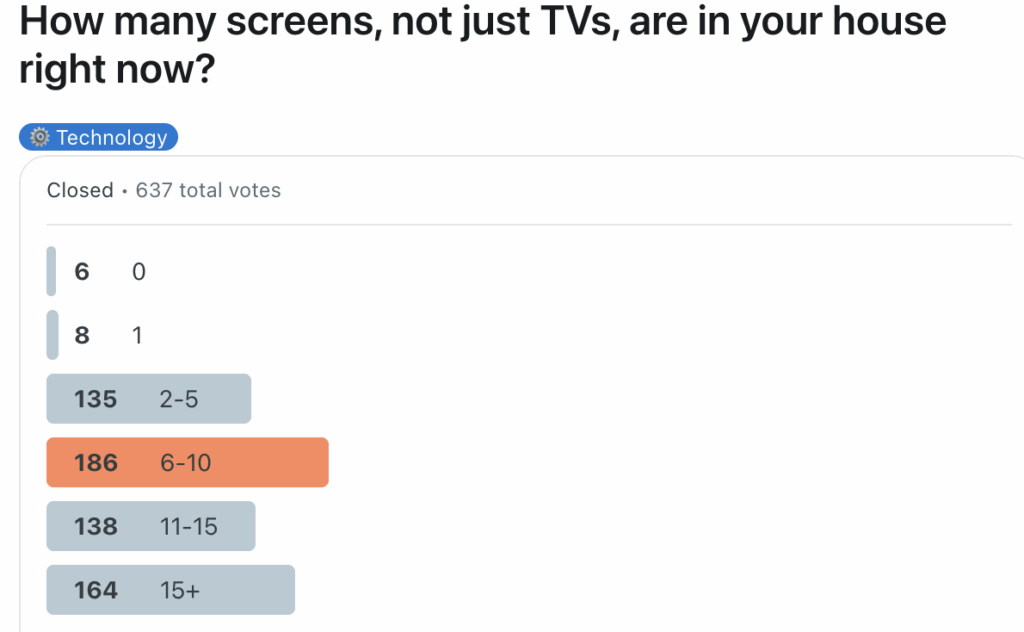
The video taps into a growing cultural moment where many families are trying to navigate screen time limits, digital burnout, and device dependency. According to a 2023 Pew study, the average U.S. household has more than 10 connected devices—and with smart homes on the rise, that number is only climbing.

Whether you’re screen-rich or just screen-aware, this mom’s viral moment is a good reminder: maybe it’s time for a quick digital audit of your own. (And maybe—just maybe—some fresh air.)

You Shouldn’t Give 100% at Work… a Solid 85% Is Plenty

If you’re constantly being told to give 100% — or worse, 110% — at work, it might be time to hit the brakes. According to a concept called the “85% rule,” putting in just enough effort could actually make you better at your job.

The idea? Stop overexerting yourself. Instead of running on all cylinders every minute of the day, aim to give about 85% effort. It sounds counterintuitive, especially in hustle culture, but there’s science — and Olympic gold — behind it.

The rule was popularized by none other than track legend Carl Lewis.

The Olympic sprinter was known for starting races at a seemingly relaxed pace, only to surge past competitors in the final stretch.

Why? Because he wasn’t tensed up and burning out in the first half — he was running at about 85%, saving the rest for when it really counted.

In a work setting, the same logic applies. Operating just below your maximum capacity can actually help you:

  • Stay mentally flexible
  • Be more present and aware
  • Boost your creativity
  • Avoid burnout

By contrast, always pushing yourself to the limit can leave you drained, scattered, and ironically, less productive.

Think of it like trying to drive a car with your foot glued to the gas pedal — you’re going to burn through your fuel fast and probably miss your turns.

Of course, this doesn’t mean slacking off. The 85% rule isn’t about doing the bare minimum — it’s about working smart, not just hard. It’s a reminder that peak performance often comes when we dial it back just enough to stay sharp, steady, and sustainable.

So the next time someone tells you to give 110%, just smile and give them your well-balanced 85. Carl Lewis would approve.

How Many “Chuggas” Come Before a “Choo Choo”?

Some debates never die—they just circle back with more votes. A quirky internet question we first saw pop up in 2019 is chugging along again in 2025: How many “chuggas” come before a “choo choo?”

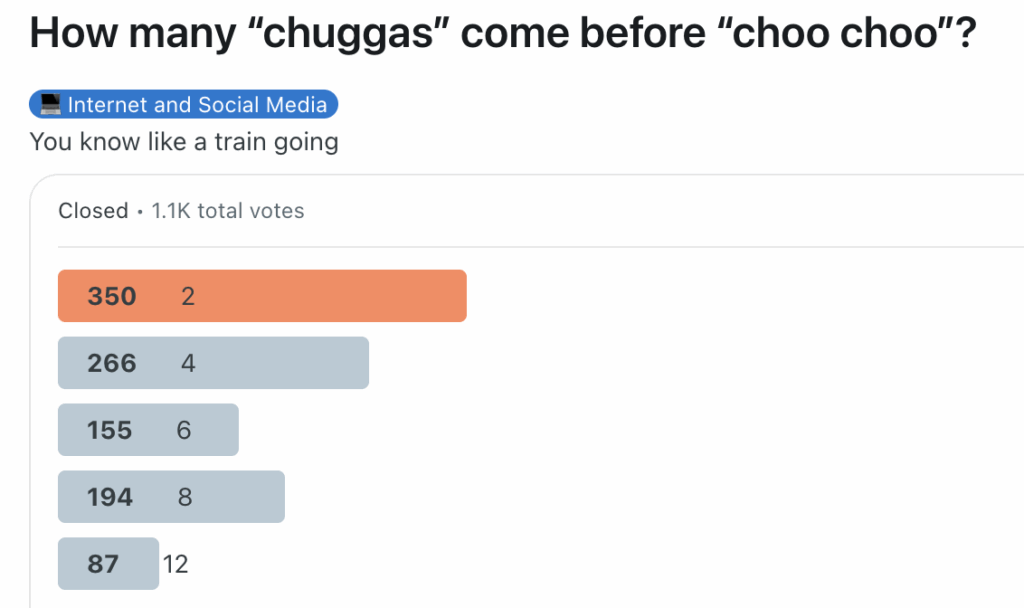
A Reddit poll revisiting the viral debate racked up over 1,000 votes, and the results are as divided (and passionate) as ever.

The most popular response? Just two chuggas—earning 33% of the vote.

That was followed by four (25%), eight (18%), six (15%), and a small but mighty 8% insisting it’s a full dozen chuggas before the train toots its horn.

If you’re wondering why this is even a thing, it all stems from the rhythmic chant often used when pretending to be a train, usually by children (or nostalgic adults): “chugga-chugga chugga-chugga choo choo!” But clearly, not everyone agrees on how many “chuggas” it takes to reach the iconic double “choo.”

While the internet may have spoken in favor of the minimalist two-chugga camp, strong opinions persist. The hot take? One person argued that eight is the only answer that feels complete.

“One loud chugga followed by three quieter chuggas repeated twice.  ‘CHUGGA chugga chugga chugga, CHUGGA chugga chugga chugga, CHOO-CHOO!!’

If you’re out here doing 12, you might be trying too hard.

Someone else in the Reddit comments suggested 14, and was met with the response, ” Bro out here saying chugga chugga for an eternity.”

As silly as the debate is, it taps into something universal: our collective love for low-stakes internet arguments that somehow feel very important. And like all great debates—pineapple on pizza, the correct way to hang toilet paper—this one’s bound to roll back around in another few years.

Until then, count your chuggas wisely.

Exit mobile version