Life advice you didn’t ask for, trends you’ll forget by next week, and feel-good fluff designed to help you stop doomscrolling, at least for five seconds.
If you’ve ever ended the day wondering what you actually accomplished, here’s your answer: about half what you could.
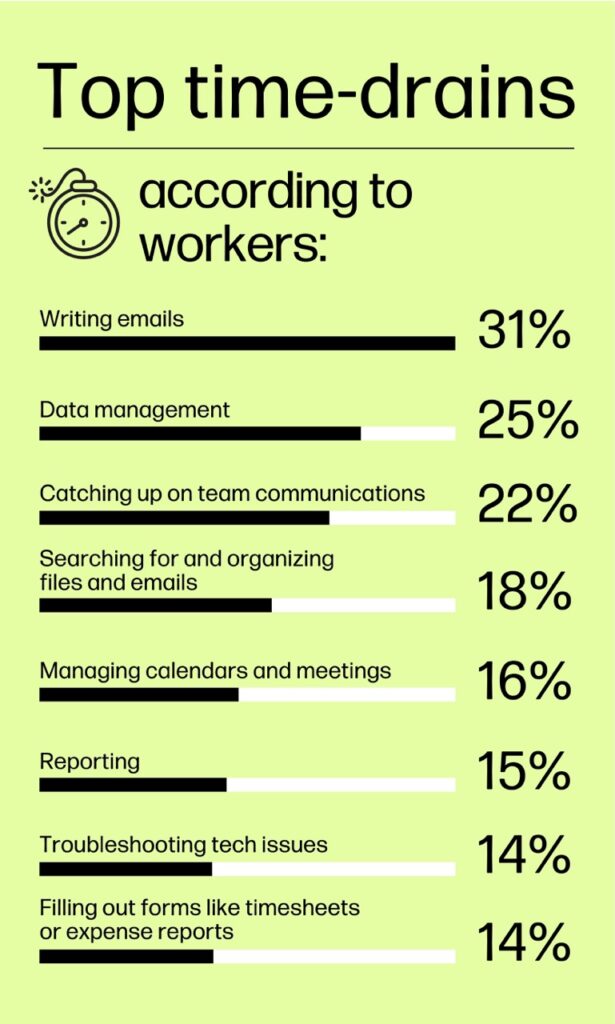
A new survey says American office workers spend half their day (literally, 51%) doing nonsense busywork like writing emails, digging through files, and copy/pasting. Basically, it’s admin Groundhog Day.
That’s not all the annoyance we have to deal with either. The survey found 1 in 3 people have considered quitting because of bad or outdated tech, and 85% blame repetitive tasks for their burnout.
The Top 3 Biggest Time Sucks
The poll found the biggest time suck of them all is email, followed by data entry, and then catching up on team messages. So basically, you spend half your day talking about work instead of doing it.
Even IT folks admit things are out of hand. They say employees waste way too much time on menial junk, and not even 4 in 10 workers feel like they’ve got the right tools to do their best work.
Will A.I. save us?
The “good” news? Companies say they’re rolling out A.I. tools to save us from all that busywork. The bad news? If history’s any clue, those tools will come with training videos, logins, and new ways to “streamline” the same stuff we already hate.
The dream is simple: less typing, fewer tabs, and eventually a workday that feels like work instead of a never-ending email marathon.
Here’s a fun little nugget to file under “stuff that’ll make your next flight way more stressful.”
You know how the cabin lights get dimmed during takeoff and landing? It feels kind of relaxing, like they’re setting the mood for a nap or a mid-air spa day. Yeah, nope.
The real reason is much more unsettling.
Turns out, they’re not dimming the lights to soothe you. They’re doing it because those are the two riskiest parts of the flight, and if something goes wrong… you might need to escape in the dark.
The real reason for the moody lighting, according to industry experts, is to give your eyes time to adjust — just in case there’s a sudden loss of power and you need to make a quick exit.
Basically, they want you to be able to see the glowing “EXIT” signs and emergency path lights without your retinas screaming, “Why is it pitch black?!”
Unsettling, yes. Makes sense? Also yes.
Think about walking into a dark movie theater from the blinding afternoon sun. You’re bumping into chairs, whisper-apologizing to strangers, trying not to drop your popcorn. Now imagine doing that, but the theater is a plane, there’s no popcorn, everyone’s screaming, and the stakes are slightly higher.
The dim lights are a pre-game warmup for your eyeballs. If something goes sideways, you’ll be better equipped to see where you’re going instead of flailing around in the dark like you’re in the worst escape room ever.
So the next time you’re buckled in and the lights start to fade, remember it’s not about comfort. It’s about survival. Sleep tight!
Spooky season is officially here, and a new survey ranked how much each state actually loves Halloween.
Turns out the most obsessed trick-or-treaters live in… Delaware, Idaho, and North Dakota. Those three scored a 4.2 out of 5 on the Halloween Spirit Scale, which basically means their houses are covered in fake cobwebs and 12-foot skeletons before October even starts.
Nipping at their heels are Alabama, California, Iowa, New Hampshire, Oregon, Rhode Island, and Wyoming. So if you live there, expect to see entire neighborhoods that look like Tim Burton movie sets and parents competing for “Most Over-the-Top Front Yard” like it’s the Olympics.
But not everyone’s feeling the spooky spirit. Arizona landed dead last. Maybe it’s hard to get in the Halloween mood when it’s 102 degrees outside and your Snickers melts before it hits the candy bucket.
Wisconsin, Montana, Hawaii, South Carolina, Nebraska, Virginia, Alaska, North Carolina, and Georgia also didn’t exactly scream “boo” with enthusiasm.
Now, let’s talk candy, because Halloween isn’t Halloween without it. The average American household buys 4.5 bags of candy every year, and nearly half of us go straight for the party size bags. Altogether, 132 million households stockpile about 745.8 million pounds of candy every Halloween season.
So whether your state goes full haunted house or barely carves a pumpkin, one thing’s clear: America runs on sugar, costumes, and a little bit of chaos. And for some of us, spooky season doesn’t end…it just hibernates until next August.
Hallmark loves to tell us we’re “older and wiser” every year. Cute. But according to science, your brain is basically on a rollercoaster: it climbs, it peaks, and then… it nosedives.
A new study in the journal Intelligence found that the human brain hits peak performance between ages 55 and 60. That’s when your life experience, judgment, and wisdom finally outweigh the fact that you just Googled “how to Google.”
Here’s the ride in a nutshell:
Fluid intelligence (reasoning, memory, mental speed) maxes out in your early 20s. So yes, you peaked at Mario Kart in college. It’s been downhill ever since.
Crystallized intelligence (all that random trivia you collect over the years) just keeps building. By your 50s, you’re basically a lesser-Wikipedia… with back pain.
Personality traits like patience and emotional stability improve as you get older.
Moral reasoning sharpens with age, meaning you actually know right from wrong. Too bad it arrives decades after you needed it in your 20s.
Financial literacy keeps improving into your 60s. That’s right around the time you finally pay off your student loans.
Cognitive flexibility and empathy start to fade with age, so if your parents can’t figure out TikTok or don’t care about your vibe check, cut them some slack.
So yes, the sweet spot is late 50s. You’re wise, savvy, and make solid decisions… basically the Yoda years of your brain. But after that, it’s a slow slide into “What’s my password again?” territory.
The researchers say this mental peak matters most for business and politics. Which is science’s polite way of hinting that maybe, just maybe, 80-year-old senators shouldn’t be the ones steering the ship.
How much do Americans hate sitting on hold with customer support?
A poll found over a quarter of us would rather do our taxes, go to the dentist, or stand in line at the DMV. (We’re not sure we buy it, but over one in five also said they’d rather spend a night in jail or shave their head.)
Only 46% of customer service issues actually get resolved. It takes an average of three attempts and 90 minutes on hold to make it happen.
Here are the five most annoying things that can happen when dealing with customer support:
1. Having to repeat details when you’re transferred or get disconnected.
2. Having to call or email multiple times to solve a problem.
3. Only having one option to reach out. Like you have to call, no emails.
4. Not being able to reach a real person quickly and easily.
5. Terrible hold music.
A few more that made the top ten include: A bad connection, or having a hard time hearing them… not being able to resolve an issue online… and too many button options, like “To talk to a customer service rep, press 9.”
Green poop, Princess Leia’s bikini, and Justin Bieber’s ‘baby’ maker. Here’s what was in the news 10 years ago this week.
Burger King’s Halloween Whopper was turning people’s poop green
Spookiest fast food item ever? Health experts told people not to worry. Food coloring in the Whopper’s black bun was the likely culprit. The festive fecal fiasco even inspired its own couple’s costume that year.
Justin Bieber stepped out onto a balcony fully naked
He was vacationing in Bora Bora with British model Jayde Pierce when the paparazzi caught him stepping out in his birthday suit. Fans were impressed with what he was packing. Justin’s dad even decided to (oddly) weigh in, tweeting, “What do you feed that thing. #proud daddy.” 👀
The weirdest stuff people ever got trick-or-treating
A BuzzFeed list went viral after readers were asked to name the weirdest thing they (or their kid) ever got while trick-or-treating. Answers included “potato salad in a plastic bag,” “condoms,” and “a pack of cigarettes.” Good job, America.
The skimpy, metallic wardrobe item from “Return of the Jedi”fetched $96k at an auction of Hollywood memorabilia. It turned out to be a pretty solid investment, selling again in 2024 for $175,000.
Steve Irwin’s daughter – just 17 at the time – broke down in tears at the end of her contemporary dance routine with partner Derek Hough. Her little brother Robert Irwin was in the audience. A decade later, he’d appear on the show as well. His shirtless routine prompted Chippendales to offer him a contract.
A study found these states are the most “normal”
“Business Insider“ used 40 different metrics to rank all 50 states according to how “normal” they are. Most Normal: Indiana, Missouri, Oregon, North Carolina, and Michigan. Weirdest: Hawaii, Alaska, California, New York, and Utah.
First woman to announce MLB postseason game
ESPN analyst Jessica Mendoza (sitting alongside John Kruk and Dan Shulman) became the first woman to ever call a nationally televised postseason game. The Astros beat the Yankees 3-0 in that one, but the Kansas City Royals would go on to become World Series champs a few weeks later, beating the New York Mets in five games.
An NBA player drove 95 miles to fight an NBA coach
Grizzlies forward Matt Barnes reportedly found out Knicks coach (and former Lakers teammate) Derek Fisher was shtupping his wife. Media outlets reported that Barnes drove 95 miles from Santa Barbara to kick Fisher out of his home. Cops were called, but Fisher was gone by the time they got there and no one pressed charges.
4 in 5 people said they’d rather work in solitude
80% of people polled said they preferred working alone because they felt their office work environment was “hostile” or “unhelpful.” COVID would eventually hold their feet to the fire on that one five years later.
“Boob Spelled Backwards Is Boob”
It was like “We Are the World” for boobies! A ton of big stars pitched in on a charity single called “Boob Spelled Backwards Is Boob“ for Breast Cancer Awareness Month. San Francisco DJ Mike Nelson was behind the project – his wife Christi was battling breast cancer, and their eight-year-old son wrote the lyrics.
Featured artists included Florence Welch, Noel Gallagher, Hozier, Michael Franti, Graham Nash, The Grateful Dead, and more. Christi kept fans updated and inspired during her decade-long cancer battle. (Her family got another 10 amazing years with her! Sadly, she passed away in Sept 2025.)
Congrats, fast-food chains – you tried to make drive-thrus smarter with A.I., and somehow made them dumber.
According to the latest annual Drive-Thru Study from Intouch Insight, the average fast-food drive-thru experience lasts a little longer than it did a year ago. We’re now clocking in at 5 minutes 35 seconds per visit, or nine seconds slower than last year. That may not sound like much, but when your french-fry-fueled serotonin levels are crashing, it’s a lifetime.
To be fair, they added more chains to their study this time around. If you only look at the ones they tested last year, the average drive-thru time was actually flat – or technically 3 seconds faster than it was in 2024.
Intouch Insight Drive-Thru Study
Taco Bell has the fastest drive-thru
Taco Bell took the crown for fastest service, at just 4 minutes 16 seconds. Probably helps that every single item is some variation of a tortilla and cheese. KFC, Tim Hortons, and Arby’s weren’t far behind, keeping things moving and the curly fries flowing.
Chick-fil-A had the longest wait times at over 7 minutes. But before you cancel your waffle fry plans, there’s a good reason for that wait. They also had much busier lines, and still managed to rank first in friendliness and customer satisfaction. So yes, it takes longer. But Chick-fil-A customers feel it’s a worthwhile wait.
Burger King and Wendy’s are the most accurate
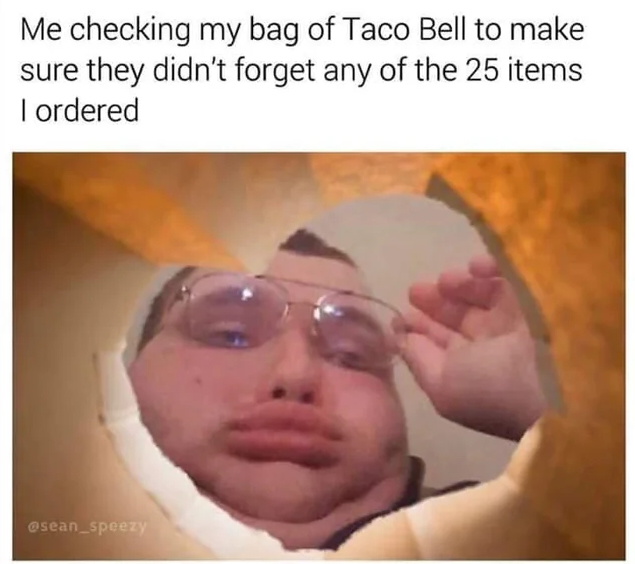
As for order accuracy, Burger King and Wendy’s tied for first among non-coffee chains, both hitting 88% accuracy. (Am I the only one who thinks that’s pathetic? The best of the best still get 1 in 9 orders wrong?)
The most common flubs overall? “Ice” issues, like ignoring requests for “no ice” or adding too much of it. Next on the list was forgetting an item or giving customers the wrong food.
A.I. screwed up more orders
When drive-thru A.I.’s worked as intended, they did make things go a little quicker. The problem is they’re still not as good at asking “would you like fries with that” as the average 16-year-old employee who does it while scrolling TikTok.
Drive-thrus using A.I. were less accurate, getting orders right just 83% of the time. That’s lower than the overall industry average of 87%.
One in every three customers also had to repeat themselves to A.I., and a human had to take over 21% of the time.
Trying to have a heart-to-heart with your kid these days is damn-near impossible, since you’re competing with TikTok, Snapchat, and whatever’s trending on YouTube.
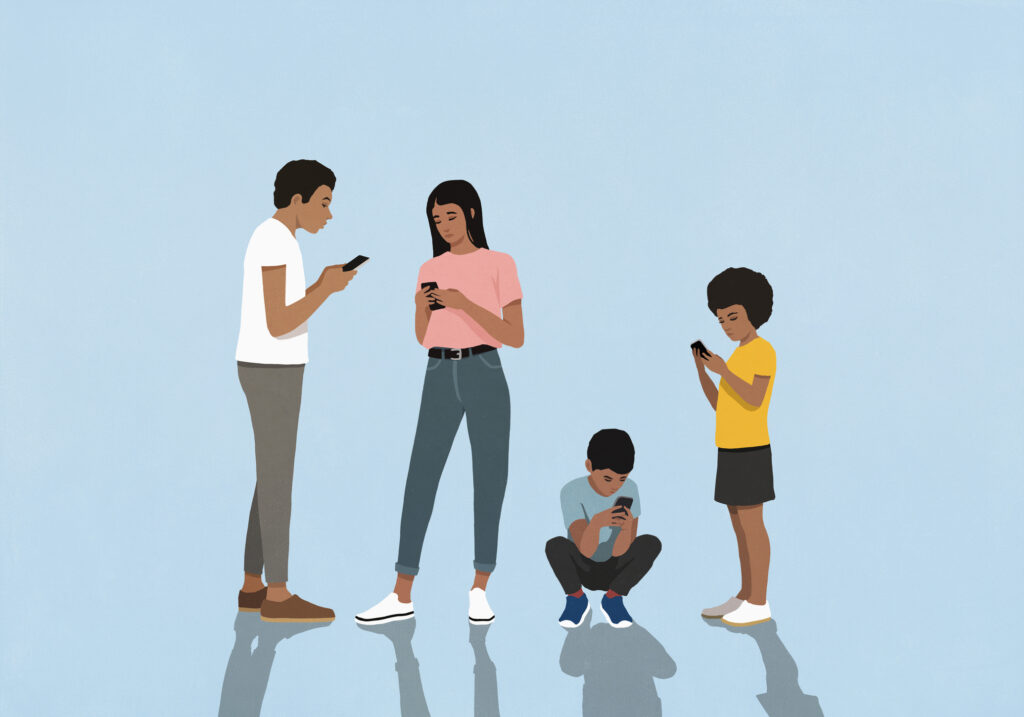
A new survey found that kids under 18 are holding a phone 52% of the time their parents are trying to talk to them. That’s right… half your valuable wisdom is probably getting drowned out by memes and cat videos.
And before you roll your eyes at “these kids today,” let’s be real: parents aren’t much better. The same survey says partners are glued to their phones 58% of the time during conversations. So basically, everyone’s ignoring everyone.
But at least we’re ignoring each other together.
Only 74% of parents could say they’d had a real, device-free conversation with their kid in the past week. Which means a quarter of families haven’t gone even seven days without someone scrolling mid-sentence. No wonder 78% of parents are worried about losing face-to-face time with their kids.
Some households are trying to fight back with “no phone zones” during dinner, family outings, or movie night. You know, those rare times when you actually want to see each other’s faces instead of the glow of a screen. But enforcing those rules is easier said than done.
So yes, the internet is winning. But the silver lining? At least when your teen pretends to listen while glued to their phone, they can say they “learned it from watching you!” (Gen X’ers will get that reference, if they’re even listening to me.)
October is here, so it’s crunch time for parents who promised to make their kids’ Halloween costumes.
A new survey says 52% of parents are going the DIY route this year, especially in Colorado, Iowa, California, Maryland, and Arkansas. Somewhere out there, a mom is already crying into a pile of felt.
Money is the big motivator. Store-bought costumes are averaging more than $70, while a handmade creation usually runs under $40. That’s a huge deal if you’ve got more than one kid, because nothing says “spooky” like spending $210 on matching polyester jumpsuits… that get worn once… and disintegrate before next Halloween.
But it’s not just about cash.
Parents say homemade costumes feel more creative, unique, and sometimes just… necessary, since the store-bought options are either flimsy, overpriced, or completely sold out.
For some families, it’s even a tradition. (The tradition being: panic-shopping at Michaels on October 29th.)
Then there’s the social media pressure. A whopping 81% of parents say they feel the need to make costumes Instagram-worthy. Idaho parents are the most stressed about it, followed by those in Missouri and Connecticut. Nothing says Halloween spirit like comparing your kid’s glue-gun disaster to a Pinterest mom’s hand-stitched masterpiece.
As for what kids are demanding, Pokémon is still going strong, Taylor Swift costumes are in the mix, and Labubu is unfortunately a thing.
You’ll also see the classics (witches, skeletons, vampires, werewolves) and of course superheroes.
And then there are “unique creations,” which is code for “your kid saw it on YouTube once, and now you’re up at 2 a.m. turning a cardboard box into something unrecognizable.”
So here’s wishing all the crafty parents good luck. May your glue sticks last, your sewing machine not jam, and your child not suddenly decide they actually want to be Elsa… the day before Halloween.
So you should celebrate by ordering pumpkin-spice-something… just like you’ve been doing every day for the past month now.
A while back, researchers from Montclair State University combed through nearly 20,000 social media posts to find out if we actually love pumpkin spice as much as it seems like we do. Yes, it’s a weird thing to “research,” but whatever.
They found that 55% of posts mentioning “pumpkin spice” or the hashtag #pumpkinspice were positive in nature… 37% were considered neutral… and only 8% were negative.
They also found that pumpkin spice fervor surged from 2011 to 2017, when it peaked.
For the next four years, the hype was a little subdued, but it’s trending again of late… so apparently, pumpkin spice is as popular as ever. Unfortunately, or not!
Who knew people paid so much attention to pumpkin spice trends?