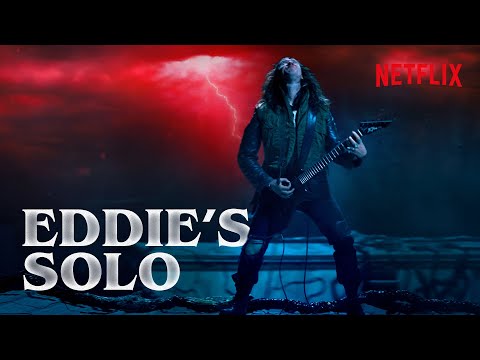
The dream is dead, “Stranger Things” fans – literally.
Creator Matt Duffer has officially crushed the long-running theory that Eddie Munson might somehow make a comeback in the show’s fifth and final season.
In an interview, Duffer confirmed what most of us probably knew deep down but refused to accept: Eddie’s gone for good. “I love that Joe Quinn is toying with people,” Duffer said. “But no, he’s dead. Joe is so busy anyway. He’s shot like five movies since! When’s he got time to come and shoot ‘Stranger Things‘?”
Duffer added,”No, sadly, RIP. He’s fully under that ground.”
It’s a rough blow for fans who fell in love with Eddie’s chaotic energy and heavy metal heart. His heroic Season 4 sendoff shredding Metallica’s “Master of Puppets” in the Upside Down before sacrificing himself, was one of the show’s most unforgettable moments. But ever since, the fandom has been buzzing with conspiracy theories and wishful thinking.
Joseph Quinn, who played Eddie, didn’t exactly help. In mid-2024, he told fans there was a “high chance” of his character returning, fueling months of speculation that maybe, just maybe, the lovable metalhead wasn’t gone forever. Was he messing with us? Or was Duffer playing defense to keep a secret twist under wraps? I guess we will just have to wait and see.
Fans have been flooding social media with heartbreak and memes, mourning Eddie all over again. One fan on X (formerly Twitter) wrote, “They could’ve at least given us ghost Eddie. Justice for Hawkins’ most misunderstood rock god!”
The countdown is now on for the show’s final chapter. The first four episodes of “Stranger Things” Season 5 will drop November 26th on Netflix.
Apple TV is rolling out a five-part docuseries about one of Hollywood’s greatest directors, Martin Scorsese. The project, simply titled Mr. Scorsese, dives deep into the filmmaker’s life and career, featuring interviews with some of the biggest names in entertainment.
But one major name is missing: Joe Pesci.
Director Rebecca Miller revealed that Pesci was the only person who said no to being interviewed for the series. Which, considering his role in so many of Scorsese’s best films — Raging Bull, Goodfellas, Casino, and The Irishman — feels like a cinematic tragedy. Pesci even took home an Oscar for Goodfellas, so it’s not like his absence goes unnoticed.
According to Miller, though, Pesci’s decision wasn’t about ego or scheduling conflicts. It was personal. She explained that Joe “just doesn’t want to talk about the experiences that made him so perfect for this kind of role.” Apparently, those experiences hit a little too close to home.
Miller hinted that Pesci’s childhood in Newark, New Jersey, surrounded by real-life criminals, shaped his ability to play Scorsese’s volatile underworld characters so convincingly. “Joe was marked far worse than Marty was by those people,” she said. “I don’t think he wants to go over all that.”
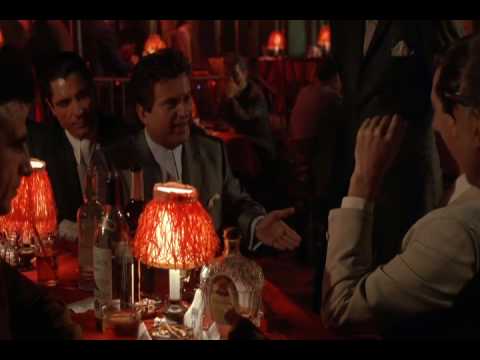
One of the most famous scenes in “Goodfellas” was based on something Joe actually witnessed:
It’s a reminder that for some actors, art really does imitate life — and sometimes that life is better left off-camera.
So while Mr. Scorsese promises plenty of star power and behind-the-scenes insight, don’t expect any of that signature Pesci fire. The man who gave us “Funny how? Am I funny like a clown?” is sitting this one out, and for reasons only he can truly understand.
Disclaimer: From my earliest childhood memories until the moment I sat down to type this, I have never been romantically interested in another man. So while one never knows what tomorrow will bring, at this moment I can confidently say I am, and have always been, a straight white male.
I do consider myself an ally, though, so before we dive into bizarre examples of LGBTQ representation in pre-woke horror, I want to assure all members of the community that my goal is NOT to offend you. And thus, if I should fail, it is with my deepest apologies. And now, on with the show:
Positive portrayals of queer characters in horror movies were a lot harder to come by in the pre-woke era, and often had to be hidden, or “coded” in order to go relatively unnoticed by a public that was deemed not ready for them.
Some famous examples include “Bride of Frankenstein” and “Dracula’s Daughter” in the 1930s, and “A Nightmare on Elm Street 2: Freddy’s Revenge” in the ’80s. (The “subtext” in that one couldn’t have been more obvious, but my clueless teenage ass missed it completely when I saw it in the theater.)
But every once in a while in those Before Times, queer characters weren’t hidden or hinted at. And the results varied widely. Here are some famous and infamous examples:
Tammy and the T-Rex (1994)
Theo Forsett plays Byron, best friend of Tammy, played by a young Denise Richards. Tammy’s going through some stuff, because her boyfriend Michael (Paul Walker) has been killed, and his brain stolen by a mad scientist and placed in the head of an animatronic dinosaur.
It happens.
Byron is out, loud and proud. And nobody seems to care. Even Michael, a high school jock, doesn’t flinch when they’re introduced at the beginning of the movie. And even after he becomes a rampaging (fake) dinosaur, Michael shows Theo kindness, sparing him while tearing apart several of his classmates.
Byron’s sexuality is only mocked by two dumb comic-relief cops, and their little jabs fall flat and feel out of place, because Theo is treated so respectfully by the film.
1994 may not be ancient history, but remember, this was three years before Ellen DeGeneres came out… and faced some serious career setbacks for doing so.
Butcher, Baker, Nightmare Maker (1981)
This one’s weird. Like, really weird. ’70s teen idol Jimmy McNichol plays Billy, a high school senior being raised by his clingy aunt (the legendary Susan Tyrrell), who very much wants to have sex with him. She’s also prone to committing murder.
Enter Bo Svenson, playing a homophobic cop who’s determined to pin the murders on Billy’s gay basketball coach, Tom Landers, played by Steve Eastin. Tom is portrayed as just a regular guy who happens to be gay, which was really progressive for 1981.
He’s also one of the most sympathetic and heroic characters in the film, and the ending leaves no question about whose side you should be on.
Interesting Note: Four years later, Landers would appear in “A Nightmare on Elm Street 2: Freddy’s Revenge,” one of the most thinly disguised gay horror movies of all time.
Killer Condom (1996)
A condom with teeth that bites off male genitalia, presented by the guys who made “The Toxic Avenger”? If this piques your interest, be warned: this is not a typical Troma movie. In fact, they didn’t make it. It’s a German film that they picked up for distribution.
At its heart, it’s a gay love story between a cop and the male prostitute he meets in the seedy underbelly of New York City while investigating the castrating prophylactics. The film is peopled with LGBTQ characters we actually care about and root for… unlike the real villain, who’s unveiled in the final act.
Interesting Fact: H.R. Giger – the Swiss artist who created the xenomorph in “Alien” – served as a creative consultant on this one.
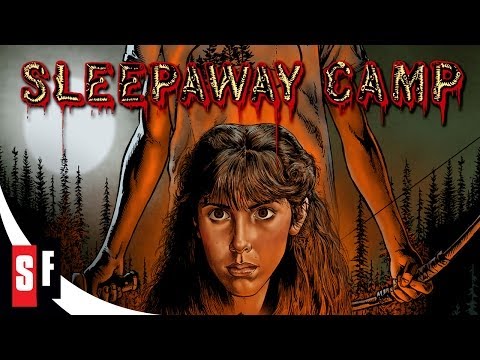
Sleepaway Camp (1983)
The granddaddy of gender-dysphoric killer flicks. Or is it the grandmommy? All these years later, I’m still confused. By now, anybody interested enough to have read this far should know the plot, and its infamous twist ending.
A series of murders at a summer camp are revealed to be the work of Angela, a girl who was secretly a boy all along! At a very young age, Angela’s aunt decided to raise him as a girl, following the deaths of his sister and their father in a boating accident.
Oh, and just to pile on, Angela’s father was gay, and as a young child she/he witnessed Pops in bed with another guy; the implication being that this screwed her/him up even more.
I seriously doubt the filmmakers were trying to make a social or political statement; it’s all just shock value. But still, it sends the message that if your gender doesn’t match your genitals, people die.
Interesting Fact: Kenan Thompson of “Saturday Night Live” fame is producing a remake with the original writer-director. It’ll be interesting to see if they keep the same ending. My guess is no, but mainly because audiences will be expecting it.
Fatal Games (1984)
Students training at an elite athletics academy are being picked off by somebody who chucks a mean javelin.
The killer turns out to be a nurse named Diane, played by Sally Kirkland, who you may remember from “The Sting,”“Best of the Best,”“JFK” and a bunch of other stuff.
But the real reveal is that Diane used to be a man. She had gender reassignment surgery to become a woman so she could be a champion at javelining… which, I discovered while writing this, is an actual word! But Diane was disqualified from competition after tests showed she had too many male hormones.
In the film’s most absurd moment, once the final girl discovers Diane’s secret, she starts speaking in a male voice.
She tells her intended victim, “Don’t you understand? I have sacrificed everything. I have risked everything just to win. I even became a woman just to win!”
Yes, it’s transphobic as shit. But as with “Sleepaway Camp,” I really don’t think any statement was being made here other than, “Yo, dig this crazy twist!”
Still, I’m shocked this flick hasn’t been picked up by the anti-trans movement. I could see Riley Gaines screening it before her (hate) speeches and saying, “See? They’ve been doing it for decades!”
If you’re in the mood for a little black magic, cauldrons, and broomstick chaos, this list of the 15 best witch movies ever made has you covered.
It runs the full spellbook, from funny and campy to dark enough that you’ll want to sleep with the lights on. Witch movies never really go out of style, and this lineup proves that point, mixing timeless classics with modern horror favorites.
At the top of the list sits The Wizard of Oz (1939). Between Glinda’s glitter and the Wicked Witch of the West’s green face, it’s basically the blueprint for every witchy trope we still love today. Then there’s The Witches of Eastwick (1987), which gave us Cher, Susan Sarandon, and Michelle Pfeiffer conjuring chaos—and somehow still made devilish Jack Nicholson look like he was having the time of his life.
Of course, Hocus Pocus (1993) is still the Halloween season’s MVP, with the Sanderson sisters proving that campy magic never dies.
And fans of cozy covens will never get tired of Practical Magic (1998), the holy grail of midnight margaritas, while Bell, Book and Candle (1958) delivers vintage witchy glam with Kim Novak at her most bewitching opposite Jimmy Stewart.
Newer witch tales take things to much darker places. The Witch (2015) and Hereditary (2018) remind us that witchcraft isn’t all sparkly wands—it’s goats whispering in your ear and family dinners that go horribly wrong. The Blair Witch Project (1999) turned found footage into a cultural phenomenon, and The Conjuring (2013) brought demonic possession back to the big screen with a vengeance.
Even the fairytale witches made the cut.
Sleeping Beauty (1959) and Snow White and the Seven Dwarfs (1937) prove Disney’s been warning us about wicked stepmothers and cursed apples for decades. And tucked among these timeless classics is a new addition: Weapons (2025), already getting buzz for its eerie, witchy undertones that feel straight out of a nightmare.
So whether you want a broomstick comedy, a spellbound romance, or a horror flick that’ll make you swear off forests forever, these 15 witch movies cast a spell that never wears off.
(Now if only someone would teach us that “light as a feather” trick for real.)
Selena Gomez is officially over the internet drama.
After Hailey Bieber made headlines for saying she’s tired of being pitted against Selena, the singer and Rare Beauty founder stepped in with a simple message: “Just leave the girl alone.”
Hailey recently spoke to a journalist who asked if she was worried about her Rhode beauty line being compared to Selena’s Rare Beauty. Her answer was clear and calm: “It’s always annoying being pitted against other people. I didn’t ask for that. When people want to see you a certain way and they’ve made up a story about you in their minds, it’s not up to you to change that.”
Selena seemed to respond shortly after, without naming names.
She wrote, “Just leave the girl alone. She can say whatever she wants. Doesn’t affect my life whatsoever. It’s just about relevance, not intelligence. Be kind. All brands inspire me. There is room for everyone. And hopefully we can all stop.”
The internet, of course, did not stop because the Selena vs. Hailey “feud” is basically a social media cottage industry. Fans have been dissecting their relationship for years, from Hailey’s marriage to Justin Bieber (Selena’s very public ex) to side-by-side beauty brand comparisons and conspiracy-level TikTok theories about alleged shade.
But both women have made it clear they’re done with the noise.
This isn’t the first time Selena has spoken up about kindness online, and it fits her long-running theme of shutting down unnecessary drama. Meanwhile, Hailey has said repeatedly that she’s not interested in being part of some imaginary rivalry.
So, in the great tradition of women supporting women, and maybe just trying to get through their skincare routines in peace, Selena’s words hit perfectly: “There is room for everyone.”
Maybe it’s time the rest of us take the hint and, well, leave the girl alone.
Selena Gomez puts an end to the ongoing narrative between her and Hailey Bieber:
“Just leave the girl alone. She can say whatever she wants. Doesn't affect my my life whatsoever. It's just about relevance not intelligence. Be kind. All brands inspire me. There is room for… pic.twitter.com/feqzrUrUqB
Some fans collect vinyl records for the sound. Others do it for the aesthetic. And then there’s Aiden Watson, a Swiftie who just spent around $800 collecting every single physical version of Taylor Swift’s latest album, “The Life of a Showgirl.”
Aiden proudly claims to own all 26 variants . . . although Swiftie sleuths online say there are actually 27. The breakdown? 18 CDs, 8vinyl editions, and one cassette. (Yes, a cassette. Taylor’s nostalgia game is strong.)
He says the collection isn’t just fandom: it’s an investment.
“In a weird parasocial way, it’s like you’re helping make history,” Aiden explained. And honestly, that’s kind of the perfect summary of modern Taylor culture: a blend of music, marketing, and mutual obsession.
But it’s not just about bragging rights. Aiden’s built his social media presence around Taylor-related content, and showing off his collection has actually paid off. “Most people think it’s absurd to own this many copies of the same album—and they’re not wrong,” he said. “But I knew I’d make content of me buying the variants, unboxing them, and showing them off. It’s been quite a fruitful investment.”
Here’s the kicker: Aiden doesn’t even play most of them. He uses the vinyls as wall art instead. Which, in fairness, does make sense, Taylor’s album covers are practically designed for that.
How much have you spent on Taylor Swift in your lifetime?
Timothée Chalamet might already have the acting chops to someday land an EGOT, but this week, he added a much rarer title to his résumé: White Boy of the Year.
Yes, you read that right. The “Dune” star received the cheeky honor from Minnesota Timberwolves star Anthony Edwards during his online “Believe That Awards” show.
Chalamet beat out a surprisingly competitive list of nominees, including Adam Sandler, Tom Cruise, Pat McAfee, and MrBeast. And in true Chalamet fashion, he didn’t just accept the award with a quick “thanks.” The actor joined the show remotely from Budapest, Hungary, where he’s currently filming, and gave a playful acceptance speech. He even joked about teaming up with Edwards for a “Training Day” reboot, which honestly, someone in Hollywood should make happen immediately.
timothée chalamet accepting “white boy of the year” at the believe that awards. 😂 pic.twitter.com/WZThQBPtRm
Social media exploded after the segment aired, with fans and celebrities chiming in to congratulate Chalamet on his newest “achievement.”
The internet seems to agree that if there were ever going to be an official “White Boy of the Year,” Timmy fits the bill—charming, talented, and just self-aware enough to laugh at the whole thing.
So if Timothée ever does go on to achieve EGOT status, he’ll actually be in a league of his own—a WEGOT winner, since “White Boy of the Year” clearly deserves its own category.
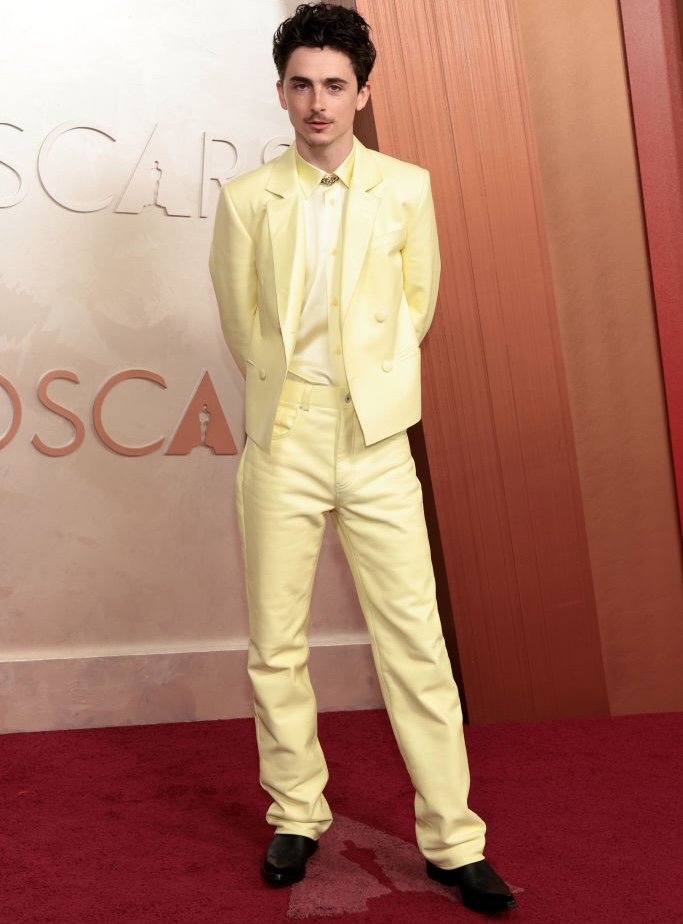
HOLLYWOOD, CALIFORNIA – Timothée Chalamet attends the 97th Annual Oscars at Dolby Theatre on March 02, 2025 in Hollywood, California. (Photo by Monica Schipper/Getty Images)
Their 2025 ranking of The Scariest Movies According to Science is out, and it’s based on cold, hard data—specifically, how fast your heart starts pounding while you watch.
Here’s how they figure it out: volunteers are hooked up to heart monitors while watching a lineup of horror movies, and their heart rates are tracked from start to finish.
The higher the spikes, the scarier the movie. Simple, scientific, and absolutely terrifying.
According to this year’s study, “Sinister” (2012) remains the undisputed champion of fear. Directed by Scott Derrickson and starring Ethan Hawke, the film’s mix of true-crime writing and supernatural terror has once again left audiences with the biggest jumps in heart rate.
Right behind it is “Host” (2020), the pandemic-era Zoom horror flick that somehow managed to make video calls even scarier than they already were. And in third place is “Skinamarink” (2022), a hauntingly slow, surreal nightmare that proves minimalism can be just as scary as monsters or gore.
Here’s the full Top 10 list:
“Sinister” (2012)
“Host” (2020)
“Skinamarink” (2022)
“Insidious” (2010)
“Hereditary” (2018)
“The Conjuring” (2013)
“Smile 2” (2024)
“Smile” (2022)
“The Exorcism of Emily Rose” (2005)
“Talk to Me” (2022)
The Science of Scare Project has been running this heart-pounding experiment for years, and while the lineup changes, Sinister almost always lands near the top. The takeaway? Even a decade later, it still knows how to get under your skin.
If you’re looking for a scientifically proven reason to sleep with the lights on tonight, start from number one and work your way down. Just maybe keep a defibrillator handy.
When it comes to ending a beloved show, the Duffer Brothers aren’t winging it.
The creators of “Stranger Things” have been studying the art of the TV finale, looking to some of the most acclaimed series for inspiration: “Six Feet Under”, “Friday Night Lights”, and “The Sopranos”.
Ross Duffer told “Variety“ that they spent time analyzing what made those endings work so well. “The best ones were very true to themselves,” he said. “The shows that are trying to be super clever, I think that’s where it can go wrong really quickly.”
His brother Matt added that they’ve actually had the end in mind for a long time.
“We knew roughly what the end scene was for years,” he said. “There were elements of it that were discussed for weeks, but the core idea of the ending, we had for a really long time. Anyway, we’re really happy with the way it ended. It’s nerve-racking to put it out. I’m sure people will have opinions!”
While we won’t know exactly what elements from those classic finales inspired them until the show’s fifth and final season drops on Netflix this New Year’s Eve, the Duffers did reveal one detail: the final episode will be titled “The Rightside Up” and run about two hours long.
If you’re curious what makes those other finales so memorable, here’s a quick refresher.
“Six Feet Under” gave us a haunting, emotional montage showing how each main character eventually dies. “Friday Night Lights” went a more hopeful route, flashing forward to show where everyone ended up. And then there’s “The Sopranos”, which cut to black mid-scene, leaving viewers to debate Tony Soprano’s fate for nearly two decades.
With “Stranger Things” . . . a show that’s balanced supernatural horror with heartfelt storytelling since day one . . . the bar is sky-high. But if the Duffers’ research pays off, Hawkins might just get an ending as iconic as the Upside Down itself.
Streaming services may rule the music world now, but for a lot of Americans, nothing will ever beat the crackle of vinyl, the ka-chunk of an 8-track, or the thrill of a mixtape carefully dubbed on a boom box.
UltimateClassicRock.com just put together a list of music gadgets from the past that we still miss, and honestly, reading through it feels like opening a time capsule.
At the top of the list is the pocket transistor radio, a little box of magic that made family road trips and lazy afternoons at the beach feel like adventures. And for kids of the ‘70s and ‘80s, nothing beat the Fisher-Price turntable. You’d sneak Mom and Dad’s double Neil Diamond album and play it until the grooves practically wore out.
Of course, no nostalgia trip is complete without the 8-track player.
Sure, the sound quality wasn’t perfect, but that loud ka-chunk between tracks was an experience in itself. Then there was the portable turntable, where listening to music was practically a ritual: flipping through album covers and reading liner note as the needle hit the groove.
Some memories are tied to very specific setups, like Dad’s leather-wrapped garage radio or his glass-door stereo, where finally being trusted to close those smoky panels felt like a rite of passage. And who could forget the boom box with the handle? It wasn’t just for blasting tunes, it was an instant party kit.
Then came the glory days of personal listening. The Sony Walkman made music feel private for the first time, while the bright yellow Walkman Sport made you feel like the hero of your own movie soundtrack.
Later came the Sony Discman, which was amazing as long as you didn’t move too suddenly and make the CD skip.
Not every device was a hit. The MiniDisc player never really caught on in the U.S., though it earned some cool points among European exchange students. But the car multi-CD changer? That was peak road trip nostalgia. Loading up your CD binder before heading out often felt more exciting than the trip itself.
Music might be more convenient now, but it’s hard not to miss the personality those gadgets brought to the experience. Streaming is fine, but nothing compares to the magic of slamming a cassette into a boom box or hearing the first crackle of a vinyl spin.




![Tammy and the T-Rex (1993) [Vinegar Syndrome Blu-ray Promo Trailer]](https://i.ytimg.com/vi/NlW0EAhXJbE/hqdefault.jpg)

![Killer Condom (1996) [Vinegar Syndrome 4K Ultra HD + Blu-ray Promo Trailer]](https://i.ytimg.com/vi/lDUcmCuwMdA/hqdefault.jpg)
![Fatal Games (1984) [Vinegar Syndrome Blu-ray Promo Trailer]](https://i.ytimg.com/vi/EN5foKBQGGw/hqdefault.jpg)