Six Wild Phone Features We Want by 2036

Samsung asked 2,000 people what they want their phones to do by 2036, and the answers did not disappoint.

Some are genius. Some are terrifying. All of them prove we’re sprinting toward a future where your phone might know you better than your mom.


One charge = one week of freedom

No more panicking at 3% while begging your Uber to arrive. People want a phone that can hold a charge for at least seven days. Bonus points if it charges just by moving around. You’d never need a charger again – just pace around your apartment like a caffeinated squirrel.


Languages no longer matter

Real-time translation during phone calls? Yes, please. Imagine chatting with anyone in the world, no Duolingo owl required. It’s like the Babel fish from Hitchhiker’s Guide, but less slimy and more Bluetooth.


Holograms, baby

We’re talking full-on Star Wars projections. 3D meetings, holographic selfies, maybe even midair cat videos. People want to interact with their screens in the air. The future is one big Zoom call where nobody’s pants are real.


Your phone is your life coach

Forget Googling. Folks want their phones to listen in and offer real-time advice. Like, “Hey, maybe don’t text your ex right now.” We’re already kinda there, but this would crank it to full-on nosy best friend mode. Privacy? Never met her.


Total money management

Imagine never paying a bill again – because your phone just… handles it. Auto-pay on steroids. You’d wake up, sip coffee, and your phone’s already paid rent, canceled your unnecessary subscriptions, and moved your leftover fun money to a taco fund. (Sadly, tacos will cost $100 each by 2036.)


Think it, send it (regret it instantly)

Hands-free texting? Yes, your phone can read your mind. Why type when your iPhone could just know what you’re thinking and send it for you? It’s efficient, sure – but your phone better not leak your inner monologue. Yikes.

Most People Can’t Tell an A.I. Song from a Human One, and That’s Terrifying

If you’ve been looking for a fresh reason to panic about artificial intelligence, congratulations, your search is over.

A new music survey is basically the plot of every Black Mirror episode we were hoping wouldn’t come true.

In a study that tested whether people could tell the difference between A.I. music and human made music, more than 9,000 people across several countries, including the U.S., listened to three short clips. Two were composed by A.I., one was made by an actual human.

And here’s the unsettling part, the part that should probably count as a dystopian jump scare: 97 percent of participants couldn’t tell which was which.

Yes, ninety. Seven. Percent. For anyone keeping score, that means your odds of spotting A.I. music are now only slightly better than your odds of winning a scratch-off. Not great.

This new finding comes as A.I. generated music becomes more common online, especially on social media where fake collaborations and fake celebrity vocals spread faster than real releases. The study highlights something a lot of people have quietly worried about, that A.I. isn’t just getting good, it’s getting indistinguishable.

And some of these A.I. systems have learned enough patterns from human composition to mimic structure and style so well that even trained listeners are getting fooled.

What makes the whole thing even more intriguing, or unsettling depending on your caffeine level, is the emotional reaction. More than half the people who failed the test admitted they were uncomfortable with how easily A.I. fooled them. So people care, but caring doesn’t seem to help anyone tell the difference. It’s like realizing the call is coming from inside the house, shrugging, and going, “Huh. Weird.”

The broader trend here is obvious. As A.I. improves, creative fields keep bumping into the same question, if you can’t tell what’s real, does it matter who made it? Musicians are already wrestling with deepfaked voices and synthetic samples, and this survey won’t exactly ease their minds.

It also raises questions for streaming platforms, record labels, and anyone who relies on authenticity as part of the art.

So yes, if you wanted another reason to side-eye your playlist, you officially have one. And the next time a new track sounds strangely perfect, maybe don’t assume it came from a human. It might have been cooked up by a server farm somewhere, quietly learning that we can’t tell the difference.

Sleep tight.

Literally Half Your Workday Is Busywork

If you’ve ever ended the day wondering what you actually accomplished, here’s your answer: about half what you could.

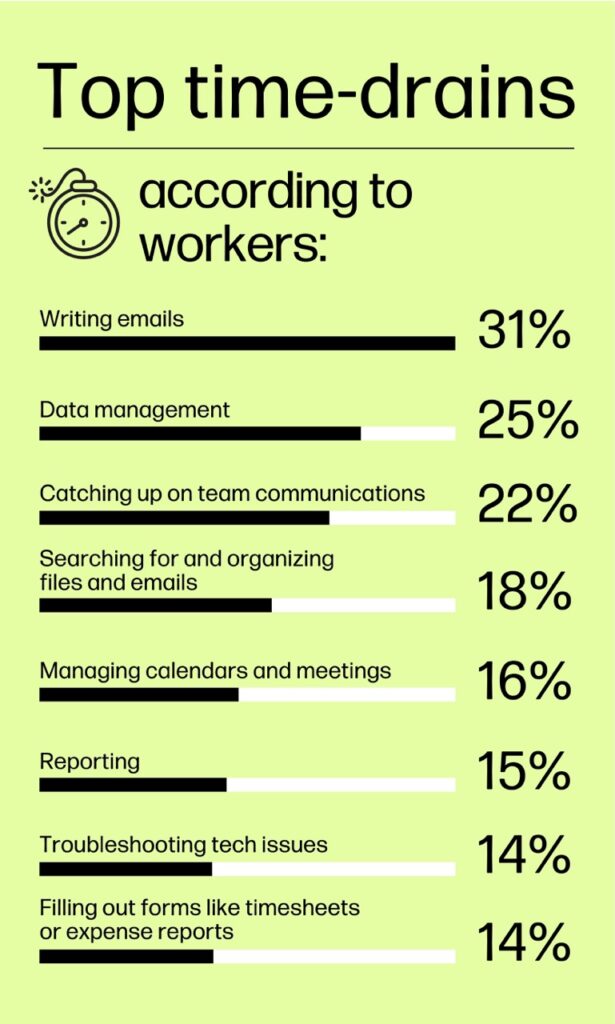
A new survey says American office workers spend half their day (literally, 51%) doing nonsense busywork like writing emails, digging through files, and copy/pasting. Basically, it’s admin Groundhog Day.

That’s not all the annoyance we have to deal with either. The survey found 1 in 3 people have considered quitting because of bad or outdated tech, and 85% blame repetitive tasks for their burnout.

The Top 3 Biggest Time Sucks

The poll found the biggest time suck of them all is email, followed by data entry, and then catching up on team messages. So basically, you spend half your day talking about work instead of doing it.

Even IT folks admit things are out of hand. They say employees waste way too much time on menial junk, and not even 4 in 10 workers feel like they’ve got the right tools to do their best work.

Will A.I. save us?

The “good” news? Companies say they’re rolling out A.I. tools to save us from all that busywork. The bad news? If history’s any clue, those tools will come with training videos, logins, and new ways to “streamline” the same stuff we already hate.

The dream is simple: less typing, fewer tabs, and eventually a workday that feels like work instead of a never-ending email marathon.

For now, we’ll just keep dreaming.

Talker Research

Place Your Bets: Bob Ross vs. Mr. Rogers

A.I. videos of unlikely wrestling match-ups are TikTok’s new obsession.

Sure, Bob Ross was in the Air Force for two decades, so maybe you’re money’s on him. But Mr. Rogers could be surprisingly scrappy.

Who ya got?

Such a shame… a few happy little clouds could have made for a beautiful day in the neighborhood if they could have teamed up.

Mark Zuckerberg’s Big AI Reveal? More Like a Glitchfest

Mark Zuckerberg’s big AI moment turned into a tech fail for the ages, after not one, but two onstage demos of Meta’s new smart glasses completely flopped in front of a live audience.

At Meta’s annual Connect conference, Zuck tried to show off the company’s newest pair of AI-powered Ray-Bans and a neural wristband that’s supposed to make digital life more hands-free. Instead, what people saw was a masterclass in awkward silences, failed commands, and some truly brutal buffering.

To kick things off, Zuckerberg joined food influencer Jack Mancuso live on video, and asked Meta’s fancy new glasses to help him make a Korean-inspired steak sauce. Simple enough, right? Not for Meta’s AI. It glitched almost immediately, ignoring basic questions and repeating incorrect steps like a robot stuck in a feedback loop. Mancuso had to ask what to do three times before the AI gave the same wrong answer twice.

The segment was quietly cut short as the team blamed “bad Wi-Fi” and tried to laugh it off. But the worst was yet to come.

In the very next segment, Zuckerberg attempted to make a video call using the new glasses and wristband. What followed was four failed call attempts, a bunch of awkward hand waving, and a visibly frustrated Zuck mumbling things like, “We’ll debug that later,” while the audience sat in secondhand embarrassment.

Meta’s CTO Andrew Bosworth eventually bailed him out by appearing on stage, cracking a joke about the Wi-Fi. But by then, the damage was done. Even Zuckerberg admitted, “You practice these things like 100 times, and then you never know what’s going to happen.”

The $799 Ray-Ban smart glasses are part of Zuckerberg’s effort to put Meta back on the AI leaderboard, especially after a string of high-profile stumbles.

He even took direct control of Meta’s AI division this year, reportedly offering new hires massive salaries in the hopes of catching up to rivals like OpenAI and Google.

But Wednesday’s fiasco felt like a metaphor: no matter how much money or ambition is thrown at it, the tech still isn’t quite ready for prime time. And when your futuristic glasses can’t even make a steak sauce or dial a phone call onstage, it’s hard not to wonder if we’re just being sold another pair of overhyped goggles.

In the meantime, the internet had a field day. The gifs, memes, and “bad Wi-Fi” jokes practically wrote themselves.

One in Six Single People Have Dated an A.I.

Singles are using AI to find love… and sometimes to even be in love. According to Match’s 14th Annual Singles in America report, nearly one in six single people have dated an A.I. (Kinda…)

One in four singles say they’ve used A.I. to help with dating, a massive 333% jump from last year.

The report found a surprising number of singles are bringing artificial intelligence into the dating world.

So how exactly are people using A.I. to boost their love lives? Some are letting it help write dating profiles or come up with clever openers. Others are even using it to screen for compatibility–basically letting AI swipe left or right for them.

26% of singles overall admit to using A.I. to help with dating in one way or another, with Gen Z leading the charge.

49% of Gen Z singles have tried A.I.-assisted dating.

Yep, half of young singles are now leaning on A.I. to help them track down their soulmate. Just meeting up and seeing if you have chemistry doesn’t cut it anymore.

But here’s where it really gets weird. A surprising number of single people have also used A.I. as a sort of fill-in while they keep looking for Mr. or Mrs. Right.

One in six singles have used A.I. as a “romantic companion.”

You read that right. 16% of singles say they’ve interacted with A.I. as a romantic companion before. The poll described it as using A.I. for “companionship or emotional support” that a romantic partner would normally provide. (Translation: lots of people have already tried out robot boyfriends or girlfriends, or at least dipped their toe into that world.)

It’s not just a Gen Z thing.

Around a third of Gen Z singles say they’ve experimented romantically with A.I., but so have a quarter of Millennial singles. So whether it’s loneliness, curiosity, or just testing out the tech, it’s clear people are getting more comfortable with blurring the line between real and virtual romance.

Does dating an A.I. mean you’re already taken? (Asking for a friend.)

If you’re dating a robot and a warm-blooded human shows up, maybe opt for the human. But Match asked, and the answer is yes. Many people feel that dating an A.I. would count as “cheating” these days.

40% said having an A.I. boyfriend or girlfriend would be cheating. (We assume that’s emotional cheating. If it’s physical too… please wipe down your keyboard.)

If you find all this a little unnerving, you’re not alone.

As A.I. tools get smarter and more customized, the world of dating could see an even bigger tech upgrade whether we’re ready for it or not. But no matter what, one thing’s clear: A.I. isn’t just writing emails and grocery lists anymore. It’s also playing Cupid.

If you thought ghosting was complicated, just wait until A.I. sends you a break-up text.

Exit mobile version