Are We All Feeling the Pressure to Buy Presents for Our Coworkers?

If your workplace just sent out an email announcing Secret Santa and your first instinct was to fake your own disappearance, you are not alone. But before you start complaining, remember the alternative: buying gifts for half your office like you’re Santa with a corporate expense account.

A new report found that 64% of companies do some kind of employee gift exchange.

Sounds harmless enough, until you learn that more than half of employees feel pressured to buy multiple gifts for multiple coworkers.

That includes your teammates, your supervisor, your supervisor’s supervisor (because strategic gifting is absolutely a thing), and the people who report to you, who are probably also panicking about what to get you. It’s the holiday gift-giving ouroboros. (And honestly, *I* deserve a gift for that very clever reference.)

About one-third of employees say they feel “a lot” or “extreme” pressure to participate.

Gen Z and Millennials feel it the hardest, probably because they already spend most of December trying to find gifts for 57 cousins. And 46% say they feel expected to spend a specific amount on each gift, which is exactly how you end up panicking in a Target aisle asking yourself, “Does this candle smell like leadership potential?”

Of course, the problem isn’t just the financial strain. Office gift-giving can get messy fast. It can create favoritism, weird obligations, or that awkward moment when someone gives their boss an expensive gourmet gift box while you show up with… socks. Very nice socks, but still socks.

This is why structured gift exchanges like Secret Santa or White Elephant actually make sense, as long as they replace personal gift-giving instead of adding a second layer of festive chaos. One gift. One budget. No emotional landmines.

So if your office insists on holiday gifting, the best-case scenario is a fun little exchange where everybody laughs, someone ends up with a novelty mug that says “World’s Okayest Coworker,” and no one feels obligated to give their boss a $25 fruit basket to secure a Q1 performance review.

Half of Us Have “Revenge Quit” a Job

If you’ve ever fantasized about telling your boss to shove it and walking out mid-shift, you’re not alone – and many of us have actually done it.

According to a new poll from Monster, revenge quitting – quitting without notice as an act of frustration or vengeance – is surprisingly common.

Almost half of us have done it before

47% of workers say they’ve done it at some point in their life. And it’s not just a personal rebellion; 57% say they’ve witnessed a coworker do it too.

Why we “revenge quit”

The top reason people gave for going full scorched-earth on their job? A toxic work environment. Poor management and feeling undervalued were also high on the list. Basically, if your office feels like a daily test of patience, you’re more likely to bail without a heads-up. (aka, no two-weeks notice)

Bad bosses partly to blame

Interestingly, nearly half (46%) of those who revenge quit said they might have stuck it out if they’d had a different boss. So yes, a good boss really can make or break a workplace.

But while revenge quitting might sound like something out of a workplace comedy, it’s often more calculated than it seems. Over half of the people surveyed admitted they mentally checked out at least six months before making their exit. One in five people said they’d fantasized about quitting for over two years before they finally pulled the plug.

In contrast to rage quitting, which is often an in-the-moment emotional explosion, revenge quitting can simmer in the background for months (or years) before someone finally walks out.

Either way, flipping the bird on your way out the door sure sounds fun, right?

An illustration of group of business people towards giant exit word

Study Finds Some of Us Want a Mean Boss—Here’s Why

Ever had a boss who seems to think “management” means yelling louder than everyone else? Turns out, not everyone hates that.

A new study out of Columbia University suggests a surprising twist in workplace culture: a lot of people actually respect—and even prefer—mean bosses.

It all depends on how you see the world.

Some people think mean bosses are needed in order to get sh*t done.

The study – titled Savvy or Savage? How Worldviews Shape Appraisals of Antagonistic Leaders – found there are two camps.

If you believe life is mostly caring and collaborative – or that everyone’s pitching in and doing their best – then an aggressive manager might feel toxic and ineffective.

But if you think it’s a “dog‑eat‑dog world,” you might see that same boss as a strong leader who keeps people motivated and gets results.

Those who see the social world as a competitive jungle tend to attach greater value to antagonism, responding with heightened tolerance or even appreciation for leaders who show it. Those who see the world as collaborative and caring, on the other hand, may often view antagonistic leaders as “hopelessly misguided and ineffective.”

Workplace culture isn’t one‑size‑fits‑all.

According to the study, people in the “caring” camp tend to think harsh leadership is a sign you don’t know how to handle people. But those in the “dog‑eat‑dog” camp? They’re more likely to admire someone who’s fiery, even if it means they (or their coworkers) get yelled at sometimes.

The study was sparked by a real‑life viral story.

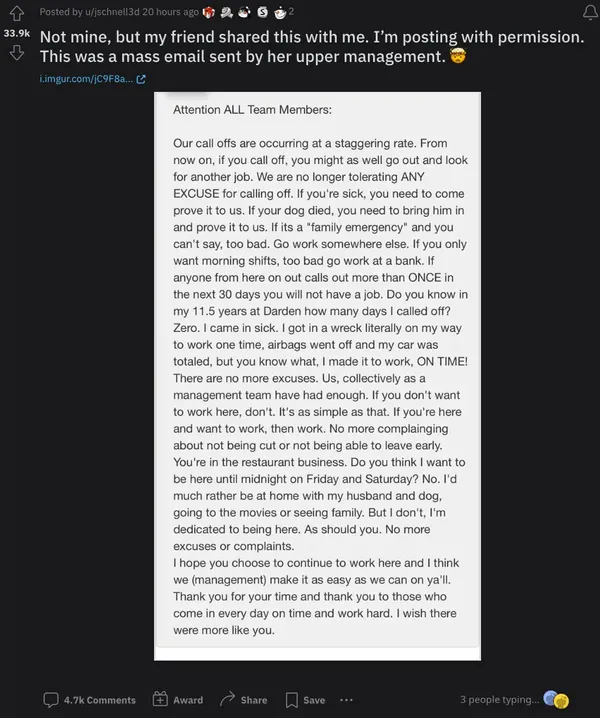
Remember the Olive Garden manager in Kansas in 2022? The one who sent a memo to staff saying, “If you call off, you might as well go out and look for another job.”

The line that really got people was, “If your dog died, you need to bring him in and prove it.” 👀

The manager got fired, but plenty of people online defended the tough‑love approach, blaming “lazy employees” instead.

Is a drill sergeant approach really necessary?

Again, it depends on how you view the world, whether you think people need a drill sergeant to stay motivated – and also, whether you think your colleagues are a bunch of lazy bastards or not.

What the study definitely shows is we all have wildly different ideas on what good, effective management looks like – what feels like abuse to one person might feel like strong leadership to another.

Do you work better under a boss who barks orders, or one who hugs it out?

Exit mobile version