Gen Z Says “Forget the the Corporate Ladder… Where Are the Lily Pads?”

For decades, people were told to “climb the corporate ladder.” But Gen Z is like, “Nah, we’re good. Ladders are wobbly. Also, an OSHA violation waiting to happen.”

Instead, they’re into something called the “career lily pad.” Picture it: instead of struggling rung by rung, you just hop around to whatever opportunity looks the comfiest at the time. (Fewer splinters, more frogs.)

An “expert” explains it like this: “We’ve traded the rigid ladder for lily pads… because hopping around is more sustainable, more realistic, and better suited for today’s workplace realities.”

Translation: “I’ll take the job that makes sense right now, and if something shinier comes along, I’m out.”

And the numbers back it up:

  • 68% of Gen Z workers say they won’t even consider management unless it comes with big money or a fancy title.
  • 57% of Gen Z already have a side hustle. (Compare that to 48% of Millennials, 31% of Gen X, and just 21% of Boomers, who apparently only side hustle when it’s coupon clipping.)

So no, Gen Z isn’t lazy… they’re just ambitious in different directions. For them, the 9-to-5 is just the investor for their passion projects.

And get this: Gen Z is still expected to make up about 10% of managers this year. They’re not against management… they just want to run things their way: more flexibility, more balance, less “micromanaging boss breathing down your neck.”

Experts even suggest older workers could learn from them:

  • Set real boundaries (no more “quick emails” at 11 PM).
  • Diversify your career moves.
  • Pick mental health over climbing corporate Mount Doom.
  • And hey, stop panicking about A.I., and use it instead of fearing it.

So yeah, the future of work might look less like climbing and more like a giant game of Frogger.

Study Finds Some of Us Want a Mean Boss—Here’s Why

Ever had a boss who seems to think “management” means yelling louder than everyone else? Turns out, not everyone hates that.

A new study out of Columbia University suggests a surprising twist in workplace culture: a lot of people actually respect—and even prefer—mean bosses.

It all depends on how you see the world.

Some people think mean bosses are needed in order to get sh*t done.

The study – titled Savvy or Savage? How Worldviews Shape Appraisals of Antagonistic Leaders – found there are two camps.

If you believe life is mostly caring and collaborative – or that everyone’s pitching in and doing their best – then an aggressive manager might feel toxic and ineffective.

But if you think it’s a “dog‑eat‑dog world,” you might see that same boss as a strong leader who keeps people motivated and gets results.

Those who see the social world as a competitive jungle tend to attach greater value to antagonism, responding with heightened tolerance or even appreciation for leaders who show it. Those who see the world as collaborative and caring, on the other hand, may often view antagonistic leaders as “hopelessly misguided and ineffective.”

Workplace culture isn’t one‑size‑fits‑all.

According to the study, people in the “caring” camp tend to think harsh leadership is a sign you don’t know how to handle people. But those in the “dog‑eat‑dog” camp? They’re more likely to admire someone who’s fiery, even if it means they (or their coworkers) get yelled at sometimes.

The study was sparked by a real‑life viral story.

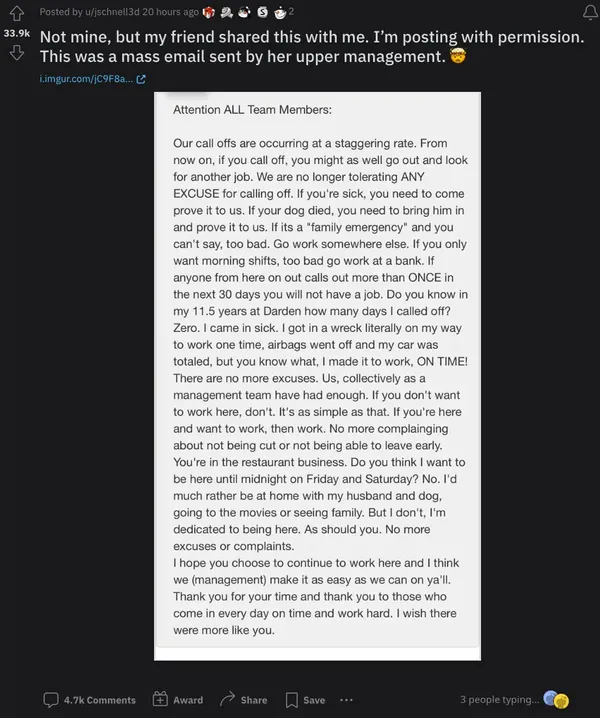
Remember the Olive Garden manager in Kansas in 2022? The one who sent a memo to staff saying, “If you call off, you might as well go out and look for another job.”

The line that really got people was, “If your dog died, you need to bring him in and prove it.” 👀

The manager got fired, but plenty of people online defended the tough‑love approach, blaming “lazy employees” instead.

Is a drill sergeant approach really necessary?

Again, it depends on how you view the world, whether you think people need a drill sergeant to stay motivated – and also, whether you think your colleagues are a bunch of lazy bastards or not.

What the study definitely shows is we all have wildly different ideas on what good, effective management looks like – what feels like abuse to one person might feel like strong leadership to another.

Do you work better under a boss who barks orders, or one who hugs it out?

Exit mobile version