What’s the Riskiest Meal You’ve Eaten While Driving?

April marks National Distracted Driving Awareness Month, and a new report highlights just how far drivers are willing to push their multitasking limits — and common sense — behind the wheel.

While it’s no surprise that 86% of drivers admit to being distracted by technology (mostly their phones), the report uncovers a wider—and wilder—array of behaviors that make our roads more dangerous.

Putting the “Multi” in Multitasking

Among the top distractions: grooming. Nearly 27% of drivers say they’ve gotten ready for the day while driving. That includes changing clothes, shaving, applying makeup, and even painting their nails. Gen Z takes the crown here, with a staggering 50% admitting to touching up their look on the go.

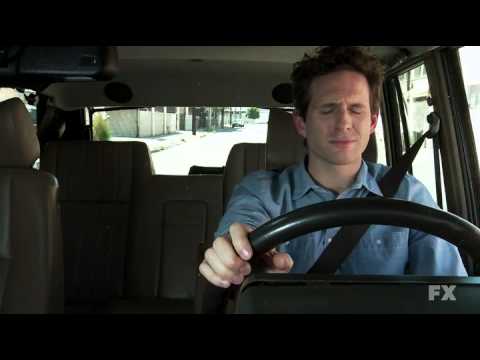
Then there’s eating — and we’re not talking about a quick granola bar. A full 72% of drivers who eat behind the wheel confess to tackling meals that probably require a table and a bib. Think BBQ ribs. Or soup. Hot soup. (Cereal also isn’t a good call. “Always Sunny” covered it in Season 8.)
Possibly the most concerning trend? Filming content. Nearly three-quarters of drivers say they’ve either created or witnessed someone filming videos or making social media posts while driving.

Emotional Baggage Rides Shotgun

It’s not all selfies and snacks. Emotional distractions like stress and anxiety also play a role. One in five drivers say stress from work, school, or relationships can pull their focus. It’s a reminder that mental distractions are just as risky as physical ones.

Where It’s Worst — and Safest

The report also maps out the most distracted driving states, with the Southwest lighting up red. California, Arizona, New Mexico, Texas, Nevada, Utah, and Colorado top the danger list. Florida, North Carolina, Michigan, and Connecticut also rank high, with additional hotspots throughout the South and parts of the Northeast.

In contrast, the safest drivers are mostly clustered in the less densely populated heart of the country — think Montana, Wyoming, the Dakotas, and Minnesota — with Maine and Vermont also getting high marks for safe driving habits.

So next time you’re behind the wheel, maybe skip the content creation, hold the hot soup, and save the charcuterie for later.

The Five Most Dangerous Songs to Drive to, According to Science

If you have ever caught yourself accidentally speeding because a song came on a little too strong, science says you are not imagining it.

A new study suggests that certain popular songs can actually make you drive faster and take more risks behind the wheel, all because of their tempo.

Researchers at the South China University of Technology looked at how music affects driving behavior and found that songs with a tempo of 120 beats per minute or higher can encourage drivers to speed up and drive more aggressively.

Translation: If the song makes you want to drum on the steering wheel, it might also make your foot heavier on the gas.

According to the study, these are the most dangerous songs to drive to:

  1. “American Idiot” by Green Day
  2. “Party in the USA” by Miley Cyrus
  3. “Mr. Brightside” by The Killers
  4. “Don’t Let Me Down” by The Chainsmokers
  5. “Born to Run” by Bruce Springsteen

The common thread here is speed. Fast tempos can raise your heart rate and adrenaline, making you more likely to drive faster without realizing it. The researchers say it is not about the genre, it is about how your brain responds to the rhythm.


On the flip side, the study also identified songs that are far less likely to turn your commute into a Fast and Furious audition.

Least dangerous songs to drive to:

  1. “Location” by Khalid
  2. “Stairway to Heaven” by Led Zeppelin
  3. “Under the Bridge” by Red Hot Chili Peppers
  4. “God’s Plan” by Drake
  5. “Africa” by Toto

Of course, this does not mean you need to delete half your music library. It just means being aware of how music can influence your mood and behavior. If you are cruising on the highway or stuck in traffic, a calmer playlist might help keep both your speed and your blood pressure in check.

So maybe save “Mr. Brightside” for karaoke night, and let “Africa” guide you safely home.

Six Things to Never Leave in Your Car When It’s Freezing

You’d never leave a gallon of milk in your trunk during a July heatwave, right? Well, winter has its own set of car-destroying, mess-making, regret-inducing mistakes.

Leaving the wrong stuff in your car when it’s below freezing can be just as bad – or worse – than when it’s too hot. If your car turns into an accidental walk-in freezer, bad things happen.

Here are six things you should never leave in your car when it’s below freezing.

Aerosol Cans

You know those cans of hairspray, deodorant, or air freshener rolling around your trunk? Yeah, they’re basically little pressurized time bombs in cold weather. Extreme temps can make them explode. Nothing says “good morning” like a can of Febreze blowing up in your backseat.

Canned Food

Bring those groceries in asap! Freezing temps can make the food inside expand, which can cause tiny cracks or even cause the can to swell. That’s how bacteria sneaks in and ruins Taco Tuesday. The USDA says if it looks swollen, toss it. If it doesn’t look swollen, maybe still toss it. Just don’t trust a cold can.

Eggs

Yes, eggs freeze. And no, they don’t bounce back from it. If you leave them in the car after a grocery run and they freeze and crack, they’re no longer safe to eat. Also, egg goo in your back seat is no fun at all.

Electronics

Phones, tablets, laptops – basically your entire digital life – is not a fan of the freeze. Cold weather can make batteries act weird, screens go wonky, and when they warm back up, condensation inside can fry them. So unless you want your iPad to become a very flat, very useless ice cube, bring it in.

Medication

Some medications, like insulin, can become unstable or even useless if they freeze. The rule of thumb with any frozen meds is: don’t guess, just toss – or talk to your pharmacist before you end up with more problems than you started with.

Loved Ones

This should go without saying, but just in case: don’t leave pets, kids, or anyone else in a freezing car, even for “just a sec.” If the idea of sitting in an ice-cold vehicle makes you miserable, don’t subject Grandma or the golden retriever to it. Your car turns into a walk-in freezer with seatbelts faster than you think.

The Most Annoying Things About Public Transportation

If your commute is driving to work, you’ve probably seen enough idiocy that makes you wish you could just use public transportation.

But if you do use public transportation, you’ve probably seen enough idiocy that makes you wish you could just drive.

1,000 people who use public transportation were asked to name the most annoying things they encounter on trains, buses, and subways.  Here are the Top 10:

1.  People who talk loud on their phone. Forcing dozens of people into their business. Dude, just text them.

2.  Aggressive people in general.  Especially if you feel unsafe.

3.  When someone won’t give up their seat for another person who needs it. Sometimes you don’t want to know how terrible the people around you are.

4.  Trash on the ground, or on the seats.  Spilled liquid is the worst too, especially if you don’t know what it is.

5.  Long delays, or your bus gets there late. You’d like to save your excuses for when it’s your fault.

6.  Pushing and shoving. No one likes human bumper cars, especially pre-caffeine.

7.  No air conditioning, or bad ventilation in the summer. And the smells it brings.

8.  Noisy kids. Especially when their own parents aren’t affected by it.

9.  Manspreading, or taking up too much space. Or invading your space.

10.  People who try to get on while you’re still trying to exit.  It’s like the equivalent of people who can’t comprehend the “zipper” merge when on the highway.

Color Us Boring: Most Cars Sold Today Are Grayscale

Have you heard about how birds are more likely to target dark-colored cars with their, well, aerial gifts?

That got us curious about what colors of cars people are selecting in different areas, and to be clear, this is not “for the birds.”

A while back, the website iSeeCars.com put out a report on car sales by color (this was in 2023)… and they found that white is more popular than ever.  28% of cars sold nationwide are white, which is up from 16% in the mid-2000s.

Black is the second-most popular, followed by gray and silver.  If you add up the percentages for those colors, 80% of the cars sold are grayscale… like you are watching a black-and-white movie.

The state with the most car-color diversity is West Virginia, where 28% of the cars are colorful.  The state with the least diversity is California, where only 17% of the cars are colorful.

If you exclude grayscale “colors,” every state’s top color is either blue or red.

Outside of that, 2% of the cars sold across the country are green… and all the remaining colors account for less than 1% of car sales each.  But if you’re curious, here’s the order:

Orange is the eighth-most popular car color, followed by beigebrownyellowgold… and purple.

Experts say that white is popular because it’s “one of the easiest colors to maintain, and because it is a common color for fleet and rental vehicles.” 

That leads to white used cars being very common.

But there’s good news for people who are brave enough to buy a bold color:  Less popular colors tend to depreciate less, because they are scarce in the used car marketplace.

Gen Z Wants Total Silence While Driving

If your ideal morning commute involves no radio, no podcasts, and no phone calls, congrats – you’re at least young at heart.

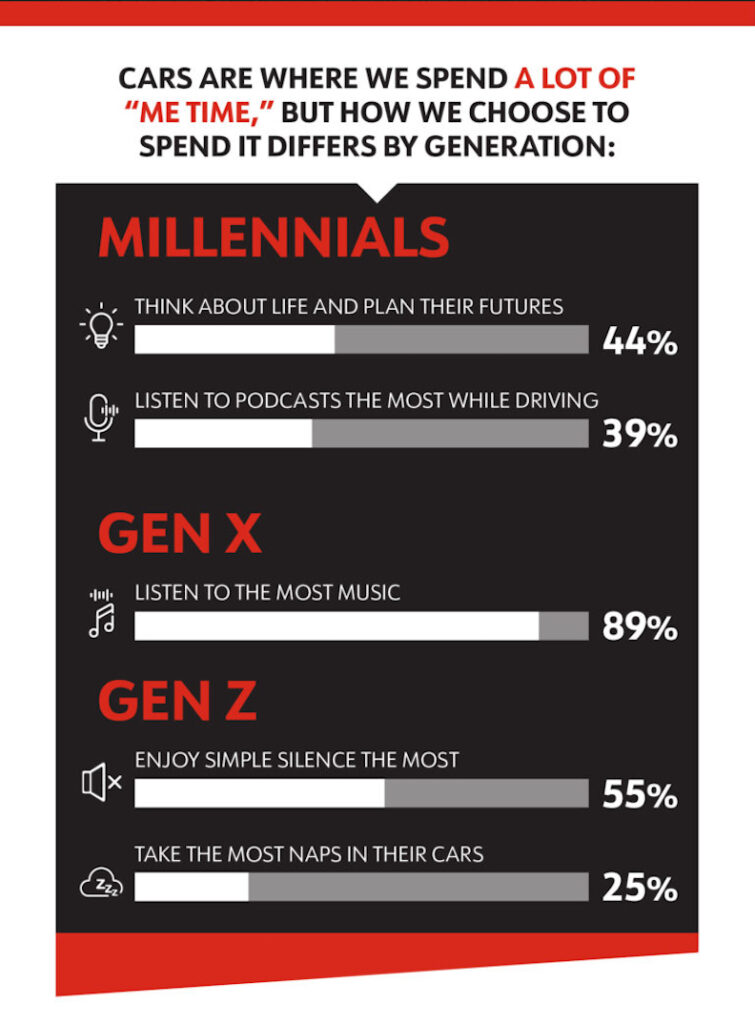
A new poll by Ziebart found Zoomers are the generation most likely to crave peace and quiet behind the wheel. 55% of Gen Z adults prefer complete silence when they drive. No podcasts. No playlists. No phone calls. Not even the gentle hum of NPR. Just the sound of rubber meeting road.

The poll looked at how different generations use their time in the car, and it turns out every age group has its own road time rituals.

Gen Z: Total silence

The poll didn’t look at why that’s the case, but here’s a guess. They think the radio is from the 1800s… think music should only be consumed through headphones… and/or they’re 24 and just got their driver’s license at 22. So they need zero distractions to avoid driving into a ditch.

Millennials: Chasing productivity

They’re the most likely to use drive time to plan their day, think about the future, or mentally run through their to-do lists. Basically, their brains are in full Google Calendar mode before they even hit the parking lot. They also listen to more podcasts than any other generation. (Probably ones on how to de-stress.)

Gen X: Still blasting those tunes

If you were born between ’65 and ’80, you’re probably still jamming out to your favorite music. A whopping 89% of Gen X respondents said listening to music is their go-to commute activity. Makes sense from the generation that had to wire a tape deck into their dad’s old Trans Am to listen to their Jane’s Addiction tapes.

Baby Boomers: ???

Boomers weren’t represented in the poll. But you can probably find them lecturing their GPS. Or if anyone from those other generations is riding shotgun, they’ll be reminiscing about when gas was under a dollar.

So whether your commute is a silent think tank, a mobile concert venue, or a motivational seminar on wheels, at least know you’re not alone in your habits. (But seriously, Gen Z. Turn that radio on. It’s free and sooooo throwback ’90s of you.)

Bad Apple: Driver Caught Speeding on Way to Pay Speeding Ticket

If there were awards for “Stupidest Timing Ever,” a 21-year-old woman in Washington just won.

Police say Jasmin Hernandez was caught Monday morning driving 74 miles per hour in a 35 zone. When officers asked where she was going in such a hurry, she gave the most ironic answer possible: the courthouse… to pay a speeding ticket.

To be clear, she wasn’t being proactive about this one. The ticket she was headed to pay was from a previous traffic stop, 17 days ago.

Unfortunately for Jasmin, the comedy of errors didn’t stop there. She was also cited for reckless driving after an officer witnessed her illegally crossing a double yellow line to pass another car… driving without insurance… and operating a vehicle without a valid license. Basically, she managed to hit the traffic violation jackpot in a single morning.

So now, instead of just settling one speeding ticket, she’s facing a much longer list of charges… and probably won’t be getting behind the wheel again anytime soon.

Moral of the story: if you’re running late to pay off a speeding ticket, maybe don’t speed on the way there.

Volkswagen Is Charging Extra to Unlock Full Horsepower

If you thought streaming services were bad with their endless subscriptions, wait until you hear what Volkswagen is doing.

The automaker just rolled out a subscription plan in the U.K. that charges drivers extra to unlock the full horsepower of their electric cars. Yes, you read that right – speed now comes with a monthly fee.

Would You Pay an Extra $22 a Month?

Here’s how it works: take the Volkswagen ID.3, an electric hatchback that technically has 228 horsepower under the hood. Unless you’re willing to cough up £16.50 a month (~$22), you’ll only be able to access 201 horsepower. So, your car is literally being held back until you pay to set it free.

VW claims they’re just “giving people options”

Volkswagen is trying to spin this as “giving people options.” The company argues that some drivers don’t need the full power – like if you’re more of a Sunday driver than a speed demon. But if you want the extra zip, you’ll have to subscribe.

The costs break down like this: In U.S. dollars, it’s around $22 per month or $225 if you pay for the full year up front. There’s also an option to purchase a one-time unlock for $880. Volkswagen says if you go with that one, it stays unlocked even if you sell the car later on. Think of it as DLC (downloadable content) for your vehicle, but with horsepower instead of new skins.

It’s not a totally novel idea

Not surprisingly, people are calling it out as just another way for automakers to nickel-and-dime their customers. And they have a point, becuase this isn’t the first time we’ve seen something like it.

BMW once tried charging U.K. drivers a subscription to use their heated seats, but the backlash was so intense that they scrapped the idea.

Volkswagen insists it’s no big deal

They’re comparing it to gas and diesel cars that have long been offered in different power levels, even with the same engine size. The difference, of course, is that those choices used to be made when you bought the car – not afterward, and with a monthly invoice attached.

For now, the horsepower paywall is limited to the U.K., and there’s no word yet on whether Volkswagen plans to expand it to the U.S. But given how drivers reacted to BMW’s heated seat stunt, they might want to tread carefully.

Would you pay extra to unlock the full performance of your car, or is this a bridge too far? One thing’s for sure: the debate over “pay-to-play” driving has officially hit the fast lane.

Are Electric Vehicles Making Us More Carsick?

Electric vehicles might be kinder to the planet, but for some passengers, they’re far less gentle on the stomach. If you’ve ever stepped out of an EV feeling a little woozy, you’re not alone… and there’s some solid science behind it.

Studies have found that motion sickness tends to be more common in electric cars than in their gas-powered counterparts. One big reason is the lack of familiar sensory cues. In a traditional car, the rumble of the engine and subtle vibrations give your brain advance notice when the car is speeding up or slowing down. In an EV, that noise and vibration are basically gone, leaving your senses flying blind.

Then there’s regenerative braking, a standard EV feature that slows the car down more gradually than a typical brake system. While it’s great for energy efficiency, it can confuse your body’s internal navigation system.

Your eyes, inner ear, and sense of balance—collectively known as the vestibular system—are getting different messages. Scientists call this a neural mismatch.

Your brain can’t reconcile what it sees and what it feels, which can trigger that dreaded “I might lose my lunch” sensation.

In short, EVs can unintentionally create the perfect storm for queasiness: quiet rides, smoother stops, and fewer physical hints that a change in motion is coming.

The good news? Researchers are already working on ways to fix it. Ideas include adding subtle vibrations to mimic engine feel, adjusting interior lighting to give visual motion cues, or even creating dashboard displays that visually predict acceleration and braking. All of these could help passengers’ brains sync up with what the car is doing.

Until then, the best seat in the house might actually be the driver’s seat.

Driving requires constant visual and physical engagement, which helps prevent motion sickness. Passengers prone to carsickness in EVs might also benefit from looking at the road ahead, cracking a window for fresh air, or avoiding backseat phone scrolling marathons.

So, while EVs are leading the charge toward a greener future, some of us may need a little time—and maybe a few engineering tweaks—before our stomachs are fully onboard.

Louisiana Law: You Can Now Get Ticketed for Driving 64 in a 65

In Louisiana, it is now legally possible to get pulled over for driving like your grandma… even if you’re going almost the speed limit. Starting this week, the state has declared war on left-lane lurkers who treat the passing lane like a slow parade route.

So if you’re the kind of person who sets your cruise control to 64 in a 65 and settles in with a podcast, congrats… you might now be eligible for a $150 fine and a confused conversation with a state trooper.

The new law targets drivers going under the speed limit in the left lane of multi-lane highways. Previously, you had to be driving at least 10 miles per hour under the posted limit to get cited. Now, going just one mph under is enough to get you busted. And yes, this includes Priuses and big rigs.

Fines escalate quickly: $150 for the first offense, $250 for the second, and $350 for the third… at which point you could also face jail time.

On most divided highways in the state, 65 mph is the standard speed limit, and this law applies to the left lane only. It’s meant to reinforce the idea that the left lane is for passing, not poking along and blocking faster drivers. But to be clear, this doesn’t mean you can speed… it just means you can’t drive slower than the limit in that lane.

The old rule allowed more wiggle room, only penalizing people going 10 mph below the limit. The updated version gives law enforcement broader authority to ticket drivers who are disrupting the flow of traffic, even slightly.

Will it be heavily enforced? That remains to be seen. But if you’re the type who likes to coast in the left lane with no one in front of you and a mile-long line behind you, it might be time to slide on over.

Exit mobile version