The 10 Moments That Finally Make Us Take Our Health Seriously

If you started caring about your health early in life, honestly, good for you.

Most people do not flip that switch until much later. A study found that 42% of people do not start taking their health seriously until age 39. And for most of us, it is not one big dramatic moment. It is a bunch of smaller wake-up calls that pile up. Here are the top things that finally push people into health mode.

  1. You do not have the energy you used to.
    This is the big one. You wake up tired, stay tired, and somehow feel exhausted after doing very little. Suddenly you are nostalgic for the version of yourself who could function without a full night of sleep and a caffeine IV.
  2. Losing weight feels way harder than before.
    The old tricks stop working. Eating one salad does nothing. Skipping dessert once a week feels like a lie you tell yourself. At some point, your metabolism quietly clocks out.
  3. Your clothes stop fitting.
    It’s not just one pair of jeans. It’s multiple outfits, all betraying you at once. You start rotating the same few “safe” clothes and pretending everything is fine.
  4. You hit a milestone birthday.
    Turning 40 or 50 hits different. It suddenly feels official, like your body expects you to start acting responsibly now. Even the cake feels judgmental.
  5. Stairs leave you out of breath.
    When a single flight of stairs feels like cardio, it gets your attention fast. You try to play it cool, but your lungs are telling on you.
  6. Running even a short distance feels impossible.
    Chasing a bus, a dog, or a kid should not feel like an Olympic event. Yet here you are, questioning your life choices mid-jog.
  7. Other people point out that you gained weight.
    Sometimes it’s concern. Sometimes it’s an offhand comment. Either way, it sticks with you longer than you would like to admit.
  8. You see a bad photo of yourself.
    This one hurts. The camera captures something you were not emotionally prepared to see, and suddenly mirrors feel less trustworthy.
  9. A family member has health issues.
    Watching someone close to you struggle is a powerful reminder that genetics are real, and ignoring them is a risky strategy.
  10. An injury takes forever to heal.
    You pull something, strain something, or tweak something, and it just will not go away. That’s usually when reality sets in.

If any of these sound familiar, you are not behind. You are right on schedule.

The Average American Begins to Notice Aging at 42

When it comes to your health, your 20s and early 30s are basically a free trial period…

Eat garbage, down a few beers on work-nights, sleep four hours, and somehow wake up feeling fine. But after that? You’re just doing whatever you can to delay your official membership in the “aches and pains” club.

A study found that the average American starts noticing the signs of aging at 42. Which feels optimistic, honestly. Most people said they were at their peak health around 34… and then it’s a slow descent into more exhaustion, supplements, and doctor visits.

Not everyone was so lucky, though.

15% of people said they started spotting the warning signs before 35… which is cruel, considering they (or their friends) were probably still getting carded at bars.

And this isn’t about a few gray hairs or crow’s feet. The telltale signs include things like joint pain, higher blood pressure, slower metabolism, random weight gain, and the occasional “chronic issue” (which sounds like something your back develops after sitting wrong once).

By age 39, most people start tweaking their health routines to, you know, not die sooner. Translation: swapping shots at the bar for green smoothies and pretending yoga is fun.

Exercise and Happiness Are the Top 2026 New Year’s Resolutions

If you are already thinking about New Year’s resolutions for 2026, you are definitely not alone.

A new poll suggests many Americans are keeping things simple this time around, focusing less on ultra-specific goals and more on broad, feel-good intentions. And honestly, that approach might finally give people a fighting chance.

According to the survey, one of the most popular New Year’s resolutions for 2026 is simply being happier.

No rigid rules, no complicated systems, just a general desire to feel better about life. Vague? Sure. But also refreshingly realistic.

The poll looked at 25 common resolutions and asked people which ones they plan to prioritize as the new year approaches. The results were familiar, with health, money, and self-improvement once again dominating the list.

Here are the Top 10 New Year’s resolutions for 2026:

  1. Exercise more
  2. Be happier
  3. Eat healthier
  4. Save money
  5. Improve overall physical health
  6. Lose weight
  7. Improve mental health
  8. Learn new things
  9. Spend more time with family
  10. Read more books

What stands out is how broad many of these goals are. Instead of “lose 20 pounds by March” or “go to the gym five days a week,” people are leaning toward resolutions that leave room for real life. Experts often say flexible goals can actually be easier to stick with, because they do not feel like an all-or-nothing commitment.

Only about one-third of adults say they plan to make a New Year’s resolution this year. But among those who do, nearly 89% believe they will follow through. History suggests that confidence may be a little optimistic, but starting the year believing things will go well is not the worst mindset.

At the very least, the message is clear. Heading into 2026, many of us want healthier habits, less stress, and a little more happiness overall. And if your resolution is simply to feel better than you did last year, that might be the most achievable goal of all.

People Exercise Less in the Winter Because It’s “Too Cold and Too Dark”

It’s always easy to come up with an excuse for NOT exercising, and it’s even easier in the WINTER.

In a survey, 31% of people admitted to being “less active” in the winter months.

Here are the Top 10 excuses they gave for not exercising as much:

1.  It’s too cold.  (As opposed to the summer, when the top excuse would probably be “It’s too hot.”)

2.  It’s too dark.

3.  It’s too wet.

4.  It’s harder to find the motivation.

5.  I worry more about safety when exercising in the dark outside.

6.  I have less energy.

7.  I’m more likely to pull a muscle or strain something because of the cold weather.

8.  Hibernation mode kicks in… I’d rather stay in and watch TV.

9.  I’m less body-conscious in the winter because we wear more layers.  (These last two are probably the most honest.)

10.  Costs are get higher in winter due to heating bills and paying for Christmas, so I want to save on a gym membership.


Here are four “tips” to stay motivated: 

  1. Get outdoors every day, even if it’s just for a short walk.
  2. Explore new outdoor places, and new types of indoor exercises.
  3. Stick to regular routines to help cement healthy habits.
  4. And listen to upbeat music all year ’round, at least when being active.  “All I Want for Christmas Is You” isn’t exactly a WORKOUT BANGER.

Just Two Minutes of Exercise a Day Can Help You Live Longer

A study a while back claimed that four-second workouts might be enough to undo all the sitting we do.

Which, if you’re honest, makes this next study sound a little less thrilling… because four seconds is hard to compete with… but the exciting thing is that it kinda backs that up.

Scientists at the University of Sydney say that just two minutes of exercise a day can actually extend your life. (That is roughly five seconds per hour, or about eight seconds per hour you’re awake.)

They tracked 70,000 people aged 40 to 70 using activity trackers like Fitbits. And here’s the kicker: people who did just 15 minutes of vigorous exercise per week… roughly two minutes a day… were 18% less likely to die over the next five years. That’s less than the time it takes to scroll through Instagram on your lunch break.

The four-second study had participants pedaling as hard as they could on a stationary bike for four seconds, resting, repeating five times, and doing the whole thing eight times a day.

In total, that’s just 2 minutes and 40 seconds of hardcore effort. A couple minutes a day might help keep the Grim Reaper at bay.

Sure, more exercise is better. But the takeaway is clear: if all you can manage is a speed-walk to the fridge, you’re technically doing something right.

This Morning Routine Can Help You Live to 100

If your morning routine is like mine, it starts and ends with a cup of coffee – and hey, if we’re (seriously) lucky, it might get us to 99! But if you want to make it to the century mark and beyond, here’s the formula.

Us roll-out-of-bed-and-crack-the-laptop types may need to set our alarm a little earlier to fit all this in. But according to the experts, it’s worth it. Doing everything on this list can add years to your life if you do them regularly.

A writer for Real Simple talked to some real smart folks – experts in aging and longevity – and compiled a list of of seven morning habits that can help you live to 100. So if you’re gunning for that 100th birthday, here’s the science-backed formula to kick off your mornings – coffee included, just not as the opening act.


1. Hydrate Immediately

First things first, pour yourself a glass of water… or go outside and sip from the hose if you want, we won’t judge. Just get some agua in your body one way or another. Experts say drinking a glass of water right after you wake up helps flush out toxins, kick-start your metabolism, and support digestion. Coffee can wait. Water is the opening act.

2. Eat a Nutritious Breakfast

Hint: Not Frosted Flakes. Get in the habit of eating healthy in the A.M. Think fiber, produce, and protein – just not the kind you get from bacon. Loading up on nutrients in the morning sets the tone for the day and leaves you feeling energized. Good choices include oatmeal with berries, Greek yogurt with nuts, and avocado on whole-grain toast. But keeping meat to a minimum, especially the processed stuff.

3. Get Moving (Even Just a Little)

You don’t need to go full “Rocky IV” with it. Just a few minutes of stretching or a brisk walk is enough to boost circulation, improve flexibility, and gently wake up your body. Consistency beats intensity here.

4. Tap Into Your Nervous System, Literally

It might sound woo-woo, but “vagal tapping” (aka, somatic body tapping) is having a moment. It involves rhythmically tapping parts of your body with your fingers to stimulate your nervous system and help you feel alert and grounded. Look it up. You’ll either feel silly or swear by it forever. Maybe both.

5. Practice Mindfulness

A few minutes of deep breathing, meditation, journaling, prayer, or even just sitting in silence can lower your stress levels. It’s like giving your brain a warm-up lap before the chaos of the day. (Notice this is Step #5. If you try the sitting-in-silence one while still in bed, you might just fall back asleep.)

6. Set Your Intentions

What do you hope to accomplish today? Taking 60 seconds to lay out your goals can improve your focus, productivity, and mood – and leave you less stressed in the long run. It doesn’t need to be profound. Even something as simple as “I’m going to answer all my emails without rage-crying” counts. You can lay out your goals mentally. Or even better, write them down so they’ll really sink in.

7. Drink That Cup of Coffee

Your beloved cup of joe isn’t just allowed, it’s encouraged. Studies have shown coffee (even decaf) can help support gut health and may reduce your risk for several chronic diseases. So yes, that morning cup still has a place – but now it’s the cherry on top, not the whole routine.


Of course, you can’t expect to live to 100 if you do all this stuff then follow it up with a Triple Baconator and two packs of Camels for lunch.

But if you can make all seven things a habit (or even three or four), chances are your new healthy attitude will spill over into your afternoons and evenings as well. So down the line, you may be eyeing triple digits.

“Siri, set a reminder to set an intention to not order a Baconator today.”

Everyone Is Doing It: “The Great Lock-In”

You know that thing where you decide you’re going to “make a big healthy change,” but then you purposely stall until January 1st so you can call it a New Year’s Resolution? And then, like clockwork, you bail on it three weeks later, usually right after you buy the yoga mat, but before you ever take the tags off?

Well, good news: now you don’t have to wait until January to disappoint yourself!

There’s a new trend on TikTok called The Great Lock-In.”

The premise: pick a goal now, and commit to it through the end of 2025. Basically, it’s like New Year’s Resolutions, but with less champagne and more “why did I agree to this?” energy.

It doesn’t even have to be fitness. You can lock in on literally anything: some side-project at work, reading more, finally learning how to cook something besides pasta, or just promising yourself you’ll delete DoorDash for at least one week.

And of course, people are posting their Lock-Ins on social media… because in 2025, if you don’t announce your personal growth online, does it even count?

If this all sounds familiar, that’s because it is. People are already pointing out it’s basically a reboot of last year’s “Winter Arc”, or “75 Hard”, or every other challenge where you go too hard for a few weeks and then reward yourself with tacos.

But hey… maybe that’s the point. Why fail in January when you can fail right now? At least you’ll be ahead of schedule.

The Latest Fitness Trend: Running Around on All Fours

Apparently, treadmills and dumbbells are out, and the hot new fitness craze is… pretending you’re a golden retriever.

The New York Post says people are now working out by “running and jumping on all fours like animals.” It’s called quadrobics, which sounds less like exercise and more like something your toddler invented in the backyard.

Clips are blowing up on social media, with people doing bear crawls and cat leaps… and yes, sometimes while wearing masks and tails. (The Post swears this has “nothing to do with furries.” Which, let’s be honest, is exactly the kind of disclaimer you give when it has everything to do with furries.)

One quadrobics fan says, “It’s definitely a full-body workout. I’ve lost a lot of weight and even got a six-pack.”

She’s been at it for a year and admits she’s still “not very good,” which makes sense because there’s no elegant way to gallop across a field on all fours unless you were literally born a horse.

A trainer explains that quadrobics overlaps with “primal movement,” and that people are craving “functional, holistic, playful ways to move.” Translation: jogging is boring, so let’s get on the ground and look like a family of raccoons fighting over a trash can.

If you’re tempted to try it, experts suggest starting small with bear crawls, leopard crawls, or crab reaches. Don’t just leap straight into cat jumps unless you’re excited about explaining to an ER nurse that you dislocated your shoulder while “panthering.”

So, if you see someone in the park galloping across the grass on all fours this fall, don’t panic… it’s not a feral human. It’s just fitness. And probably also content for TikTok.

Want to Sleep In Longer? Science Says Exercise Before Bed

If you’ve ever wished you could hit snooze just a little longer, science has a weirdly simple tip: do a few squats before bed.

A new study from the University of Otago in New Zealand found that light exercise in the evening can actually help you sleep longer the next morning. The key word here is light. We’re not talking full-on cardio or late-night CrossFit. Just a few minutes of movement, spread out over a few hours, and you might get an extra half-hour of sleep.

Here’s how it worked: Researchers had participants do simple exercises like chair squats, standing knee lifts, and calf raises every 30 minutes during the four hours before bed. Each round of movement lasted just three minutes, so by the end of the night, they’d only done 24 minutes of exercise total.

Still, the payoff was solid. Compared to when they were couch potatoes, the participants slept an average of 27 minutes longer.

They didn’t go to bed earlier, they just woke up later—without an alarm clock dragging them out of bed.

Now, if your reaction is “you want me to work out eight times before bed?”—we get it. But these aren’t sweaty, heart-pumping workouts. We’re talking about getting up during commercials or between episodes and doing a few leg lifts or pacing the room. Even a little dance party counts. Just keep it chill, because high-intensity workouts too close to bedtime can actually make it harder to fall asleep by spiking your heart rate and body temperature.

The best part? You don’t need a gym, equipment, or even to change into workout clothes. These micro-moves are meant to be done at home, in your living room, while you’re watching TV or doom-scrolling TikTok.

So if your mornings feel like a battle against your alarm clock, try sneaking in some light movement before bed tonight. Your future, better-rested self just might thank you.

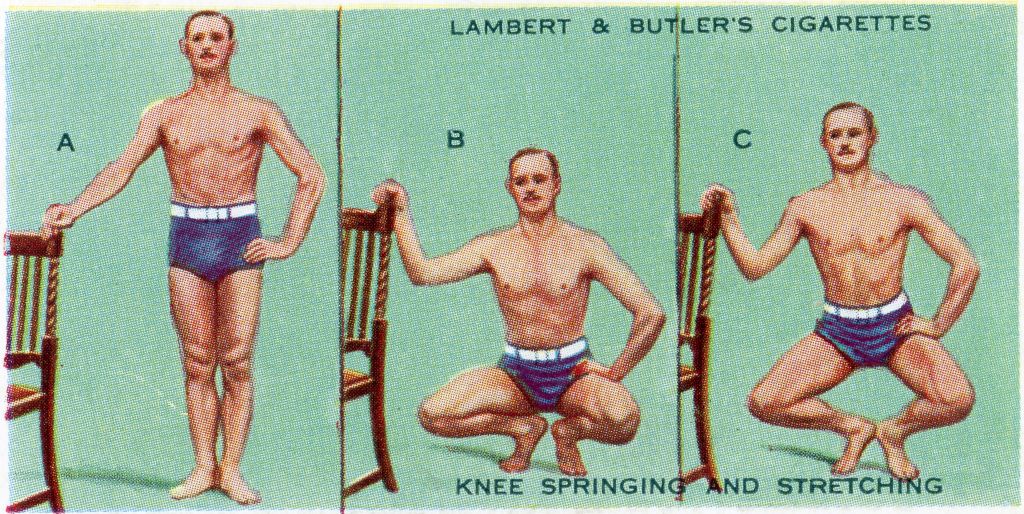
If you were curious about good squat form, check out this cigarette ad:

Collectible tobacco or cigarette card, ‘Get Fit’ series, published in 1937 by Lambert and Butler’s Cigarettes, depicting a male athlete demonstrating step by step instructions on various callisthenic or aerobic exercises and stretching for a healthy fitness routine, here chair assisted squats (Photo by Nextrecord Archives / Getty Images).
Exit mobile version