The Secret to a Good Orange Is Its Butthole

There are a million so-called “hacks” for picking the best fruit at the grocery store. But the internet may have just unlocked its weirdest produce tip yet, and yes, it involves inspecting an orange’s “butthole.”

A woman on social media claims the key to picking the sweetest navel orange is all about the little hole on the bottom, known as the “blossom end.” That’s the spot opposite where the orange was attached to the tree. Social media, of course, has given it a much more memorable name.

According to the woman, you want to avoid oranges with a large, wide opening on the bottom. In her words, you should be looking for one that is small, tight, or completely closed. She claims that is the sign of a sweet orange, while wider openings are bad news for your taste buds.

She credits this wisdom to another woman named Paige, who describes herself as an orange-picking expert. Paige even laid out a three-step ranking system for choosing the perfect orange, and color is not the top priority.

Step one is, once again, checking out the booty hole. Paige says the best oranges have a small opening, and not one that looks, in her colorful phrasing, “prolapsed” or “cavernous.”

That is apparently the most important factor of all.

Step two is weight. Heavier oranges are better, which lines up with a lot of more traditional fruit-picking advice. Extra weight usually means more juice, which is rarely a bad thing.

Color only comes in at step three. Paige says more vibrant orange fruit may generally be better, but she insists it is less important than the first two steps. According to her, an orange can still be sweet even if it looks a little yellowish or greenish, as long as that blossom end passes your backend inspection.

To back up her credentials, the woman in the viral video insists she eats two oranges every single day and has been doing so for years. That is her proof that she knows what she is talking about.

Is this advice scientifically proven? Not exactly.

But it has clearly struck a nerve online, where people are equal parts curious, skeptical, and deeply uncomfortable inspecting citrus quite this closely in public.

Still, if you catch someone staring a little too intently at the bottom of an orange in the produce aisle, now you know why.

The King of Chocolate Covered Foods Is Bacon

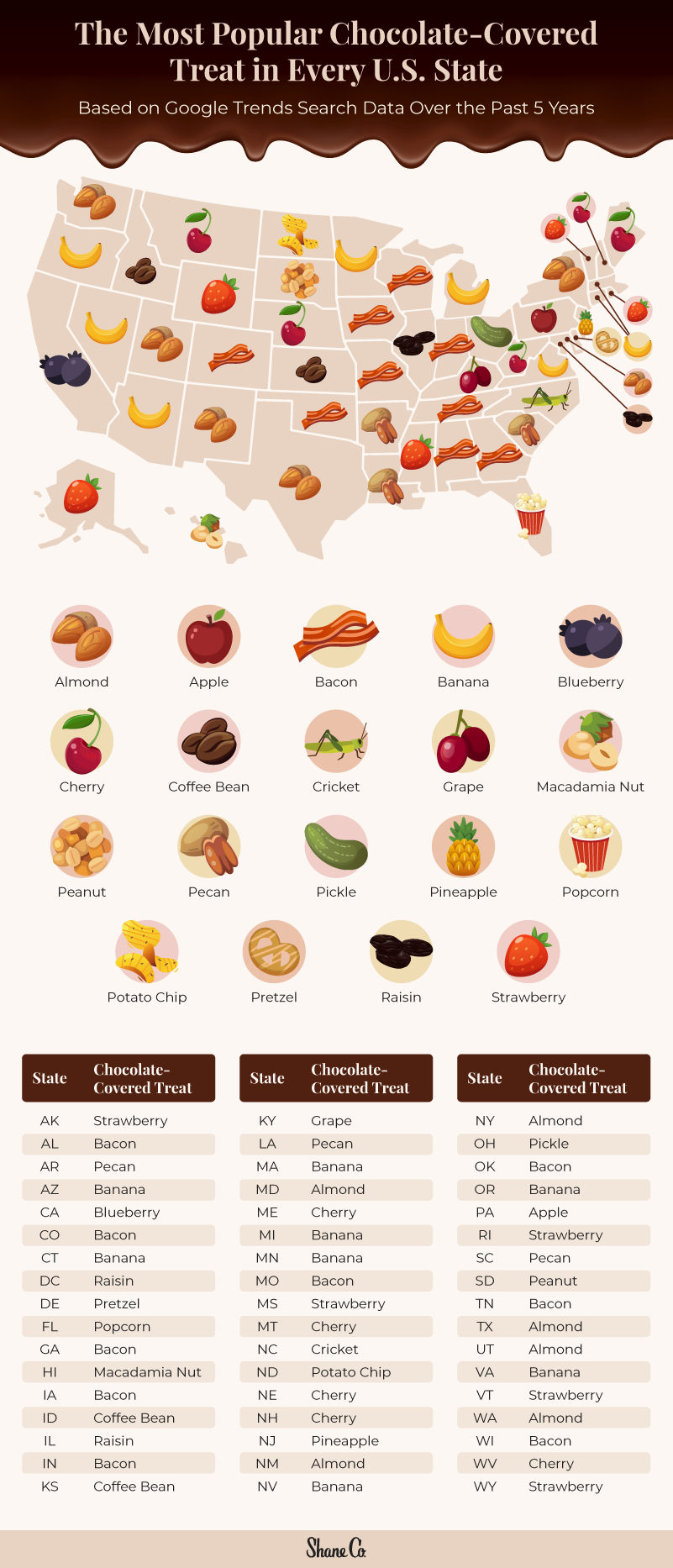
Did you know there is a map breaking down every state’s favorite thing to dip in chocolate? Most of the picks are exactly what you would expect. A few are questionable. And one of them absolutely should have stayed a secret.

Let’s start with the big headline:

Across the country, the most popular thing to cover in chocolate is bacon. Yes, bacon. Somewhere, a cardiologist just sighed very deeply.

Chocolate covered bacon takes the top spot overall, thanks largely to Middle America really leaning into the sweet and salty chaos. Bacon is the number one choice in Alabama, Colorado, Georgia, Indiana, Iowa, Missouri, Oklahoma, Tennessee, and Wisconsin. That is a lot of states agreeing that pork belongs in dessert.

Bananas come in as another big favorite. They are the most popular chocolate covered item in Arizona, Connecticut, Massachusetts, Michigan, Minnesota, Nevada, Oregon, and Virginia. Respectable. Classic. Nobody is mad at chocolate bananas.

Chocolate covered nuts also had a strong showing, which feels very on brand. Almonds are number one in Maryland, New Mexico, New York, Texas, Utah, and Washington. Pecans take the top spot in Arkansas, Louisiana, and South Carolina. Peanuts win in South Dakota, while macadamia nuts rule in Hawaii. These states are all nuts, literally.

Strawberries, the romantic overachiever of chocolate foods, are the favorite in Alaska, Mississippi, Rhode Island, Vermont, and Wyoming. Meanwhile, cherries win in Maine, Montana, Nebraska, New Hampshire, and West Virginia. This feels like something you would order off a menu without questioning it.

Then things start to get weird.

California prefers chocolate covered blueberries. Pennsylvania goes with apples. New Jersey chooses pineapples, which feels aggressively tropical for that state. Kentucky likes chocolate covered grapes, while Illinois and Washington, D.C. prefer raisins, which are just grapes that gave up.

Ohio chooses chocolate covered pickles, which raises several follow-up questions no one wants answered. Florida goes with popcorn. Delaware picks pretzels. North Dakota prefers potato chips. Idaho and Kansas opt for coffee beans, which feels like a cry for caffeine help.

And then there is North Carolina.

North Carolina’s favorite chocolate covered item is crickets. Actual insects. Covered in chocolate. Somebody had to say it, and unfortunately, somebody did.

Is Pumpkin a Fruit or a Vegetable?

Every fall, pumpkins take center stage… But here’s a fun twist that might mess with your mental produce aisle: pumpkins are technically fruits.

That’s right. According to Joe Masabni, Ph.D., a vegetable specialist and professor at Texas A&M, pumpkins fall squarely into the “fruit” category from a botanical standpoint. Why? Because fruits are what develop from the flower of a plant—and pumpkins do just that.

“Anything that starts from a flower is a fruit,” Masabni explains, turning our grocery store assumptions upside down.

So why do so many of us file pumpkins under “vegetables” instead?

It comes down to how we eat them, not how they grow. “We categorize foods by whether we eat them as a dessert, salad, or part of a meal,” Masabni said. It’s the same reason people commonly think cucumbers or tomatoes are vegetables. We slice them into salads or roast them with dinner—no sugar, no dessert plate—so we mentally label them as veggies.

Pumpkins are a bit of a culinary wildcard, though. Some people throw chunks of pumpkin into savory stews, others purée it into sweet, spiced pies. That mix of uses only adds to the confusion.

So, what exactly is the difference between a fruit and a vegetable, scientifically speaking? It all comes down to the flower.

Vegetables like lettuce, for example, never grow from a flower that turns into something edible. You harvest the leaves, and that’s it. Pumpkins, on the other hand, start as flowers that—after a little help from pollinators like bees—transform into the bright orange gourds we know and love.

This same flower-to-fruit process also applies to some other unexpected “vegetables” like tomatoes, cucumbers, eggplants, zucchini, squash, peppers, string beans, corn, and okra. Yep, they’re all technically fruits too.

Does it matter at the end of the day? Not really. Your pumpkin pie isn’t going to taste any different now that you know it’s a fruit.

But it is a great conversation starter for your next fall get-together. Maybe bust it out after dessert (fruit-based or otherwise).

“The fruit and vegetable debate is a fun one,” Masabni said. “At the end of the day, we want people to enjoy these plants as gardeners and at the dinner table.”

So now when you’re sneaking that second slice of pie, you can say you’re eating your fruit…

What’s the Right Way to Peel a Banana?

Turns out, there’s more than one way to peel a banana — and Americans are split on the matter. A recent poll sparked an online debate by asking a surprisingly simple question: Which end do you open a banana from?

For most people, the answer is the stem.

In fact, 72% of respondents said they open bananas from the stem end, which many consider the “normal” method.

But 20% said they go for the other end, what many call the bottom. Another 8% weren’t even sure which way they do it.

Interestingly, age seems to play a role in peel preference. Younger adults are more likely to open bananas from the bottom, with around 24% saying they do so — compared to only 18% of older adults. And here’s where things get even more curious: bottom-peeling is actually how monkeys do it. It may be cleaner and easier, especially when the banana is ripe. Pinching the non-stem end near the seam lets the peel fall away with less struggle and fewer mushy results.

While we’re on the topic of banana etiquette, here’s another debate: is it okay to break apart a bunch of bananas when grocery shopping?

Most people (57%) say yes, pull away! But nearly a third (31%) think it’s bad form, and 12% are unsure. Once again, younger shoppers are more relaxed about it than older generations.

And what about ripeness? When it comes to color, the ideal banana is bright yellow for 54% of people. Another 21% prefer theirs slightly underripe with a hint of green, while 15% like them speckled with brown. Only 4% want their bananas mostly green, and zero percent reported enjoying them fully brown.

Whether you’re a bottom-peeler or a bunch-breaker, one thing’s clear: Americans have opinions about bananas.

Exit mobile version