Your Brain Peaks at 58, Then Slowly Turns Into Oatmeal

Hallmark loves to tell us we’re “older and wiser” every year. Cute. But according to science, your brain is basically on a rollercoaster: it climbs, it peaks, and then… it nosedives.

A new study in the journal Intelligence found that the human brain hits peak performance between ages 55 and 60. That’s when your life experience, judgment, and wisdom finally outweigh the fact that you just Googled “how to Google.”

Here’s the ride in a nutshell:

  1. Fluid intelligence (reasoning, memory, mental speed) maxes out in your early 20s. So yes, you peaked at Mario Kart in college. It’s been downhill ever since.
  2. Crystallized intelligence (all that random trivia you collect over the years) just keeps building. By your 50s, you’re basically a lesser-Wikipedia… with back pain.
  3. Personality traits like patience and emotional stability improve as you get older.
  4. Moral reasoning sharpens with age, meaning you actually know right from wrong. Too bad it arrives decades after you needed it in your 20s.
  5. Financial literacy keeps improving into your 60s. That’s right around the time you finally pay off your student loans.
  6. Cognitive flexibility and empathy start to fade with age, so if your parents can’t figure out TikTok or don’t care about your vibe check, cut them some slack.

So yes, the sweet spot is late 50s. You’re wise, savvy, and make solid decisions… basically the Yoda years of your brain. But after that, it’s a slow slide into “What’s my password again?” territory.

The researchers say this mental peak matters most for business and politics. Which is science’s polite way of hinting that maybe, just maybe, 80-year-old senators shouldn’t be the ones steering the ship.

Gen Z Wants Total Silence While Driving

If your ideal morning commute involves no radio, no podcasts, and no phone calls, congrats – you’re at least young at heart.

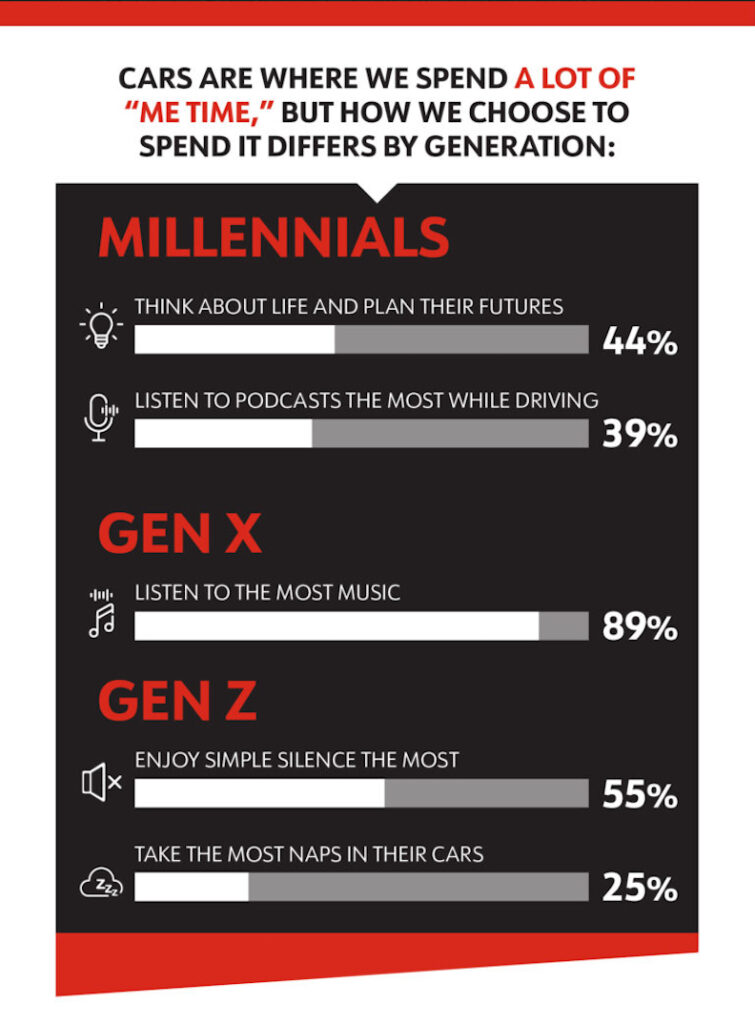
A new poll by Ziebart found Zoomers are the generation most likely to crave peace and quiet behind the wheel. 55% of Gen Z adults prefer complete silence when they drive. No podcasts. No playlists. No phone calls. Not even the gentle hum of NPR. Just the sound of rubber meeting road.

The poll looked at how different generations use their time in the car, and it turns out every age group has its own road time rituals.

Gen Z: Total silence

The poll didn’t look at why that’s the case, but here’s a guess. They think the radio is from the 1800s… think music should only be consumed through headphones… and/or they’re 24 and just got their driver’s license at 22. So they need zero distractions to avoid driving into a ditch.

Millennials: Chasing productivity

They’re the most likely to use drive time to plan their day, think about the future, or mentally run through their to-do lists. Basically, their brains are in full Google Calendar mode before they even hit the parking lot. They also listen to more podcasts than any other generation. (Probably ones on how to de-stress.)

Gen X: Still blasting those tunes

If you were born between ’65 and ’80, you’re probably still jamming out to your favorite music. A whopping 89% of Gen X respondents said listening to music is their go-to commute activity. Makes sense from the generation that had to wire a tape deck into their dad’s old Trans Am to listen to their Jane’s Addiction tapes.

Baby Boomers: ???

Boomers weren’t represented in the poll. But you can probably find them lecturing their GPS. Or if anyone from those other generations is riding shotgun, they’ll be reminiscing about when gas was under a dollar.

So whether your commute is a silent think tank, a mobile concert venue, or a motivational seminar on wheels, at least know you’re not alone in your habits. (But seriously, Gen Z. Turn that radio on. It’s free and sooooo throwback ’90s of you.)

Boomers and Gen X Are Right—Life Really Did Get Way More Annoying

Ever catch yourself stressed about replying to a text… and then stress even more because you haven’t replied in three days and now it feels illegal to even try? You’re not alone.

A recent online conversation sparked some major nostalgia (and maybe a little collective panic) as Boomers and Gen X’ers shared all the modern stressors we didn’t have to deal with 20 or 30 years ago. The main takeaway? Being an adult in the digital age feels like running a marathon through an anxiety minefield… in skinny jeans.

Here are some of the biggest “didn’t-exist-back-then” stress bombs that younger generations now have to juggle:

1. Cybercriminals
Back in the day, locking your front door was enough. Now, you’re one sketchy Wi-Fi login away from someone Venmo-ing themselves your entire life savings.

2. Social Media Everything
It’s not just about scrolling through chaos or trying not to fall down a TikTok rabbit hole. You also have to curate your own content like it’s a personal branding exercise. Is your vacation selfie fun, casual, and filtered enough? Did it get enough likes? Should you delete it?! Rinse, repeat.

3. Constant Cameras
We used to worry about bad yearbook photos once a year. Now every brunch, workout, and wardrobe malfunction could be documented, posted, and dissected in HD.

4. Fake News & Deepfakes
Back then, you could assume the news was real and your eyes weren’t lying to you. These days, “trust but verify” applies to everything, including videos that look real enough to get someone canceled.

5. Beauty Standards Have Mutated
We went from “just be clean” to “shave everything, inject something, contour everything else.” Apparently, having a normal face is now controversial.

6. Communication Anxiety
Texting was supposed to make life easier, right? Instead, people are drowning in read receipts, unspoken response-time etiquette, and email inboxes that feel like boss fights. (And yes, some folks genuinely get stressed if they have more than 100 unread emails. Meanwhile, others are just casually coexisting with 13,000.)

7. Language Inflation
People now say literally every other word, and it’s literally making others lose it.

In short, being a human in 2025 often means managing more mental tabs than a 2008 Dell laptop. The stressors might be different now, but the need to unplug (and maybe hide in the woods without Wi-Fi for a weekend) is timeless.

So if you find yourself longing for a simpler time when your biggest media concern was rewinding your Blockbuster VHS tape, just know you’re not alone…

These Obsolete Skills Still Live Rent-Free in Our Brain

Wanna feel old? (Or older than you already did?) People online are sharing all the quirky, now-useless skills they still remember… and if you were born before apps were a thing, chances are you’ve got a few of these stored in your mental attic.

Here’s a nostalgic list of obsolete talents many of us haven’t used in decades, but could still pull off in our sleep:

  1. Programming a VCR
    If you could make it stop blinking 12:00, you were basically the family tech support.
  2. Dubbing tapes with two VCRs
    Including the sacred ritual of removing the plastic tab so no one taped over Spaceballs.
  3. Rewinding a cassette with a pencil
  4. Loading and developing 35mm film
  5. Driving stick
    Still potentially useful if you find a car from the ‘90s or a luxury European rental.
  6. Using a Thomas Guide
    You had to read a map using Battleship-like grids.
  7. Making a mixtape
    From radio. In real time. With perfect timing.
  8. Covering school books with paper bags
    Sharpie doodles were encouraged.
  9. Running MS-DOS programs
  10. Memorizing phone numbers
    Jenny’s number (867-5309) lives rent-free in our heads forever.
  11. Customizing Winamp skins
  12. Using carbon paper
    The OG “copy and paste.”
  13. Folding a roadmap
    Or more accurately: trying, failing, and then “making it work.”
  14. Pinning a cloth diaper
    And doing it without poking a baby. Legend status.
  15. Making a weed pipe out of a Coke can
    You didn’t learn that in shop class, but maybe you should’ve.

Whether you’re laughing, cringing, or feeling weirdly proud, these skills are little time capsules of life before everything got smart, touch-enabled, and stored in the cloud.

Exit mobile version