If you’ve ever been stung by these things, you already know that some hurt a little… and some make you want to draft a will on the spot.
A recent poll found the most painful sting of all is from a hornet. And honestly, no one’s surprised. Hornets aren’t just bugs… they’re flying anger issues with wings. 98% of people who’ve been stung by one said it hurt, and 61% said very painful. (The other 39% were probably still crying too hard to answer.)
Wasps came in a close second on the pain scale, followed by yellowjackets, fire ants, and jellyfish. Basically, if it has stripes or lives in the ocean, don’t touch it.
The survey also asked which bites and stings people have experienced… and the results are like a “who’s who” of things that can ruin your picnic:
Mosquito – 91% (a.k.a. the unpaid interns of Hell)
Bee – 75%
Wasp – 52%
Flea – 51%
Fire ant – 46%
Horse fly – 42%
Yellowjacket – 40%
Tick – 39% (nature’s clingiest ex)
Hornet – 30%
Lice – 23%
Bed bugs – 21%
Deerfly – 17%
Jellyfish – 15%
Snake – 6%
Stingray – 4%
Portuguese man o’ war – 3% (basically a jellyfish with a lawyer)
So yeah, mosquitoes may annoy the most people… but hornets are officially the heavyweight champs of pain.
There’s a wee little hack making the rounds on TikTok, and it’s sparked the kind of question you didn’t know you needed answered: If you pee on an ant hill, will it kill the ants or just invite more of them?
According to people pushing this so-called “green” pest control method, human urine is an all-natural, eco-friendly way to take care of your ant problem. And technically, they’re not wrong – but there’s a pretty big catch.
Turns out, ants are really into pee. Seriously.
Human urine contains a compound called urea, and ants love the stuff. A 2019 study found they were even more drawn to it than sugar water, which is saying a lot when you’re talking about insects basically designed to find and hoard sugar.
If you march out into the backyard, drop your pants, and douse an ant hill thinking you’re going full eco-warrior exterminator, you might just be handing out invitations to an ant rave. Yes, peeing on an ant hill can actually attract more ants.
The hack can still work… but only if you’re a weirdo.
Despite those urophilic tendencies ants have, the hack itself isn’t totally off base, and there is some science behind why the idea got traction. It can work if you do it right – you just won’t want to. (And if you do want to, I’m not sure we can be friends.)
Over time, urea breaks down and turns into ammonia, which ants hate. But the key word here is time.
For the pee-to-ammonia transformation to actually kick in, it needs to ferment. And we’re probably not talking a quick 24-hour marinade. Experts say it works best if you wait at least a month.
You read that right. If you want to solve your ant problem with your own urine, you’ll need to start hoarding that urine in jars for weeks on end. (Some claim letting it ferment for a few days does the trick, but I call those people lazy with commitment issues.)
You’re still reading? Wow, you are weird.
Okay, so maybe you’re on board with the idea of storing your pee in mason jars like an insane person. If so, apparently the method really can work as a chemical-free way to rid your property of ants… or at least convince them to relocate to another part of your yard you haven’t doused in month-old piddle.
Of course, the other option is call an exterminator or buy some Borax at your local hardware store. But then you wouldn’t have those fun jars of liquid gold to use as a teaching aid when you inevitably share this tip with your friends and family. Like everything, it’s got its pros and cons.
Still not sure you’re ready to hoard your own urine?
The good news is you don’t have to decide today. But why not play it safe? Start saving a few mason jars of tepid urine while you weigh your options. Worst case: you spend the rest of your life trying in vain to shake the reputation of the weirdo who can’t part with their pee. Best case: you end up with a basement full of urine just in time for spring – and hopefully, far fewer ants!
You could even take a page out of this lady’s playbook and get your kids involved! A fun bonding activity for the whole family!
It sounds like the start of a Marvel movie, but nope, this one’s real: A wasp nest contaminated with radiation was recently discovered near a nuclear facility in South Carolina.
The Department of Energy confirmed that a radioactive nest was found on July 3rd just outside the Savannah River Site, a sprawling Cold War-era nuclear facility located near the Georgia border.
The site, which once produced plutonium for the U.S. military, has long been associated with leftover radiation, often referred to as “legacy contamination.”
Savannah River Site
“Moderately high” levels of radiation detected
Tests showed the nest was emitting 100,000 disintegrations per minute (DPM)—a term used to measure radioactive decay. That number puts it in the “moderately high” range, though it’s still far below the kind of levels you’d see in something catastrophic like Chernobyl.
Officials were quick to clarify there’s no active leak or immediate danger to the public.
So how did the wasps become radioactive?
No one’s sure, but the insects may have picked up old contaminants while building the nest, possibly from soil or materials around the aging nuclear facility.
While it sounds horrifying, this isn’t the first time nature has had an awkward meet-cute with radioactive leftovers. Similar incidents have occurred over the years, usually involving small animals or plant life near long-decommissioned nuclear sites.
In response, crews treated the nest like any other radioactive waste. They sprayed it down and disposed of it according to nuclear safety protocols.
The nest is gone, but the wasps are still M.I.A.
One weird detail: A local report said the nest didn’t contain any actual wasps when it was found. That’s either a relief—or a setup for the sequel, where the mutant wasp swarm emerges. (We’re half-kidding. Probably.)
The story is a strange reminder of the long environmental shadow cast by Cold War nuclear production. While the situation sounds alarming, energy officials and local authorities maintain there’s no reason to think there’s an ongoing leak or elevated risk to people nearby.
So no, you don’t need to stock up on wasp spray and hazmat suits just yet. But if you live in the area and hear a suspicious buzzing sound… maybe stay inside.
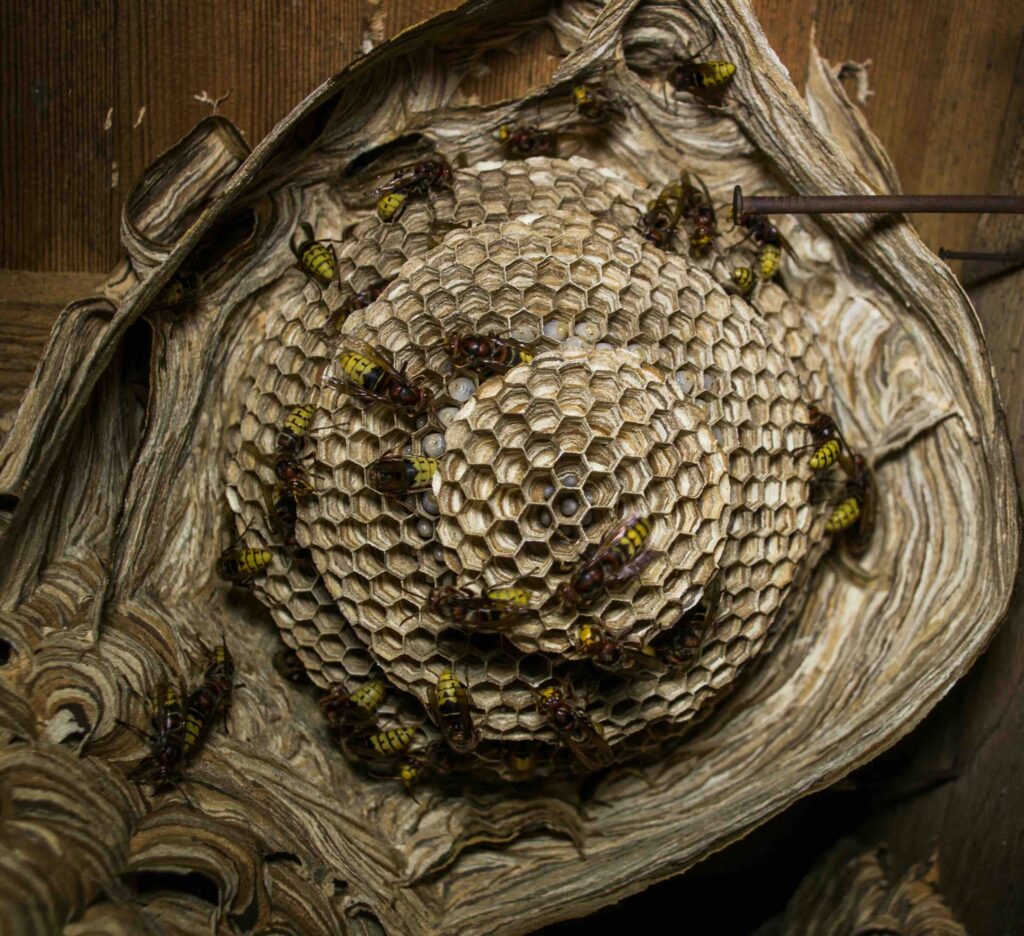
Stock photo of wasps building a nest. Not the radioactive kind… the normal, huggable kind. Photo by David Hablützel