Embrace a fulfilling lifestyle with content on wellness, personal growth, and everyday joys. Discover tips and stories that inspire a balanced and meaningful life.
When you’re trying to drift off to sleep, your TV choice can make or break the mission. You want something calm enough to help you nod off, but not so boring that you start scrolling through TikTok instead.
According to an analysis from the site AmberWillo, some shows are basically melatonin in streaming form – while others are more like a triple espresso at midnight.
Researchers ranked shows by how likely they are to help or hinder your sleep, looking at factors like episode length, genre, content rating, and whether they contain frightening or jarring scenes.
The 10 Most Relaxing Shows to Fall Asleep To
Bluey
Seinfeld
Mr. Bean
Pride and Prejudice (the 1995 BBC miniseries)
The Office (U.S. version)
Friends
Fawlty Towers (British classic from the ’70s)
Haikyuu!! (a Japanese anime about volleyball)
Yes Minister (a sharp British political sitcom from the ’80s)
Arrested Development
Basically, if it’s lighthearted, nostalgic (aka, you’ve seen it before), and doesn’t involve anyone being chased by a demon or tortured in a basement, you’re safe to snooze.
The 10 Least Relaxing Shows to Fall Asleep To
Hannibal
Sons of Anarchy
Daredevil
Boardwalk Empire
Peaky Blinders
Dexter
Spartacus
The Boys
Mr. Robot
Black Mirror
So if you’re planning to fall asleep to Black Mirror, don’t be surprised if you wake up questioning the nature of reality – or your toaster. Or basically, just avoid anything that might cause your dreams to feature a soundtrack of screaming and existential dread.
The general guideline? When it’s time to power down, skip the gore and go for something that feels like a warm blanket for your brain. Because sometimes, the best bedtime story is just Bluey asking her dad to play one more game.
If your ideal morning commute involves no radio, no podcasts, and no phone calls, congrats – you’re at least young at heart.
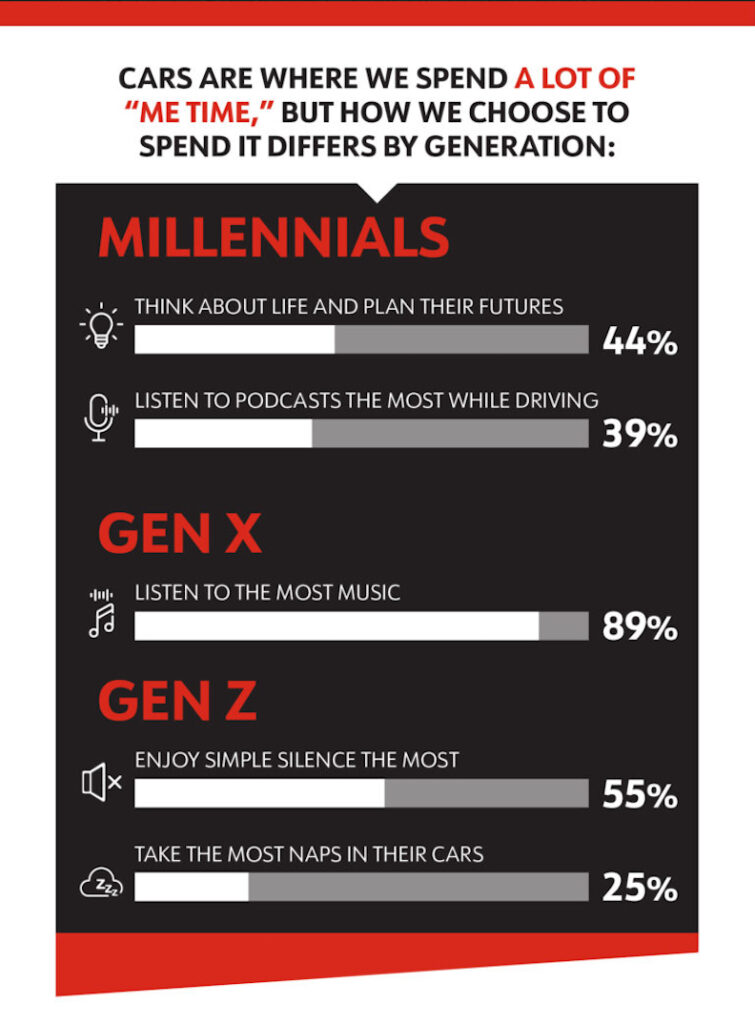
A new poll by Ziebart found Zoomers are the generation most likely to crave peace and quiet behind the wheel. 55% of Gen Z adults prefer complete silence when they drive. No podcasts. No playlists. No phone calls. Not even the gentle hum of NPR. Just the sound of rubber meeting road.
The poll looked at how different generations use their time in the car, and it turns out every age group has its own road time rituals.
Gen Z: Total silence
The poll didn’t look at why that’s the case, but here’s a guess. They think the radio is from the 1800s… think music should only be consumed through headphones… and/or they’re 24 and just got their driver’s license at 22. So they need zero distractions to avoid driving into a ditch.
Millennials: Chasing productivity
They’re the most likely to use drive time to plan their day, think about the future, or mentally run through their to-do lists. Basically, their brains are in full Google Calendar mode before they even hit the parking lot. They also listen to more podcasts than any other generation. (Probably ones on how to de-stress.)
Gen X: Still blasting those tunes
If you were born between ’65 and ’80, you’re probably still jamming out to your favorite music. A whopping 89% of Gen X respondents said listening to music is their go-to commute activity. Makes sense from the generation that had to wire a tape deck into their dad’s old Trans Am to listen to their Jane’s Addiction tapes.
Baby Boomers: ???
Boomers weren’t represented in the poll. But you can probably find them lecturing their GPS. Or if anyone from those other generations is riding shotgun, they’ll be reminiscing about when gas was under a dollar.
So whether your commute is a silent think tank, a mobile concert venue, or a motivational seminar on wheels, at least know you’re not alone in your habits. (But seriously, Gen Z. Turn that radio on. It’s free and sooooo throwback ’90s of you.)
If you needed something new to worry about this week… yawning just made the list. Hayley Black, a 36-year-old mom in the UK, recently shared the terrifying story of how a simple morning yawn nearly ended her life. The incident happened back in 2016.
How a big yawn could paralyze, or even kill you
It all started around 5 a.m., when Hayley woke up to feed her newborn daughter, Amelia. After watching her baby yawn, Hayley instinctively did the same, tossing in a casual stretch for good measure. Then everything went sideways.
“I felt this immediate electric shock sensation go through half my body,” she said. Her arm locked midair, and she started experiencing what she described as seizure-like sensations. She knew right away something was seriously wrong.
Even her husband didn’t believe it
Her husband Ian initially brushed it off, but quickly changed course and called an ambulance. At the hospital, despite Hayley’s obvious pain, scans initially showed nothing. Medical staff assumed she was fine. But the pain kept intensifying, and she became paralyzed on her right side.
How did it paralyze her?
A more in-depth evaluation eventually revealed the horrifying truth: the force of her yawn had caused her C6 and C7 vertebrae to shoot forward into her spinal cord. She was given a 50/50 chance of walking again, or even surviving.
Rushed into surgery
Thankfully, emergency surgery was successful, but recovery was long and brutal. Hayley had to re-learn how to walk and was in a wheelchair for months. She now lives with permanent nerve damage, takes daily medication, and has developed fibromyalgia.
Paranoid it could happen again
Even today, she says any attempt to yawn triggers a wave of fear. “I can’t yawn without panic,” she said. “Every time I take a step [without medication], I get electrical shocks all up my spine and into my head.”
So the next time you feel a yawn coming on, maybe just… sip some water instead.
If you’re a pasta lover who’s ever wished you could twirl your fork into a big bowl of spaghetti without feeling like you just signed up for a post-dinner nap, Kristen Bell has a trick for you.
According to her “Nobody Wants This” co-star Justine Lupe, Bell swears by a simple hack that helps stabilize blood sugar, keeps you fuller longer, and may even prevent weight gain.
Here’s the move: before digging into a carb-heavy meal like pasta, she eats a serving of leafy greens—think spinach, kale, or anything fibrous enough to make your mom proud. If a salad isn’t an option, she’ll reach for a glass of Metamucil or even a quick shot of apple cider vinegar (and yes, the liquid, not those trendy gummies).
Lupe shared the method during an interview and gave credit where credit’s due, saying, “It supposedly stabilizes your glucose. You can thank Kristen Bell for that, everyone.”
And it’s not just Hollywood pseudoscience. A registered dietician backed up Bell’s approach, noting that stable blood sugar does more than just help with cravings. Over time, it can reduce the risk of diabetes, heart disease, insulin resistance, and obesity. In other words, Kristen’s little pre-dinner routine isn’t just a celebrity quirk—it’s a legit bio-hack with real health benefits.
The logic behind it is pretty straightforward.
When you eat greens or fiber before carbs, your body slows down the absorption of sugar into your bloodstream. That means fewer spikes and crashes, more steady energy, and less chance you’ll raid the pantry for cookies an hour later. Think of it as giving your metabolism a little pep talk before the main event.
Of course, no single hack is a magic bullet. Bell’s trick works best as part of a balanced lifestyle, not as a green light to live exclusively on fettuccine Alfredo. Still, for anyone who’s tried every diet trend only to wind up back at square one, this one feels refreshingly doable. You don’t have to give up pasta—you just have to start with some spinach first.
So, the next time you’re eyeing a plate of linguine, remember Kristen Bell’s advice: a handful of greens now, a steadier you later. Your blood sugar (and maybe your waistband) will thank you.
If your morning routine is like mine, it starts and ends with a cup of coffee – and hey, if we’re (seriously) lucky, it might get us to 99! But if you want to make it to the century mark and beyond, here’s the formula.
Us roll-out-of-bed-and-crack-the-laptop types may need to set our alarm a little earlier to fit all this in. But according to the experts, it’s worth it. Doing everything on this list can add years to your life if you do them regularly.
A writer for “Real Simple“ talked to some real smart folks – experts in aging and longevity – and compiled a list of of seven morning habits that can help you live to 100. So if you’re gunning for that 100th birthday, here’s the science-backed formula to kick off your mornings – coffee included, just not as the opening act.
1. Hydrate Immediately
First things first, pour yourself a glass of water… or go outside and sip from the hose if you want, we won’t judge. Just get some agua in your body one way or another. Experts say drinking a glass of water right after you wake up helps flush out toxins, kick-start your metabolism, and support digestion. Coffee can wait. Water is the opening act.
2. Eat a Nutritious Breakfast
Hint: Not Frosted Flakes. Get in the habit of eating healthy in the A.M. Think fiber, produce, and protein – just not the kind you get from bacon. Loading up on nutrients in the morning sets the tone for the day and leaves you feeling energized. Good choices include oatmeal with berries, Greek yogurt with nuts, and avocado on whole-grain toast. But keeping meat to a minimum, especially the processed stuff.
3. Get Moving (Even Just a Little)
You don’t need to go full “Rocky IV” with it. Just a few minutes of stretching or a brisk walk is enough to boost circulation, improve flexibility, and gently wake up your body. Consistency beats intensity here.
4. Tap Into Your Nervous System, Literally
It might sound woo-woo, but “vagal tapping” (aka, somatic body tapping) is having a moment. It involves rhythmically tapping parts of your body with your fingers to stimulate your nervous system and help you feel alert and grounded. Look it up. You’ll either feel silly or swear by it forever. Maybe both.
5. Practice Mindfulness
A few minutes of deep breathing, meditation, journaling, prayer, or even just sitting in silence can lower your stress levels. It’s like giving your brain a warm-up lap before the chaos of the day. (Notice this is Step #5. If you try the sitting-in-silence one while still in bed, you might just fall back asleep.)
6. Set Your Intentions
What do you hope to accomplish today? Taking 60 seconds to lay out your goals can improve your focus, productivity, and mood – and leave you less stressed in the long run. It doesn’t need to be profound. Even something as simple as “I’m going to answer all my emails without rage-crying” counts. You can lay out your goals mentally. Or even better, write them down so they’ll really sink in.
7. Drink That Cup of Coffee
Your beloved cup of joe isn’t just allowed, it’s encouraged. Studies have shown coffee (even decaf) can help support gut health and may reduce your risk for several chronic diseases. So yes, that morning cup still has a place – but now it’s the cherry on top, not the whole routine.
Of course, you can’t expect to live to 100 if you do all this stuff then follow it up with a Triple Baconator and two packs of Camels for lunch.
But if you can make all seven things a habit (or even three or four), chances are your new healthy attitude will spill over into your afternoons and evenings as well. So down the line, you may be eyeing triple digits.
“Siri, set a reminder to set an intention to not order a Baconator today.”
Who needs spreadsheets or a five-year plan when you’ve just got a really good feeling about it?
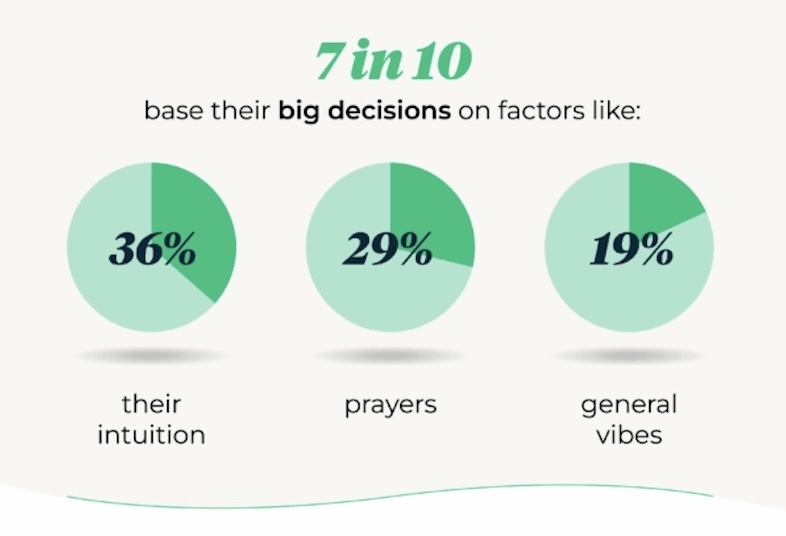
According to a new poll by the life insurance hawkers at LifeHappens.org, 7 in 10 Americans admit they sometimes rely on gut instincts when making big life decisions. Not research, not logic – just straight-up vibes and intuition.
Basically, we’re all out here choosing jobs, partners, and zip codes the same way we pick what to watch on Netflix: “Eh, this feels right.”
What counts as “gut instinct”?
They went pretty broad with it. A gut feeling could mean your “intuition,” the “general vibes” you’re feeling, or what you decided after prayer or reflection. So, basically anything that’s not “I fully thought this through, ran the stats, weighed the pros and cons, and here’s my decision.”
10 things we’ve decided with our gut
They asked people about some common life decisions that shouldn’t be made on a whim, just to see how often our gut influences our decision making. And spoiler alert: it happens a lot.
Here’s a breakdown of just how many of us admit to letting our instincts take the wheel when it comes to major life choices:
32% have chosen a job based on gut instincts.
26% have decided where to move the same way.
26% have used their gut to end a relationship.
24% relied on vibes to quit a job or change careers.
21% have chosen a pet based on instinct.
20% have made investment decisions this way.
20% followed their gut to say yes to marriage.
19% trusted it while accepting a first date.
18% have gone with a feeling when buying a home.
13% decided to go back to school based on instinct.
Basically, if it’s a major decision that could affect your career, finances, or love life, there’s a good chance you or someone you know made that call with more gut than analytics.
So yeah, we like to think we’re rational beings who look at things logically and weigh the pros and cons. But if you’re mostly just vibing your way through life, you’re far from alone.
We’ll willingly go into debt for a gut feeling
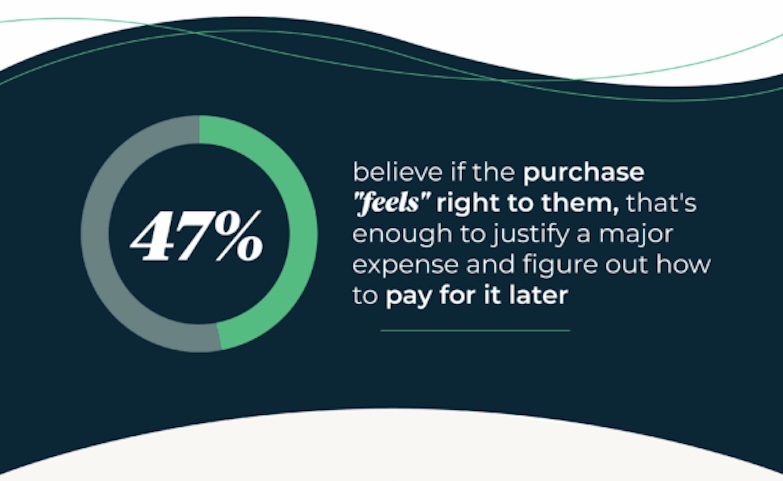
Nearly half of people said they’re also willing to follow their gut when purchasing something they know they can’t afford. If our gut says yes, so does our wallet… and we’ll just figure it out later. YOLO!
Is trusting your gut really a bad thing though?
Many would argue trusting your intuition in many (if not all) of those situations is actually the smart route to take, and maybe even a necessary one. Is it really just impulse? Or is it your brain tapping into experience faster than logic can catch up?
You could argue the “feeling” you get is just a shortcut built from patterns, past outcomes, and emotional intelligence. Or to put it another way, maybe your subconscious knows better than your conscious mind does sometimes. So while spreadsheets are great, it’s possible your gut knows what your head just hasn’t figured out yet.
It’s like a built-in tiebreaker
We’ve all been there before. You have weighed the pros and cons. You’ve run the stats, thought it through the best you can, and still can’t decide. When that’s the case, what choice do you have?
Nothing breaks a tie quite like, “My gut is telling me to ______.”
For decades, people were told to “climb the corporate ladder.” But Gen Z is like, “Nah, we’re good. Ladders are wobbly. Also, an OSHA violation waiting to happen.”
Instead, they’re into something called the “career lily pad.” Picture it: instead of struggling rung by rung, you just hop around to whatever opportunity looks the comfiest at the time. (Fewer splinters, more frogs.)
An “expert” explains it like this: “We’ve traded the rigid ladder for lily pads… because hopping around is more sustainable, more realistic, and better suited for today’s workplace realities.”
Translation: “I’ll take the job that makes sense right now, and if something shinier comes along, I’m out.”
68% of Gen Z workers say they won’t even consider management unless it comes with big money or a fancy title.
57% of Gen Z already have a side hustle. (Compare that to 48% of Millennials, 31% of Gen X, and just 21% of Boomers, who apparently only side hustle when it’s coupon clipping.)
So no, Gen Z isn’t lazy… they’re just ambitious in different directions. For them, the 9-to-5 is just the investor for their passion projects.
And get this: Gen Z is still expected to make up about 10% of managers this year. They’re not against management… they just want to run things their way: more flexibility, more balance, less “micromanaging boss breathing down your neck.”
Experts even suggest older workers could learn from them:
Set real boundaries (no more “quick emails” at 11 PM).
Diversify your career moves.
Pick mental health over climbing corporate Mount Doom.
And hey, stop panicking about A.I., and use it instead of fearing it.
So yeah, the future of work might look less like climbing and more like a giant game of Frogger.
Taylor Swift and Travis Kelce are officially engaged, and the internet basically set itself on fire. Headlines exploded, social feeds filled up, and yet, when you ask the average person how they feel about it, the answer is… a collective shrug.
A new poll shows that 72% of people say they don’t care at all about the engagement. Just 5% admit to caring a lot, while 15% care a little, and 7% aren’t sure what they feel. In other words, the overwhelming vibe is meh.
But here’s the kicker: if no one cares, how did Swift and Kelce’s engagement photos break Instagram?
The couple’s post, featuring dreamy black-and-white shots paired with Taylor’s song So High School, became the fastest to reach a million reposts—doing it in just six hours. That’s a record.
And while everyone was busy claiming they weren’t invested, Spotify data told a different story. Streams of So High School spiked 400% after the post went live. So, while most folks might say they don’t care, the receipts suggest otherwise.
It’s a fascinating contradiction, and honestly, pretty on-brand for celebrity culture. We love to pretend we’re above the hype, but then we’re double-tapping in secret. The whole situation feels like when you insist you don’t like reality TV, but somehow you know every contestant on The Bachelor.
So maybe the poll is right in spirit—most people don’t want to care. But when record-breaking posts and streaming surges start happening, it’s clear plenty of us are secretly paying attention. After all, indifference doesn’t usually make Instagram history.
Do all your colleagues think you’ve got your life together at work—emails answered, deadlines crushed, boss totally fooled—but secretly you’re screaming into the void? Congratulations, you might be quiet cracking.
The shiny new term – coined by the workplace training company TalentLMS – describes that awkward stage between burnout and quiet quitting. You’re not phoning it in yet, but you’re definitely not okay.
Think of it like your career is holding a “this is fine” mug while the office is on fire. And you’re not the only one watching the room around you burn.
Quiet cracking is shockingly common
A new survey by Resume Templates found 59% of employees are currently in quiet cracking mode. Another 20% said they were recently. That’s almost 8 out of 10 workers who are either cracking now or just pieced themselves back together. So if the break room feels like a haunted house of tired smiles and forced “I’m good, how are you?”s, that’s why.
What’s making us crack?
What’s pushing people over the edge? The top culprits are:
Too much work (43%)
Personal life stress (40%)
Bad bosses (36%)
Repetitive, soul-sucking tasks (34%)
Low pay (31%)
Just outside the top five were not being recognized (30%) and no room to grow (28%). Basically, people are overworked, underpaid, ignored, or stuck in career quicksand. Fun!
How are we coping?
Mostly by taking time off or secretly job hunting. In fact, 62% of quiet crackers admitted they’re at least somewhat likely to quit in the next six months. Translation: if your office feels stable now, just wait. The great resignation sequel is coming soon to a cubicle near you.
The big takeaway? Quiet cracking is basically the new burnout, but sneakier. If you’re crushing it at work while quietly unraveling, you’re not alone. Odds are, most of your coworkers are too. So maybe, just maybe, it’s time companies stop calling it “employee engagement” and start calling it what it really is: survival mode with a smile.