Are We All Feeling the Pressure to Buy Presents for Our Coworkers?

If your workplace just sent out an email announcing Secret Santa and your first instinct was to fake your own disappearance, you are not alone. But before you start complaining, remember the alternative: buying gifts for half your office like you’re Santa with a corporate expense account.

A new report found that 64% of companies do some kind of employee gift exchange.

Sounds harmless enough, until you learn that more than half of employees feel pressured to buy multiple gifts for multiple coworkers.

That includes your teammates, your supervisor, your supervisor’s supervisor (because strategic gifting is absolutely a thing), and the people who report to you, who are probably also panicking about what to get you. It’s the holiday gift-giving ouroboros. (And honestly, *I* deserve a gift for that very clever reference.)

About one-third of employees say they feel “a lot” or “extreme” pressure to participate.

Gen Z and Millennials feel it the hardest, probably because they already spend most of December trying to find gifts for 57 cousins. And 46% say they feel expected to spend a specific amount on each gift, which is exactly how you end up panicking in a Target aisle asking yourself, “Does this candle smell like leadership potential?”

Of course, the problem isn’t just the financial strain. Office gift-giving can get messy fast. It can create favoritism, weird obligations, or that awkward moment when someone gives their boss an expensive gourmet gift box while you show up with… socks. Very nice socks, but still socks.

This is why structured gift exchanges like Secret Santa or White Elephant actually make sense, as long as they replace personal gift-giving instead of adding a second layer of festive chaos. One gift. One budget. No emotional landmines.

So if your office insists on holiday gifting, the best-case scenario is a fun little exchange where everybody laughs, someone ends up with a novelty mug that says “World’s Okayest Coworker,” and no one feels obligated to give their boss a $25 fruit basket to secure a Q1 performance review.

1 in 4 People Use Zero Vacation Days?

A new report found that 23% of employees didn’t take a single vacation day in the past year, even though most of them technically have PTO.

You’ve probably heard it from your boss or HR team: “Make sure you take time for yourself!” Which sounds lovely… until you try to schedule a week off and suddenly you’re treated like you just asked to take the breakroom coffeemaker to Mexico.

The main reason? Work has become like a treadmill that’s on fire.

43% say their workload is just too heavy to justify taking time off, and 30% worry they’ll drown in emails the second they get back. Another 29% say they feel guilty about requesting PTO because it might make them look “less committed,” and one in four workers say their boss would probably react badly if they asked for a whole week off. (Apparently, “mental health” is only encouraged on weekends and national holidays.)

Then there’s the “unlimited PTO” trap… a perk that sounds amazing until you realize it’s really code for, “We’ll never tell you what’s too much, but you’ll know when you’ve crossed the line.”

Workers in tech know this game well: unlimited vacation, but somehow every week is the wrong week to take it.

And sure, some people say they don’t have enough PTO to take a real vacation anyway. A day off to do laundry and cry into a sandwich doesn’t count.

Here’s the thing: time off actually helps companies. It boosts morale, focus, and productivity. It even makes workplaces feel more like a team instead of a group therapy session that charges by the hour.

So yeah, “take time for yourself.” Just make sure it’s not during a busy quarter, before a product launch, after a holiday, or on any day ending in “Y.”

Literally Half Your Workday Is Busywork

If you’ve ever ended the day wondering what you actually accomplished, here’s your answer: about half what you could.

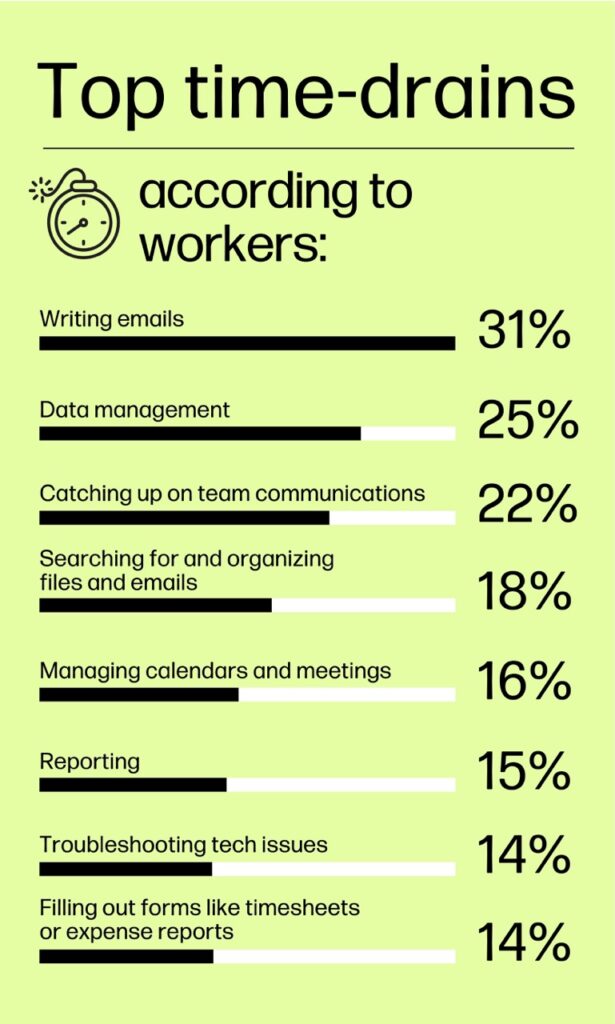
A new survey says American office workers spend half their day (literally, 51%) doing nonsense busywork like writing emails, digging through files, and copy/pasting. Basically, it’s admin Groundhog Day.

That’s not all the annoyance we have to deal with either. The survey found 1 in 3 people have considered quitting because of bad or outdated tech, and 85% blame repetitive tasks for their burnout.

The Top 3 Biggest Time Sucks

The poll found the biggest time suck of them all is email, followed by data entry, and then catching up on team messages. So basically, you spend half your day talking about work instead of doing it.

Even IT folks admit things are out of hand. They say employees waste way too much time on menial junk, and not even 4 in 10 workers feel like they’ve got the right tools to do their best work.

Will A.I. save us?

The “good” news? Companies say they’re rolling out A.I. tools to save us from all that busywork. The bad news? If history’s any clue, those tools will come with training videos, logins, and new ways to “streamline” the same stuff we already hate.

The dream is simple: less typing, fewer tabs, and eventually a workday that feels like work instead of a never-ending email marathon.

For now, we’ll just keep dreaming.

Talker Research

Fourth of July: Half of Americans Think They Should Get the Whole Week Off

If your productivity this week has dipped below “bare minimum,” you’re in excellent (and lazy) company. A recent poll found that 45% of American workers admit they’re not really getting anything done between now and the Fourth of July. And frankly, the other 55% might just be lying to look good.

That’s right: nearly half of us are mentally out of office, spiritually beachside, and physically still showing up to Zoom meetings with the camera off.

And we’re not just talking about a slow day or two. Half the country thinks the entire week of July 4th should be a national no-work zone.

49% say companies should just close up shop and let everyone live their best summer life. Millennials and Gen Z are especially here for it: 61% are in favor of making it official.

Meanwhile, only 32% of older workers agree. Which tracks. These are the same people who think taking a sick day for appendicitis is “pushing it.”

But here’s the twist: a mid-year summer break might actually help companies.

35% of workers believe they’d be more productive the rest of the year if they knew they had a week off in July. 28% said they’d work harder, and 22% would be more likely to recommend their company to others. So yes, Cheryl in HR… time off is a retention strategy.

If you are getting more than just Friday off, congratulations, you’re living the dream. Only 34% of workers will get two or more days off this week, and just 10% are getting the full five-day break. The rest of us are pretending to care while googling “patriotic jello shot recipes.”

So go ahead and phone it in this week. Just make sure your boss is phoning it in too.

Exit mobile version