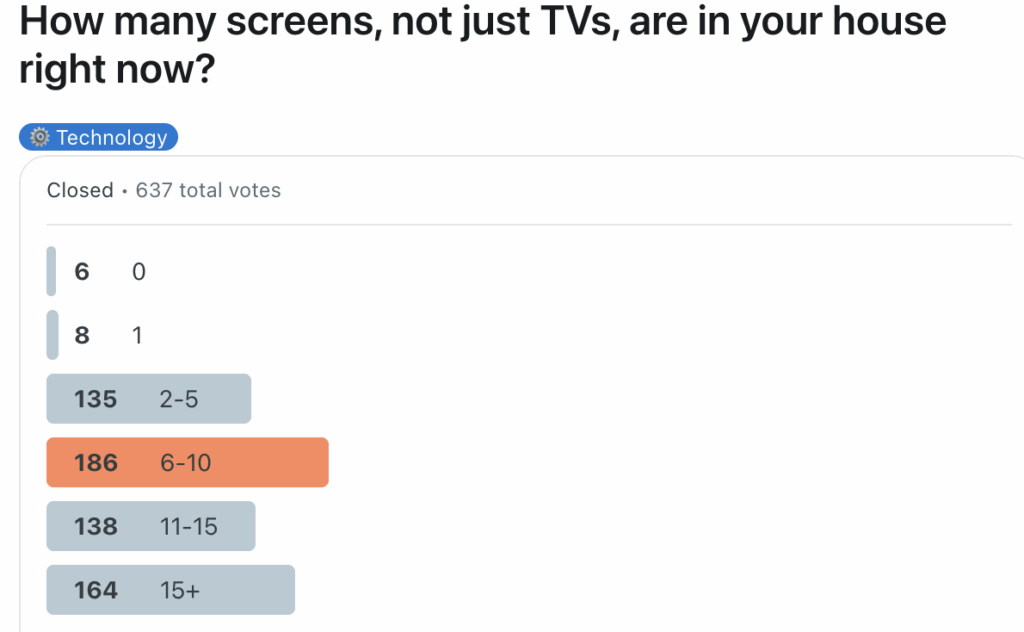
This Mom Counted Every Screen in Her House—and the Total Is Wild

How many screens are in your home right now? You might want to sit down before you start counting—because one mom on TikTok did the math, and her household total has the internet rethinking their own digital habits.

The mom, who shares snippets of family life online, recently went viral after revealing her family owns 24 different screens. Yes, 24.

She and her husband have four kids, aged two to 10, and every member of the household—toddler included—has multiple devices.

In a breakdown that feels more like an electronics store inventory, she included everything with a screen: TVs, tablets, phones, computers, even smartwatches. Shockingly, nine of the 24 screens are televisions. (That’s more TVs than people in the house.)

Then there are the tablets—seven in total. Each family member has their own iPad, and her five-year-old has a second one specifically for speech therapy. Add in three iPhones, two Apple Watches, two computers, and a Nintendo Switch, and you’ve got a fully loaded digital household.

Some outlets tried to bump the number to 27 by including game consoles like PlayStations and Xboxes. But the mom clarified: if it doesn’t have a screen, it didn’t make the list. Naturally, the video sparked conversation. Some commenters were amazed, others horrified.

“No wonder nobody plays outside anymore,” one viewer quipped.

Others admitted their own families weren’t far off—with one user tallying up 30 screens between six people.

The video taps into a growing cultural moment where many families are trying to navigate screen time limits, digital burnout, and device dependency. According to a 2023 Pew study, the average U.S. household has more than 10 connected devices—and with smart homes on the rise, that number is only climbing.

Whether you’re screen-rich or just screen-aware, this mom’s viral moment is a good reminder: maybe it’s time for a quick digital audit of your own. (And maybe—just maybe—some fresh air.)

Is “CocoMelon” Destroying Our Children’s Brains?

It’s one of the most-watched children’s shows in the world, but not everyone is singing along. “CoComelon” — the ultra-bright, music-driven animated series — has captivated millions of young viewers. Now, it’s also drawing criticism from some parents and influencers who claim it might be doing more harm than good.

Across social media, concerned parents are calling the show overstimulating, with some comparing it to “crack for kids.” Their main concern? The show’s rapid pacing, constant sound, and flashy visuals, which they say can lead to mood swings and behavioral issues — especially when it’s time to turn it off.

Too Much of a Good Thing?

One mom said she bans “CoComelon” in her house entirely. “It’s too fast-paced, it’s too aggressive, and I don’t like how big their eyes are. It’s scary,” she said in a now-viral video. “I also feel like the overstimulation is playing into the short attention span I think kids already have. When kids get used to constant entertainment, they struggle with boredom and quiet play.”

The sentiment has sparked a growing online conversation among parents, educators, and child development experts about how screen time — particularly high-stimulation content — impacts early development.

What Does the Science Say?

While research on “CoComelon” specifically is limited, studies have shown that rapidly paced media can affect attention regulation in young children. The American Academy of Pediatrics recommends limiting screen time for toddlers and encouraging unstructured, imaginative play to help develop focus and problem-solving skills.

That said, not all experts are in agreement that shows like “CoComelon” are inherently harmful. Context, content quality, and viewing habits all matter.

CoComelon Responds

The creators behind “CoComelon,” Moonbug Entertainment, have pushed back on the criticism. In a statement, the company said:

“We dedicate substantial care and resources to ensure all of our content, including ‘CoComelon’, is as enriching as it is entertaining. We work closely with experts in childhood development to inform our content development choices.”

The Takeaway

Whether “CoComelon” is helpful or harmful may depend more on how — and how much — it’s used. Like any screen-based activity, moderation is key. If you’re noticing meltdowns or withdrawal-like symptoms when the show ends, it might be worth mixing in quieter, slower-paced content — or better yet, some unplugged playtime.

Do Parents Care If Kids Swear?

If you have ever heard a kid casually drop a swear word in the grocery store and felt your soul leave your body, you are not alone.

A new poll looking at parents’ attitudes toward kids swearing, and yeah: parents have strong opinions about profanity, right up until their own child says something wildly inappropriate at the worst possible moment.

The poll surveyed parents of kids ages 6 to 17 about whether swearing is acceptable, and nearly half of them, 47%, say profanity is never okay. Not even accidentally. Another 35% say it depends on the situation, while 12% say it depends on the word. And then there is the 6% of parents who shrug and say swear words are no big deal, which probably tells you everything you need to know about what their house sounds like.

Age matters a lot here. Parents of younger kids, ages 6 to 12, are far more likely to say swearing is totally off-limits. Parents of teenagers, on the other hand, are more likely to say it depends on the situation. This is likely because once your kid is 15, you are just happy if they are not swearing at you.

Of course, when it comes to their own children, most parents swear their kids are basically saints.

44% say their child never uses profanity, and another 32% say it happens rarely. Meanwhile, 24% admit their kid swears occasionally or frequently, which feels like the most honest group in the room.

So why are kids doing it? According to parents, 41% say it is just “out of habit.” 37% think kids swear to fit in with friends, while 36% say they are trying to be funny. 21% believe their child is doing it for attention, and 27% say, with a deep sigh, that it is just the way kids talk these days now. Cool. Love that for us.

As for where kids learn these words, parents mostly blame other people, but not entirely. 65% say friends or classmates are the main influence. 58% point to popular media. But 45% of parents admit their kids probably learned those words by hearing them say it first, usually while driving.

So parents hate swearing in theory… tolerate it in reality… and secretly know they are responsible.

You can make all the rules you want, but once a kid learns a bad word, it is only a matter of time before they use it loudly, confidently, and in front of someone important.

Viral Chore List Sparks Debate Over Parenting Styles

Is today’s generation of kids too soft?

That’s the question lighting up social media, after one man shared the very detailed list of chores his dad assigned him as a kid—and people have some strong opinions.

The man posted the list on Threads, noting that it all started when he was just eight years old. He says his dad was “the coolest man on Earth,” but also ran a pretty tight ship. “Hella structure and rules,” he wrote.

And he wasn’t kidding.

The list breaks chores down by daily, weekly, and monthly expectations, covering everything from bed-making and trash duty to scrubbing the toilet and deep-cleaning the basement.

Even before-school routines were regimented: bed made, breakfast eaten, homework double-checked, and out the door on time. After school? Get changed, finish all homework, check in before dinner, and be inside before 9. Then dishes, trash, shower, and lights out by 10.

On top of that, each week had its own themed cleaning session. Monday was trash and liners. Sunday was full laundry—including ironing school clothes (yes, ironing). And each Saturday of the month brought its own deep-cleaning assignment: bathroom, kitchen, basement, and finally, the front and back of the house.

As you might guess, the internet had thoughts.

Some commenters were impressed, praising the structure and saying it taught discipline, responsibility, and time management. Others felt it was too intense for a child, arguing that kids need some free time that doesn’t involve bleach or a vacuum.

Still, the post struck a chord—especially with those who grew up in homes where “chores” weren’t optional, they were just life. The bigger takeaway for many was that structure, even if it sounds rigid by today’s standards, helped set kids up for adulthood in a way participation trophies and unlimited screen time maybe don’t.

Whether you see it as admirable parenting or old-school overkill, one thing’s clear: we’re all a little nostalgic for the days when “clean your room” actually meant cleaning your entire room… not just shoving stuff under the bed and calling it a win.

Kids Now Make $52 a Month in Allowance

The newest Americans to get a cost-of-living raise are not government workers or teachers or anyone who actually needs one. Nope. It is children. Small children. Children who sometimes complete chores… and sometimes just confidently lie about completing chores.

A new report says the average kid now pockets $52 a month in allowance, which is about $13 a week.

Of course each kid’s take varies depending on age, work, and whether the family budget is held together by coupons and prayer. But before Grandpa fires up the rant machine about “kids these days,” a quick reality check: inflation is real. Paying a 12-year-old $13 a week today is basically the same as paying a kid in the 1990s about $5.50 a week. And for grandparents who grew up in the 1960s, it would have been about $1.25 a week.

The one place older generations are absolutely justified in shaking a fist? The workload. Kids in previous generations were probably doing more adult work, not to mention farm chores before school. Meanwhile today’s kids are earning thirteen bucks a week for cleaning their room and maybe putting the plates in the dishwasher. Truly the golden age of labor.

Still, parents say the allowance is teaching valuable skills. 78% think their kids can handle money responsibly.

61% even admit their kids are more financially responsible than they were, which is fair, because many of today’s parents learned about money by accidentally racking up overdraft fees in college.

Cash is still the most common allowance method at 56%, but parents are going digital fast. 17% pay their kids through apps like Venmo, which means somewhere an 11-year-old just typed “ty” with a sparkle emoji after receiving five dollars. 14% use special debit cards for kids.

A small slice of parents skip money entirely and pay their kids with experiences (6%) or precious screen time (another 6%), which honestly may have more value than Bitcoin in a young kid’s world.

Bottom line: Kids are earning more, working less, and somehow negotiating better benefits than most grown adults. Grandpa may not love it, but every 11-year-old with chore-induced wealth certainly does.

Australia Banned Social Media for Kids Under 16—Here’s How It Could Backfire

It’s official: Australia just hit the digital reset button on childhood – but not everyone’s convinced it’s actually a good idea.

As of December 10th, 2025, kids 15 and under in Australia are banned from using any social media platform, including TikTok, Instagram, Facebook, Snapchat, YouTube, and others. It’s the first country in the world to enforce a nationwide age-restricted ban, and reactions immediately started coming in faster than a group chat meltdown.

The law, which passed in November 2024, gave platforms a year to comply. They face serious fines if they don’t play along, and also have to take “reasonable steps” to prevent kids from setting up new accounts.

Will Real-World Socializing Make a Comeback?

Supporters of the move are hoping it turns back the clock a bit. Like, pre-smartphone era back. The idea is that without apps to scroll through 24/7, kids might (gasp!) actually start hanging out face-to-face again.

A poll found 77% of Australians support the crackdown, so a lot of parents are probably crossing their fingers that this means more bike rides and fewer TikTok dances in the living room.

How It Could Backfire

Not everyone’s convinced it will work as planned. Critics say kids could just end up feeling isolated or less informed, especially if the only online voices they can access are their parents’ Facebook posts from 2011. If kids can’t connect (and get their news) from social media, will they go elsewhere? Or will they just not connect at all?

The negative effects could be even more pronounced for children with health issues or disabilities that keep them isolated, effectively eliminating their only social outlet. Others argue enforcement could be impossible anyway, since kids are already finding ways to get around the law.

A Global Test Case

It’s a massive shift for a generation that’s never known a world without social media. Australian Prime Minister Anthony Albanese is a proponent of the ban, but even he admitted, “This will be one of the ­biggest social and cultural changes our nation has faced.” He predicted it would eventually become “a source of national pride.”

Other nations are closely watching to see how it plays out as governments everywhere struggle with how to protect kids online. Will it lead to more analog childhoods, or just more creative loopholes?

“Eggnog” as a Baby Name? It’s Happened 23 Times in 500 Years

Whether you’re a boy or a girl, you can’t get much more unique and festive than “Eggnog.” Yes, it’s been done.

A site in the U.K. called Find My Past poured through 14 billion historical documents from the past five centuries looking for people with festive holiday-themed names, and this one in particular caught our eye.

At least 23 “Eggnogs” have walked the earth

They found records of at least 23 people in the past 500 years named “Eggnog.” “The Mirror” got their hands on the full list but obviously didn’t have a copy editor take a very close look. Their article says “37,” but the list itself says “23.” (Remember when fact-checkers were a thing?)

Depending on which number you believe, that’s one Eggnog baby every 14 to 22 years over the past five centuries. So come on, people! Take one for the team and name your next kid Eggnog. No one will call child services… probably.

The 20 most common holiday names

Not surprisingly, 23 isn’t enough for “Eggnog” to crack the Top 20. Top honors go to “Ivy,” which is holiday-adjacent at best. (Is Christmas really the first thing you think of when you hear “Ivy”? I think of Wrigley Field… or of that time I went camping and accidentally wiped with the poison variety.)

They found 2.3 million Ivys since the 1500s, and “Angel” is a distant second place. But the list gets more and more fun as you go.

1. Ivy (2,332,758)

2. Angel (652,337)

3. Present (459,150)

4. Holly (452,011)

5. Star (327,747)

6. Wine (311,116)

7. Santa (157,840)

8. Chestnut (141,666)

9. Christmas (131,926)

10. Turkey (27,550)

11. Sleigh (17,843)

12. Pudding (12,022)

13. Crackers (3,711)

14. Reindeer (3,190)

15. Sprout (2,827)

16. Tinsel (2,634)

17. Mistletoe (2,015)

18. Snowman (579)

19. Bauble (293)

20. Nutcracker (284)

Wait, 284 couples have named their child “Nutcracker”? Y’all are nuts. 🤪

Parents Answer 46 Kid Questions a Day

If you’re a parent of a young kid, congratulations: You’re basically a full-time customer service rep for the Department of ‘Why?’.

A new report says the average parent fields 46 questions a day from their child. That’s one every 18 minutes if you’re lucky enough to sleep through the night.

Of course, that’s an average. Some parents with teenagers might only get one grunt-like “Can I have money?” ask a day, while parents of toddlers are fielding thousands of urgent inquiries like, “Why are there clouds in the sky?” and “Where do puppies come from?” and “Why can’t you make me macaroni and cheese?”

Most of the time, the questions are manageable, but parents admit they still don’t have answers about 35% of the time.

(“Where do dreams go when you wake up?” is apparently not covered in the handbook.)

Despite the chaos, 91% of parents say it’s important to nurture their child’s curiosity. Though based on the same report, those same parents also yell “Be careful!” about 27 times a day, and “Don’t touch that!” 25 times… so curiosity has its limits.

And it turns out today’s kids might actually be more curious than their parents were. 77% of moms and dads think their little ones ask more questions than they ever did.

Which makes sense… back in the day, we didn’t have YouTube explaining how volcanoes work.

So if you’re feeling exhausted, just remember: all those endless “whys” are proof you’re raising a future genius. Or at least a future person who will absolutely dominate trivia night.

The World’s Favorite Crayon Color Is…

In the most pressing news your inner child (or actual child) will care about, Crayola just released results from a massive global poll to find the world’s favorite crayon color.

After surveying people in 183 countries, we finally have an answer – and yes, it’s incredibly specific.

Our Favorite Crayon Color? Cerulean

Yup, that soft, sophisticated shade of blue that Meryl Streep’s character famously lectures Anne Hathaway about in The Devil Wears Prada. You might remember the monologue where a simple sweater becomes a masterclass in fashion history. Turns out it’s also a global favorite when it comes to coloring outside the lines.

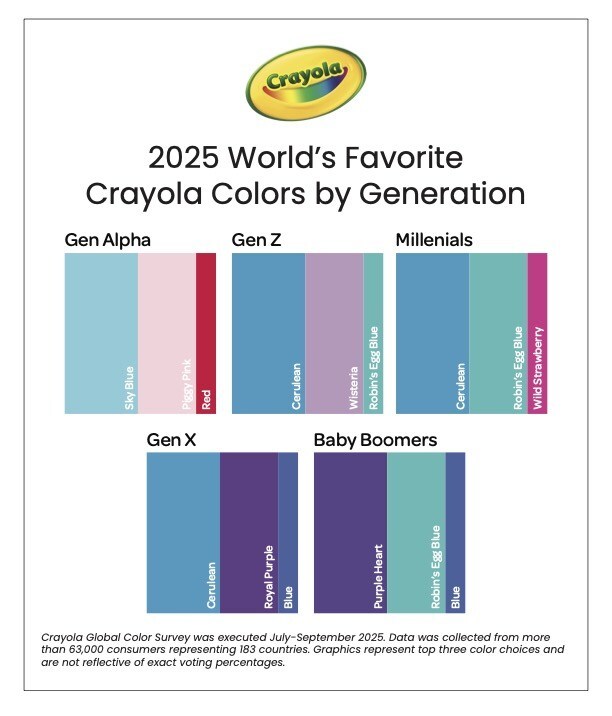
The top three crayon colors in the world are Cerulean, Robin’s Egg blue, and Wisteria purple.

Each generation’s favorite color?

Crayola also broke it down by age, and the blue obsession crosses generational lines. Boomers are the only generation that didn’t have blue at the top of their list.

Blue has been a top pick for decades

This isn’t the first time blue has dominated the crayon world. In fact, it’s kind of a long-standing monarch. Back in 1993, Crayola polled Americans and blue won then too. Then in a 2000 poll, six different shades of blue made the Top 10. So if you’re wondering why your kid’s coloring books all look like the ocean, now you know.

“Adultoween” Is the New Holiday Every Parent Wants

Kids might have trick-or-treating, but adults are out here trying to claim Halloween for themselves as well – and honestly, they’ve got a pretty good case.

If you haven’t heard of “Adultoween” yet, here’s what all those grown-ups (especially parents) are getting on board with.

Ferrero (the candy folks) just dropped a new batch of stats showing that adults are fully on board with spooky season, and not just to supervise their kids or sneak one measly Reese’s from their pumpkin buckets.

The company is pushing the concept of “Adultoween” – basically, a night of Halloween celebrations sans kids. And according to their polling results, it’s got some traction.

“Adultoween” is a surprisingly popular idea

Over half of adults – 54%, to be exact – say they wish Halloween included an official night just for grown-ups. No kids. Just costumes, candy, and possibly cocktails.

Here’s a breakdown of the most fun (and petty) takeaways from their Halloween survey.


Halloween is not just for the little goblins.

62% of Americans say the holiday is just as much for adults as it is for kids. And if you’re a parent, you’re even more likely to agree – 71% say adults deserve equal rights to the spooky fun.


Candy taxes are real, and parents are enforcing them.

Two-thirds of parents say they have the “right” to dip into their kid’s leftover candy stash. 58% aren’t even waiting that long – they’ll happily sneak a treat or two during trick-or-treating. It’s called a parenting perk, look it up.


No kids? No problem. Adults are still hoarding candy.

64% of adults say they’ll buy candy in October even if no one’s trick-or-treating at their door. And 71% of parents admit to buying “extra” candy for themselves just in case.


Full-size candy bars reign supreme.

76% of adults say full-size bars are the best kind to steal. But we’re also nostalgic: 67% say they still prefer the same candy they loved as kids, and 72% stick to the classics over newfangled flavors. Why mess with a good thing?


Men take Halloween candy weirdly seriously.

52% of men buy premium candy to make sure their house gets that coveted “good candy” reputation, compared to 41% of women. And 21% of men will absolutely judge you if your candy game is weak. (15% of women admit they will too.)


It’s all about the nostalgia.

For 60% of people, the reason they love Halloween is pure nostalgia, and among parents it jumps to 68%. There’s just something about the smell of plastic masks and the sight of toilet paper on trees that brings us all back.


Is Halloween America’s favorite holiday?

47% of people said Halloween is the holiday they look forward to most. Sorry, Santa.


So should adults get their own official Halloween night? If it means fewer tantrums, more candy, and finally getting to wear a costume that doesn’t involve Disney characters, we say absolutely yes.

Exit mobile version