Want to Sleep In Longer? Science Says Exercise Before Bed

If you’ve ever wished you could hit snooze just a little longer, science has a weirdly simple tip: do a few squats before bed.

A new study from the University of Otago in New Zealand found that light exercise in the evening can actually help you sleep longer the next morning. The key word here is light. We’re not talking full-on cardio or late-night CrossFit. Just a few minutes of movement, spread out over a few hours, and you might get an extra half-hour of sleep.

Here’s how it worked: Researchers had participants do simple exercises like chair squats, standing knee lifts, and calf raises every 30 minutes during the four hours before bed. Each round of movement lasted just three minutes, so by the end of the night, they’d only done 24 minutes of exercise total.

Still, the payoff was solid. Compared to when they were couch potatoes, the participants slept an average of 27 minutes longer.

They didn’t go to bed earlier, they just woke up later—without an alarm clock dragging them out of bed.

Now, if your reaction is “you want me to work out eight times before bed?”—we get it. But these aren’t sweaty, heart-pumping workouts. We’re talking about getting up during commercials or between episodes and doing a few leg lifts or pacing the room. Even a little dance party counts. Just keep it chill, because high-intensity workouts too close to bedtime can actually make it harder to fall asleep by spiking your heart rate and body temperature.

The best part? You don’t need a gym, equipment, or even to change into workout clothes. These micro-moves are meant to be done at home, in your living room, while you’re watching TV or doom-scrolling TikTok.

So if your mornings feel like a battle against your alarm clock, try sneaking in some light movement before bed tonight. Your future, better-rested self just might thank you.

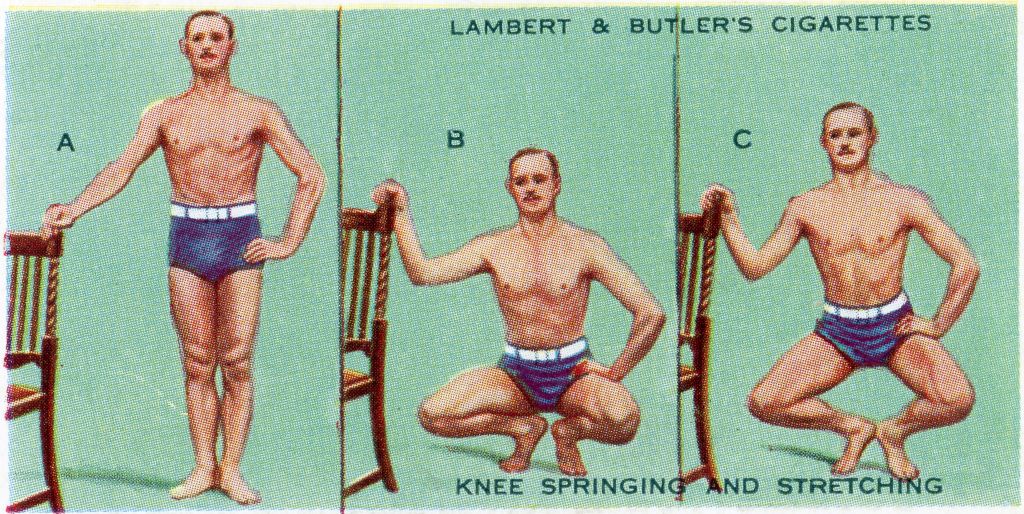
If you were curious about good squat form, check out this cigarette ad:

Collectible tobacco or cigarette card, ‘Get Fit’ series, published in 1937 by Lambert and Butler’s Cigarettes, depicting a male athlete demonstrating step by step instructions on various callisthenic or aerobic exercises and stretching for a healthy fitness routine, here chair assisted squats (Photo by Nextrecord Archives / Getty Images).

Hate Running? Science Says Learn to Juggle

If the idea of lacing up for a run or squeezing into a crowded gym makes you break out in hives, here’s a fun alternative: try juggling. Yes, really.

According to a recent feature in The New York Post, juggling is more than just a party trick… it’s surprisingly good for your brain and body. Multiple studies are now pointing to real cognitive and physical benefits, even if you’re just juggling two balls (which, let’s be honest, is most of us).

Researchers say the act of juggling can improve hand-eye coordination, reaction time, posture, and even balance. One neuroscientist explained that it actually “changes how quickly you react to objects, how well you coordinate between two hands, and how you keep your posture under control.” Translation: you might not become a circus performer, but you will sharpen your reflexes.

And it’s not just a brain booster. Juggling counts as light physical activity. Apparently it can burn up to 280 calories an hour, about the same as a brisk walk. So yes, you can technically burn off that latte while throwing things at yourself in the living room.

What’s even more encouraging is that it doesn’t require Cirque du Soleil-level talent to see results. A 2022 study followed a group of seniors learning to juggle and found that every single one of them eventually managed to juggle three balls. It took practice, but no one was left out.

Aside from being a decent workout and a brain booster, juggling is low-impact, cheap, and can be done indoors (read: no weather excuses). Plus, it might even give you a cool party trick.

So if you’re over burpees and done pretending yoga is “relaxing,” grab a couple of tennis balls and start dropping them. Just remember: if you’re not chasing at least one ball under the couch, you’re not doing it right.

https://www.thetopicalfruit.com/wp-content/uploads/2025/08/GettyImages-1166200099.mp4

Science Says: Twangy Voices Can Be Heard Clearer in Loud Environments

Turns out Dolly Parton might’ve been onto something all along—science just gave a big thumbs-up to twang.

A new study out of Indiana University found that twangy voices, especially from women, are easier to understand than neutral ones when there’s background noise, like in traffic or other chaotic environments. No need to shout. Just a little country flair could do the trick.

Researchers used AI-generated voices to test how different speaking styles performed in noisy settings. The result?

Twangy speech was not only easier to hear, but it also made listening less mentally exhausting. People caught more words and stayed more engaged, without even turning up the volume.

So what makes twang so effective? It boosts sound in a specific hertz range—the so-called “sweet spot” for hearing human speech. That helps it rise above background noise and reach your brain without making your ears work overtime.

This discovery could have real-world applications too. The researchers suggested that train conductors, pilots, emergency broadcasters, and anyone delivering important information in loud places might benefit from a little vocal country seasoning.

Imagine a flight announcement delivered with a thick, southern accent: “Hey Houston.  It’s Delta up here, man.  How y’all doin’ down there?  Just wanted to let you know we’ll be landin’ in no time. Over and out, buddy.”

Okay, maybe not that much flair—but the science checks out.

Bottom line: next time you’re trying to make yourself heard in a noisy room, don’t speak up—speak sharp. A little nasal brightness and a touch of twang might be the secret weapon your voice has been missing. Yee-haw!

Coffee Can Add Years to Your Life

Turns out your cranky uncle was right all along: coffee is the nectar of the gods… as long as you don’t ruin it with a bucket of cream and a pound of sugar.

A new study out of Tufts University found that drinking one to three cups of black, caffeinated coffee a day is linked to a lower risk of dying, especially from heart-related issues.

So, not only does it not “stunt your growth,” like your grandma warned you about, it might actually extend your life.

But there’s a catch: we’re talking about real, honest, grown-up coffee. Not the 700-calorie dessert disguised as a beverage that you just ordered from Starbucks with whipped cream, caramel drizzle, and a misspelled name.

Researchers say the benefits are mostly tied to black coffee, or coffee with only tiny amounts of added sugar and fat. People who drank it this way had a 14% lower risk of death than non-coffee drinkers.

For the record, “low sugar” means about half a teaspoon per cup. And “low fat” means something like one tablespoon of light cream, or five tablespoons of 2% milk if you’re feeling fancy.

Two to three cups a day seems to be the sweet spot, but don’t bother doubling that and expecting to live forever.

Drinking more than three didn’t give any added benefits… except maybe the ability to hear colors.

Scientists think the credit goes to bioactive compounds in coffee that help your heart, fight inflammation, and possibly make mornings bearable.

So go ahead, pour yourself another cup of black gold. Just don’t let the barista turn it into a milkshake.

F*#@ Yeah! America Swears More Than Any Other Country

The U.S. may not lead the world in healthcare or math scores, but it’s secured a different kind of dominance—one four-letter word at a time.

An expansive new study led by Australian researchers found the United States swears online more than any other English-speaking country.

The researchers analyzed over 1.7 billion words from nearly 340,000 websites, and the U.S. came out on top when it comes to online expletives.

On average, roughly 1 in every 3,000 words posted on American websites is a curse word.

That figure rises to 1 in 2,300 words on American blogs, which are more likely to feature informal language.

For comparison, the U.K. trails slightly behind with one curse word in every ~4,200 words, followed by Australia at one in ~4,500.

Their list included nearly 600 different swear words.

The research team cast a wide net in defining what counts as a swear word—an important detail that sheds light on the numbers. The 597 different words they included ranged from heavy hitters like the F-word (and its many creative uses and misspellings) to milder jabs like “jackass” and “butthead.”

Interestingly, the study’s authors didn’t try to hide their national disappointment. While American writing may dominate in online profanity, they hinted that Australia could still hold the edge when it comes to spoken language. “One possible explanation,” they wrote, “is that Australians are more conservative when they write online, but not so much when they are face-to-face.”

Sure, Australia. Tell yourself whatever you need to so you can sleep at night. But everyone knows when it comes to cussin’, America kicks ass. Still the leader of the free world in more ways than one.

Exit mobile version