Americans Only Feel Fully Healthy 19 Days a Month

A new report reveals that the average American only feels “fully healthy” for 19 days out of each month. That means for roughly one-third of any given month, most people are contending with some kind of physical or mental discomfort.

The survey, conducted by Talker Research, highlights how feeling “100%” might be more elusive than we admit. While 19 days per month works out to around 228 days per year, framing it that way doesn’t necessarily soften the reality: At least 37% of the time we’re not feeling great.

So what’s dragging everyone down?

Fatigue is the most common complaint, impacting people an average of 13 days per month.

That’s nearly every other day. Mood changes aren’t far behind, showing up around 10 days per month, followed by digestive issues (9.8 days) and headaches (7.5 days). These overlapping issues suggest that many people are battling multiple symptoms at once, not just the occasional off day.

When respondents were asked how they felt right now, only 28% said they felt completely healthy. The remaining 72% reported being in moderate or poor health. And it’s not just the occasional down day—51% said they’ve been dealing with recurring health issues that have persisted for six months or more.

That persistent state of unwellness is taking a toll beyond the physical.

About 15% of those surveyed said that not feeling well has negatively impacted their ability to enjoy time with their family.

While the report didn’t explore the underlying causes in depth, the numbers hint at broader issues in public health, mental well-being, and perhaps even work-life balance. Chronic stress, poor sleep, and diet likely all play a role, especially as fatigue and mood are among the most frequently cited issues.

The Best Songs to Listen to While Falling Asleep

If you’re the kind of person who puts on music at bedtime and hopes it magically shuts your brain off, science has some good news.

A study claims it has figured out the best songs to listen to if you’re trying to fall asleep, and yes, they actually used a formula to do it.

The most sleep friendly songs tend to share a lot with lullabies. Think slower tempos, softer energy, and melodies that feel comforting instead of stimulating.

In other words, this is not the time for a hype playlist or anything with surprise beat drops. Your brain wants calm, familiar vibes, not a musical jump scare at 11:47 p.m.

The study broke things down by genre, which is helpful because not everyone relaxes to the same kind of music. Rock fans, pop lovers, and hip hop listeners all got their own Top 10 lists.

Rock:

1.  “Your Song”Elton John

2.  “Going to California”Led Zeppelin

3.  “Mona Lisas and Mad Hatters”Elton John

4.  “Golden Slumbers/Carry That Weight”The Beatles

5.  “Wish You Were Here”Pink Floyd

6.  “The Load”Jackson Browne

7.  “Walk on the Wild Side”Lou Reed

8.  “Every Breath You Take”The Police

9.  “Desperado”Eagles

10.  “Imagine”John Lennon


Pop:

1.  “I Love You”Billie Eilish

2.  “When the Party’s Over”Billie Eilish

3.  “Memories”Maroon 5

4.  “Favorite Crime”Olivia Rodrigo

5.  “The Remedy for a Broken Heart (Why Am I So in Love)”XXXTentacion

6.  “Changes”XXXTentacion

7.  “All of Me”John Legend

8.  “Falling”Harry Styles

9.  “Idontwannabeyouanymore”Billie Eilish

10.  “You Broke Me First”Tate McRae


Hip-hop:

1.  “Sunflower”Post Malone and Swae Lee

2.  “Same Love”Macklemore & Ryan Lewis featuring Mary Lambert

3.  “Psycho”Post Malone featuring Ty Dolla $ign

4.  “Party Girl”StaySolidRocky

5.  “Swang”Rae Sremmurd

6.  “Gucci Gang”Lil Pump

7.  “Broccoli”Shelley FKA DRAM featuring Lil Yachty

8.  “Ballin'”Mustard and Roddy Ricch

9.  “Nonstop”Drake

10.  “Middle Child”J. Cole

So if counting sheep isn’t cutting it, maybe try letting Elton John or Billie Eilish tuck you in instead. Worst case scenario, you don’t fall asleep but at least your playlist is elite.

Midnight?! 44% Will Snore Their Way Into 2026

If you’re the type who likes to start the New Year well-rested instead of wildly hungover, you are absolutely not alone.

Staying up until midnight on New Year’s Eve used to feel like a sacred tradition. The countdown, the champagne, the awkward kiss at 12:01. But for nearly half of Americans, that whole vibe is officially getting… snoozed.

44% won’t stay up for it

A poll by AP-NORC found 44% of people plan to be asleep when 2025 turns into 2026. No fireworks, no toast, no “Auld Lang Syne.” Just a nice, peaceful doze under a weighted blanket while the rest of the world yells “Happy New Year” at their TVs. And honestly, can you blame them?

January 1st is a work day for some

New Year’s Eve falls on a Thursday in 2025, which means Friday is still a workday for many – and nursing a headache the size of Times Square isn’t a great way to start the year fresh.

Some time zones have it easier

West Coasters have an easy out. They can catch the New York ball drop at 9 p.m. Pacific, do a quick celebratory cheer, then dive into bed before East Coasters even finish that glass of champagne. (Is watching a replay three hours later even worth it anyway?)

Most of us do still care

The fact that over half of us plan to stay up until the wee hours means New Year’s celebrations are still alive and well. The midnight countdown isn’t going extinct anytime soon – maybe just evolving. For some, the New Year starts with fireworks. For others, a solid eight hours of sleep and maybe a smoothie the next morning.

That said, health-conscious Gen Z is more apt to sip a mocktail than take a tug on a bottle of champagne. And once you’re over 50, it can take more than a calendar flip to muster that much enthusiasm.

New Year’s Eve is still a big night either way… some of us just celebrate with less glitter and more melatonin.

Afraid of the Dark? Study Finds Nightlights Can Be Deadly

If you’re someone who can’t sleep without a nightlight, the TV glowing in the background, or your bathroom light peeking under the door, you might want to sit down. Preferably in total darkness.

A new study out of the U.K. just dropped a shocking bedtime bombshell: sleeping with even a little light on might seriously mess with your heart. Like, heart attack level mess.

Researchers strapped wrist sensors to 90,000 adults and tracked how much light was in their bedrooms at night. The average age of the participants? 62. So, no need to yank the nightlight out of your kid’s wall socket just yet – this study focused on the 40+ crowd.

Bright bedrooms increase your heart attack risk by 47%

People who slept in total darkness were the least likely to have heart issues. But folks with bright bedrooms (we’re talking overhead lights, TVs blasting, glowing electronics) had a 47% higher risk of heart attacks.

Yes, even nightlights had a deadly effect

Even those in “moderately lit” rooms – like with a nightlight or that TV you “accidentally” fall asleep to – had a 20% higher risk. So yeah, turns out your cozy little bedtime setup might be sabotaging your arteries.

What counts as “moderate light”? Think soft nightlights, your phone screen lighting up every time someone likes your cat photo, or the bluish glow of a paused Netflix screen. Apparently, your body isn’t chill about any of it.

Why is light at night so bad for you?

Previous studies have found that light messes with your circadian rhythm, reduces melatonin, and keeps your nervous system a little too alert for comfort. Your heart’s like, “Can I please get some peace and quiet in here?”

So if your bedroom looks like a low-budget spaceship at night, it might be time for a glow-down. Maybe consider some blackout curtains, cover your electronics, or at least set that sleep timer on your TV.

Whatever you do, don’t worry so much about that monster under the bed. Your nightlight might be the true villain. Sweet dreams!

Smart Beds Got Dumb: Internet Outage Left People Sleeping Like Pretzels

File this under “2025 problems”: The internet went down, and it broke people’s… beds? The increasingly connected world we all live in is getting weirder by the day.

Thanks to a major Amazon Web Services (AWS) outage this week, a bunch of tech-savvy households discovered that their “smart homes” don’t function so well without, you know, the internet. And the standout meltdown came from a company called Eight Sleep.

Smart beds are great… until they’re not

Eight Sleep makes high-end bed frames and mattress covers that do all sorts of fancy things like heating, cooling, and adjusting to different positions – you know, like a hospital bed, but luxury.

That is, until the cloud broke. Then each one became a $2,000 paperweight with a mattress on top.

People couldn’t make their bed flat

Because Eight Sleep’s beds rely entirely on cloud computing hosted by AWS, the outage left users completely stuck. If your bed was tilted upright for reading or Netflixing when the servers went kaput, that’s just how you were sleeping that night.

One user posted, “It would be great if my bed wasn’t stuck in an inclined position,” while someone else helpfully quipped, “It’s all fun and games until a hacker folds you into a taco.”

Mattresses also overheated

Some users also reported their mattresses overheating, since the smart temperature system went haywire during the blackout. One guy said his bed was stuck at 9 degrees above room temp and compared it to “sleeping in a sauna.”

Thankfully, the problems were only temporary

The beds eventually came back to life once Amazon sorted things out, and Eight Sleep scrambled to let customers know they were aware it was unacceptable. The company’s CEO promised an “offline mode” was in the works, so if there’s ever another outage (100% chance of that), your bed won’t trap you like it’s auditioning for Saw 12: Sleep Edition.

Or auditioning for a remake of 2013’s “Bad Grandpa”

Nearly a Third of Adults Are Still Afraid of the Dark

A new survey found that nearly one in three adults (29%!) still admit they’re afraid of the dark.

And not just in a “haha, cute” way. 24% sleep with a nightlight, and 10% go full “lights on” all night. Surprisingly, men are more likely to admit this than women.

Of course, some people make peace with fear by continuing to force themselves to experience it. About 28% of adults say they love horror movies. So yes, we’re a nation of people who leave the bathroom light on after watching The Conjuring.

Men top the charts in horror fandom… 33% say they love scary movies compared to 24% of women…

But they’re also more likely to have nightmares afterward. Big talkers until Pennywise shows up.

The survey also found that horror movies take a real toll on sleep. 28% of people say they’re more likely to wake up in the middle of the night after watching one, 22% say they sleep worse overall, and 12% say they sleep fewer hours.

So the next time someone laughs at you for sleeping with a nightlight, remind them: at least you’re not the one who watched Hereditary at midnight and now thinks your coat rack is haunted. Or maybe that’s you too.

The Most (and Least) Relaxing Shows to Fall Asleep To

When you’re trying to drift off to sleep, your TV choice can make or break the mission. You want something calm enough to help you nod off, but not so boring that you start scrolling through TikTok instead.

According to an analysis from the site AmberWillo, some shows are basically melatonin in streaming form – while others are more like a triple espresso at midnight.

Researchers ranked shows by how likely they are to help or hinder your sleep, looking at factors like episode length, genre, content rating, and whether they contain frightening or jarring scenes.

The 10 Most Relaxing Shows to Fall Asleep To

  1. Bluey
  2. Seinfeld
  3. Mr. Bean
  4. Pride and Prejudice (the 1995 BBC miniseries)
  5. The Office (U.S. version)
  6. Friends
  7. Fawlty Towers (British classic from the ’70s)
  8. Haikyuu!! (a Japanese anime about volleyball)
  9. Yes Minister (a sharp British political sitcom from the ’80s)
  10. Arrested Development

Basically, if it’s lighthearted, nostalgic (aka, you’ve seen it before), and doesn’t involve anyone being chased by a demon or tortured in a basement, you’re safe to snooze.

The 10 Least Relaxing Shows to Fall Asleep To

  1. Hannibal
  2. Sons of Anarchy
  3. Daredevil
  4. Boardwalk Empire
  5. Peaky Blinders
  6. Dexter
  7. Spartacus
  8. The Boys
  9. Mr. Robot
  10. Black Mirror

So if you’re planning to fall asleep to Black Mirror, don’t be surprised if you wake up questioning the nature of reality – or your toaster. Or basically, just avoid anything that might cause your dreams to feature a soundtrack of screaming and existential dread.

The general guideline? When it’s time to power down, skip the gore and go for something that feels like a warm blanket for your brain. Because sometimes, the best bedtime story is just Bluey asking her dad to play one more game.

Holiday Inn Wants You to Wake Up to… Their Smells

Forget buzzing alarm clocks or the terrifying ring of a hotel wake-up call.

Holiday Inn Express is testing a brand-new way to get you out of bed: a scent-based alarm clock. Instead of beeping at you, it releases a delicious smell of your choice, like a high-tech diffuser.

Right now, it’s only being tested in a handful of countries. People in Australia and New Zealand can wake up to the breakfast-y smells of coffee, bacon, or blueberry muffin. In Japan, they’ve added nashi pear, and in Singapore and Thailand, you can start your morning with mango.

Sadly, the U.S. isn’t on the list yet, so American travelers are stuck with the classic “housekeeping knocking at 8 a.m.” method.

But the food-inspired scents aren’t just a cruel tease. They do offer an actual free breakfast, so that bacon smell might lead you straight to the real thing.

Of course, if you’re the type who could sleep through an entire kitchen operating in your hotel room, don’t worry. Old-school wake-up calls and door knocks are still available.

The scented alarm clocks are just an extra option for people who want to rise and shine with a smile… and a sudden craving for carbs.

So if you’ve ever dreamed of literally waking up and smelling the coffee, Holiday Inn Express is making it happen… just not for Americans, yet. Figures.

A Woman Yawned So Hard, It Almost Killed Her

If you needed something new to worry about this week… yawning just made the list. Hayley Black, a 36-year-old mom in the UK, recently shared the terrifying story of how a simple morning yawn nearly ended her life. The incident happened back in 2016.

How a big yawn could paralyze, or even kill you

It all started around 5 a.m., when Hayley woke up to feed her newborn daughter, Amelia. After watching her baby yawn, Hayley instinctively did the same, tossing in a casual stretch for good measure. Then everything went sideways.

“I felt this immediate electric shock sensation go through half my body,” she said. Her arm locked midair, and she started experiencing what she described as seizure-like sensations. She knew right away something was seriously wrong.

Even her husband didn’t believe it

Her husband Ian initially brushed it off, but quickly changed course and called an ambulance. At the hospital, despite Hayley’s obvious pain, scans initially showed nothing. Medical staff assumed she was fine. But the pain kept intensifying, and she became paralyzed on her right side.

How did it paralyze her?

A more in-depth evaluation eventually revealed the horrifying truth: the force of her yawn had caused her C6 and C7 vertebrae to shoot forward into her spinal cord. She was given a 50/50 chance of walking again, or even surviving.

Rushed into surgery

Thankfully, emergency surgery was successful, but recovery was long and brutal. Hayley had to re-learn how to walk and was in a wheelchair for months. She now lives with permanent nerve damage, takes daily medication, and has developed fibromyalgia.

Paranoid it could happen again

Even today, she says any attempt to yawn triggers a wave of fear. “I can’t yawn without panic,” she said. “Every time I take a step [without medication], I get electrical shocks all up my spine and into my head.”

So the next time you feel a yawn coming on, maybe just… sip some water instead.

Want to Sleep In Longer? Science Says Exercise Before Bed

If you’ve ever wished you could hit snooze just a little longer, science has a weirdly simple tip: do a few squats before bed.

A new study from the University of Otago in New Zealand found that light exercise in the evening can actually help you sleep longer the next morning. The key word here is light. We’re not talking full-on cardio or late-night CrossFit. Just a few minutes of movement, spread out over a few hours, and you might get an extra half-hour of sleep.

Here’s how it worked: Researchers had participants do simple exercises like chair squats, standing knee lifts, and calf raises every 30 minutes during the four hours before bed. Each round of movement lasted just three minutes, so by the end of the night, they’d only done 24 minutes of exercise total.

Still, the payoff was solid. Compared to when they were couch potatoes, the participants slept an average of 27 minutes longer.

They didn’t go to bed earlier, they just woke up later—without an alarm clock dragging them out of bed.

Now, if your reaction is “you want me to work out eight times before bed?”—we get it. But these aren’t sweaty, heart-pumping workouts. We’re talking about getting up during commercials or between episodes and doing a few leg lifts or pacing the room. Even a little dance party counts. Just keep it chill, because high-intensity workouts too close to bedtime can actually make it harder to fall asleep by spiking your heart rate and body temperature.

The best part? You don’t need a gym, equipment, or even to change into workout clothes. These micro-moves are meant to be done at home, in your living room, while you’re watching TV or doom-scrolling TikTok.

So if your mornings feel like a battle against your alarm clock, try sneaking in some light movement before bed tonight. Your future, better-rested self just might thank you.

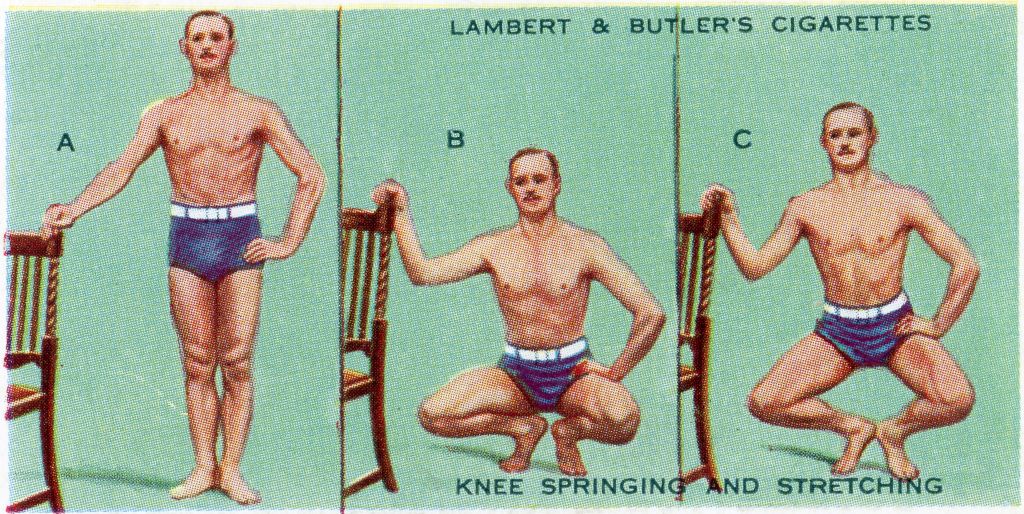
If you were curious about good squat form, check out this cigarette ad:

Collectible tobacco or cigarette card, ‘Get Fit’ series, published in 1937 by Lambert and Butler’s Cigarettes, depicting a male athlete demonstrating step by step instructions on various callisthenic or aerobic exercises and stretching for a healthy fitness routine, here chair assisted squats (Photo by Nextrecord Archives / Getty Images).
Exit mobile version