Would You Wear a Device to Study Your Farts?

Researchers at the University of Maryland have created a wearable fart-tracking device, and yes, it does exactly what it sounds like. The tiny gadget clips onto your underwear and records every time you pass gas. The goal is to help scientists finally answer a surprisingly complicated question: how often do people fart in a normal day?

While the concept might sound like a punchline, researchers say the project is actually serious medical science. Right now, there is no clear baseline for what counts as a “healthy” amount of intestinal gas. Doctors often rely on patients to self-report their symptoms, which can be… unreliable.

One of the physicians involved in the research explained that more than one in five people say they experience excess gas, but there has never been an objective way to measure it.

That is where the new wearable device comes in. By collecting real data, scientists hope to better understand digestive health and what “normal” really looks like.

The device itself is about the size of a nickel and designed to be worn discreetly. Volunteers simply clip it onto their underwear and go about their day while it logs each, well, emission. Participants in the study are asked to wear it for three days so researchers can gather enough data to analyze patterns.

The effort is now expanding across the country through a project called the Human Flatus Atlas, which is collecting data from volunteers nationwide. The idea is to build the most comprehensive dataset ever assembled on human gas production. If that sounds like a weird research project, you are not alone, but the scientists involved are genuinely excited about what they might learn.

Early results have already shown that the range varies widely from person to person. Some participants pass gas as few as four times per day. Others have recorded up to 175 in a single day, which averages out to roughly one every eight minutes.

For anyone worried about where they fall on the spectrum, the researchers say the study is still in its early stages. Right now, they are simply gathering data and trying to understand how much variation exists.

The lead doctor behind the project says that uncertainty is part of what makes the research so exciting. As he put it, exploring the unknown is where some of the most interesting discoveries happen.

Even if those discoveries happen to be about farts.

February Is the Month You’re Least Likely to Get in a Fistfight

If you’ve been walking around getting attacked by strangers constantly, this is welcome news.

Statistically speaking, you’re less likely to get punched in the face in February than any other month of the year – and no, it’s not just because it’s the month with the fewest days.

Why we’re less punchy in February

A study of ER visits in the U.K. found that February is the month you’re least likely to eat a knuckle sandwich, and the main reason is… it’s just too cold to fight.

When it’s warm, more folks are out drinking, partying, and generally being morons. In February, it’s just too dark and cold, and everyone’s at home by 6 p.m. Basically, less mingling = fewer fists flying.

Shorter days make a difference too

We’re less likely to be out and about in February simply because it gets dark earlier in the day. (Assuming you’re in the northern hemisphere, that is.)

Sure, the sun sets earlier in November and December, but that’s the holidays… when you’re battling long lines to get that toy your kid must have. Too much time with extended family just has a way of stirring up that desire to fight anyone, over anything, at any time.

When are you most likely to get in a fistfight?

The study found fight-related injuries tend to peak between May and July. The pattern is clear: warm weather is just much more conducive to knock-down, drag-out fights.

So, watch your back come summer. That idiot you had words with at the bar or in the grocery store checkout lane? They will be waiting for you in the parking lot… as soon as they know they won’t freeze to death out there.

Want to Be Happier? Just Do This One Thing Each Day

If you are looking for an easy, no-cost way to feel a little happier, there’s a study that has a surprisingly simple suggestion: have at least one solid conversation with someone every day.

That’s it. No expensive wellness apps, no major lifestyle overhaul, just an actual human connection. Researchers found that having a meaningful conversation, even just one, can help reduce stress and anxiety while also making us feel more connected to the people around us.

And before you panic thinking this means an hour-long heart-to-heart, relax. The study identified seven different types of conversations that all count, and some of them are things you probably already do without thinking about it.

According to the research, joking around qualifies. So does catching up with someone you have not talked to in a while. Deep, meaningful talks count too, but they are not required. Showing care, valuing someone else’s opinion, offering sincere compliments, and even just listening attentively all fall under the “solid conversation” umbrella.

In other words, you do not need to suddenly become the most emotionally available person in the room. Laughing with a coworker, checking in on a friend, or actually listening instead of half-scrolling on your phone can do the trick.

The study found that people who had at least one of these quality interactions each day reported feeling happier overall. They also felt less stressed and less anxious, which tracks with what a lot of us already know deep down. Humans are social creatures, even the ones who insist they are totally fine never talking to anyone ever again.

Interestingly, the benefits did not stop at just one conversation. People who had multiple quality interactions throughout the day saw an even bigger boost in happiness.

This research lands at a time when a lot of communication happens through texts, emails, and DMs. While those still count as communication, the study highlights how much impact genuine connection can have, especially when it feels intentional and present. A quick joke, a thoughtful compliment, or simply letting someone feel heard can go a long way.

The takeaway here is refreshingly simple. You do not need to schedule a therapy session or write a gratitude journal to feel better today. Just talk to someone. Really talk to them, even for a few minutes.

So the next time you are debating whether to call a friend, chat with a coworker, or actually listen instead of nodding along, remember this. That one small conversation might be doing more for your happiness than you realize.

How Do We *Still* Not Have a Great Hangover Cure?

It seems like everyone has a DIY hangover cure… that DOESN’T work.

Stuff like:  Downing glasses of water… using activated charcoal… drinking pickle juice… and rubbing lemon slices under your armpits.

Researchers in the U.K. have released a comprehensive review of hangover “cures,” and it has concluded that… nothing works.  So yes, we’re already a quarter of the way through the 21st Century, and science has failed to deliver ANYTHING.

The review included clinical trials on dozens of supposed remedies… including curcumin, red ginseng, probiotics, artichoke extract, and pear juice… and nothing helped.  At least not consistently.

The researchers also dismissed a lot of flawed experiments in the past… saying there’s “a limited number of poor quality research studies [examining] hangovers.”

In fact, only three things showed enough promise for continued study:  Clove extract… tolfenamic acid, which is a painkiller available in the U.K…. and Vitamin B.  Specifically that would be a synthetic version of Vitamin B6.

If YOU discovered something that YOU think works during this holiday season, please go on TikTok and… well.. I guess join the choir, and hopefully science finds you and tests your theory.

Parents Answer 46 Kid Questions a Day

If you’re a parent of a young kid, congratulations: You’re basically a full-time customer service rep for the Department of ‘Why?’.

A new report says the average parent fields 46 questions a day from their child. That’s one every 18 minutes if you’re lucky enough to sleep through the night.

Of course, that’s an average. Some parents with teenagers might only get one grunt-like “Can I have money?” ask a day, while parents of toddlers are fielding thousands of urgent inquiries like, “Why are there clouds in the sky?” and “Where do puppies come from?” and “Why can’t you make me macaroni and cheese?”

Most of the time, the questions are manageable, but parents admit they still don’t have answers about 35% of the time.

(“Where do dreams go when you wake up?” is apparently not covered in the handbook.)

Despite the chaos, 91% of parents say it’s important to nurture their child’s curiosity. Though based on the same report, those same parents also yell “Be careful!” about 27 times a day, and “Don’t touch that!” 25 times… so curiosity has its limits.

And it turns out today’s kids might actually be more curious than their parents were. 77% of moms and dads think their little ones ask more questions than they ever did.

Which makes sense… back in the day, we didn’t have YouTube explaining how volcanoes work.

So if you’re feeling exhausted, just remember: all those endless “whys” are proof you’re raising a future genius. Or at least a future person who will absolutely dominate trivia night.

New Jersey Is Doomed in a Zombie Apocalypse, But Alaska Could Be Safe

If a zombie apocalypse ever hits, New Jersey might want to start packing for Alaska…

Because according to a new “scientific” study, Jersey would be the worst place in America to try to survive an undead uprising.

Some so-called “experts” ranked every state’s zombie preparedness using six factors, including population density, hospitals, airports, water access, and how many hunting stores and military bases they’ve got.

The result? A readiness score out of 10 that says a lot about who’s going to make it past Episode One.

New Jersey came in dead last with a score of 1.66. Turns out, cramming 1,308 people into every square mile isn’t ideal when you’re trying to avoid a contagious bite.

The state also barely registers when it comes to survival infrastructure, with fewer than one hospital, one airport, and two hunting stores per 100,000 people. Translation: you’re not escaping, you’re not fighting back, and you’re definitely not getting a hospital bed.

Connecticut was runner-up for “fastest to fall” at 2.15, while Massachusetts and Pennsylvania tied for third-worst (2.57). Rounding out the doomed top five were California and New York, both packed with people but light on resources. (Though, as one report kindly noted, New York does have a “decent amount of water”… so if zombies can’t swim, Staten Island’s got a shot.)

On the opposite end of the apocalypse, Alaska absolutely crushed it.

The Last Frontier scored 7.89 out of 10, thanks to its massive open spaces (only one person per square mile) and more airports than moose (78.5 per 100,000 people). It also leads in freshwater access and military presence, making it the ultimate safe zone if you can handle the cold and occasional bear.

Maine took second place (5.31), mostly because it’s basically one giant Cabela’s, with nearly 70 hunting and fishing stores per 100,000 people. Rounding out the top survivors were South Dakota, Montana, and North Dakota… a.k.a. the “less-populated, more-armed” part of America.

Does your area have what it takes to “hold the line” during a zombie apocalypse? Yeah, mine neither.

Where You’re Most Likely to See Bigfoot (and Where He’ll Never Be Caught Dead)

This week the internet is celebrating National Sasquatch Awareness Day, which raises one big question: do we really need to be more aware of Bigfoot?

If a seven-foot-tall, hairy dude comes lumbering out of the forest, awareness won’t be your problem…

Still, a new report just ranked the places in North America where you’re statistically most likely to bump into Bigfoot. And no, you probably won’t find him chilling outside a Starbucks in Miami.

Researchers looked at reported Bigfoot sightings, how forested each state or province is, and the average temperature. (Apparently, the ideal Bigfoot climate is a pleasant 55 degrees Fahrenheit.)

If you’re hoping to make a found-footage horror movie, here are the top ten places to go Bigfoot-hunting:

  1. Washington
  2. West Virginia
  3. Oregon
  4. British Columbia, Canada
  5. Michigan
  6. Maine
  7. Pennsylvania
  8. Idaho
  9. Ohio
  10. Massachusetts

Prefer to stay Bigfoot-free? These are the least likely places to find him:

  1. Quebec, Canada
  2. Maryland
  3. Arizona
  4. Alberta, Canada
  5. Louisiana
  6. Manitoba, Canada
  7. Indiana
  8. California
  9. Alaska
  10. Wyoming

Really? If I were Bigfoot, I’d totally pick Wyoming or Alaska over, say, Florida. (Too many gators, not enough privacy.)

Color Us Boring: Most Cars Sold Today Are Grayscale

Have you heard about how birds are more likely to target dark-colored cars with their, well, aerial gifts?

That got us curious about what colors of cars people are selecting in different areas, and to be clear, this is not “for the birds.”

A while back, the website iSeeCars.com put out a report on car sales by color (this was in 2023)… and they found that white is more popular than ever.  28% of cars sold nationwide are white, which is up from 16% in the mid-2000s.

Black is the second-most popular, followed by gray and silver.  If you add up the percentages for those colors, 80% of the cars sold are grayscale… like you are watching a black-and-white movie.

The state with the most car-color diversity is West Virginia, where 28% of the cars are colorful.  The state with the least diversity is California, where only 17% of the cars are colorful.

If you exclude grayscale “colors,” every state’s top color is either blue or red.

Outside of that, 2% of the cars sold across the country are green… and all the remaining colors account for less than 1% of car sales each.  But if you’re curious, here’s the order:

Orange is the eighth-most popular car color, followed by beigebrownyellowgold… and purple.

Experts say that white is popular because it’s “one of the easiest colors to maintain, and because it is a common color for fleet and rental vehicles.” 

That leads to white used cars being very common.

But there’s good news for people who are brave enough to buy a bold color:  Less popular colors tend to depreciate less, because they are scarce in the used car marketplace.

Your Brain Peaks at 58, Then Slowly Turns Into Oatmeal

Hallmark loves to tell us we’re “older and wiser” every year. Cute. But according to science, your brain is basically on a rollercoaster: it climbs, it peaks, and then… it nosedives.

A new study in the journal Intelligence found that the human brain hits peak performance between ages 55 and 60. That’s when your life experience, judgment, and wisdom finally outweigh the fact that you just Googled “how to Google.”

Here’s the ride in a nutshell:

  1. Fluid intelligence (reasoning, memory, mental speed) maxes out in your early 20s. So yes, you peaked at Mario Kart in college. It’s been downhill ever since.
  2. Crystallized intelligence (all that random trivia you collect over the years) just keeps building. By your 50s, you’re basically a lesser-Wikipedia… with back pain.
  3. Personality traits like patience and emotional stability improve as you get older.
  4. Moral reasoning sharpens with age, meaning you actually know right from wrong. Too bad it arrives decades after you needed it in your 20s.
  5. Financial literacy keeps improving into your 60s. That’s right around the time you finally pay off your student loans.
  6. Cognitive flexibility and empathy start to fade with age, so if your parents can’t figure out TikTok or don’t care about your vibe check, cut them some slack.

So yes, the sweet spot is late 50s. You’re wise, savvy, and make solid decisions… basically the Yoda years of your brain. But after that, it’s a slow slide into “What’s my password again?” territory.

The researchers say this mental peak matters most for business and politics. Which is science’s polite way of hinting that maybe, just maybe, 80-year-old senators shouldn’t be the ones steering the ship.

The Average American Screws Up Four Major Decisions in Their Life

People say it’s a good idea to live without regrets… but if someone asked you how many wrong decisions you’ve made in your life, how many would you say?

And this is “major” wrong decisions… so not like “eating Taco Bell last night.” More like “my first marriage and my third child.”

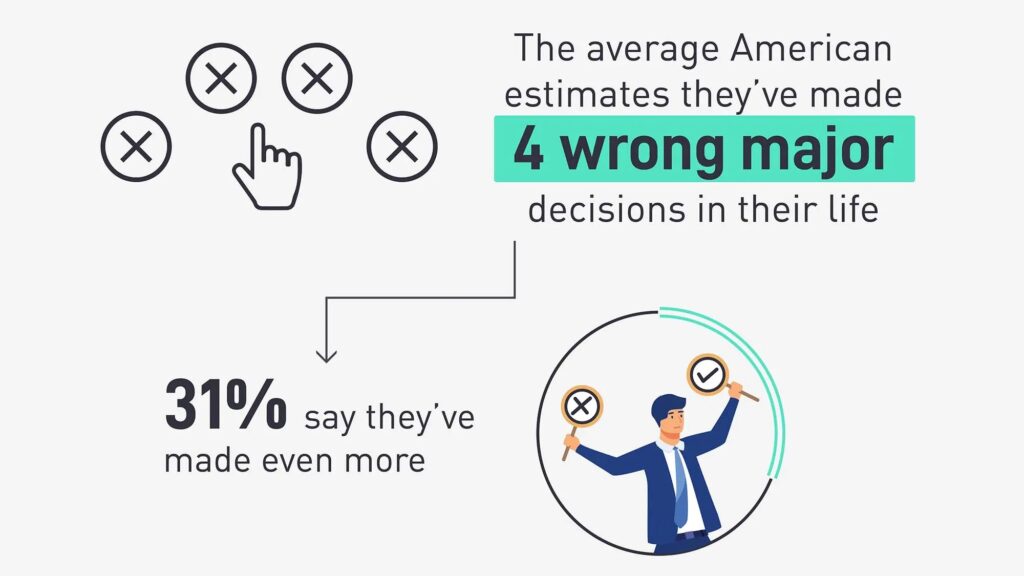
According to new research, the average American estimates they have made four wrong major decisions in their life.  31% say they’ve made more.

71% say they wish they had more guidance when it comes to making large life decisions.  But honestly, mistakes are a normal part of life.

54% say they turn to their friends and family for advice when making major decisions. 

But 40% do their own research, usually online.  28% will seek out “industry professionals”… 26% will read informational books… and 25% will look for “informational videos and TV shows.”

Poll conducted by SWNS / OnePoll on behalf of AtomFinance with a panel of 2,000 Americans
Exit mobile version