Kids Now Make $52 a Month in Allowance

The newest Americans to get a cost-of-living raise are not government workers or teachers or anyone who actually needs one. Nope. It is children. Small children. Children who sometimes complete chores… and sometimes just confidently lie about completing chores.

A new report says the average kid now pockets $52 a month in allowance, which is about $13 a week.

Of course each kid’s take varies depending on age, work, and whether the family budget is held together by coupons and prayer. But before Grandpa fires up the rant machine about “kids these days,” a quick reality check: inflation is real. Paying a 12-year-old $13 a week today is basically the same as paying a kid in the 1990s about $5.50 a week. And for grandparents who grew up in the 1960s, it would have been about $1.25 a week.

The one place older generations are absolutely justified in shaking a fist? The workload. Kids in previous generations were probably doing more adult work, not to mention farm chores before school. Meanwhile today’s kids are earning thirteen bucks a week for cleaning their room and maybe putting the plates in the dishwasher. Truly the golden age of labor.

Still, parents say the allowance is teaching valuable skills. 78% think their kids can handle money responsibly.

61% even admit their kids are more financially responsible than they were, which is fair, because many of today’s parents learned about money by accidentally racking up overdraft fees in college.

Cash is still the most common allowance method at 56%, but parents are going digital fast. 17% pay their kids through apps like Venmo, which means somewhere an 11-year-old just typed “ty” with a sparkle emoji after receiving five dollars. 14% use special debit cards for kids.

A small slice of parents skip money entirely and pay their kids with experiences (6%) or precious screen time (another 6%), which honestly may have more value than Bitcoin in a young kid’s world.

Bottom line: Kids are earning more, working less, and somehow negotiating better benefits than most grown adults. Grandpa may not love it, but every 11-year-old with chore-induced wealth certainly does.

In-N-Out Bans Order Number 67 After Teens Keep Freaking Out

In-N-Out Burger has retired the number 67 from its order system, and no, it’s not for operational efficiency. It’s because teenagers won’t stop losing their minds over it.

The California-based chain has apparently had enough of the viral chaos surrounding “Order 67.” For months, groups of teens have been hanging out at In-N-Out locations waiting to hear “Order 67” called out, just so they can collectively scream, cheer, and post it on TikTok. Now, the number has officially been banned from stores across the U.S., according to People magazine.

The origins of the “67” phenomenon are a little hazy, but it started picking up steam nearly a year ago and somehow just never died. Dictionary.com even named “67” its Word of the Year for 2025, which probably didn’t help.

Clips of the mayhem are everywhere, with teens treating the announcement of “Order 67” like it’s the start of a concert. One recent video shows a Los Angeles employee explaining that the number is gone for good because it was causing too much of a scene.

To keep the peace, the number sequence now jumps straight from 66 to 68. And fun fact: it’s not the first time In-N-Out has done this. Some employees say the chain was already skipping “Order 69” at certain locations, likely to avoid that kind of commotion too.

While this kind of viral energy is great for clicks, it’s a nightmare for restaurants just trying to get double-doubles and animal fries out the door without a flash mob erupting in the dining room. So it looks like In-N-Out is choosing order over chaos—literally.

Now if you’re waiting for your food and hear “Order 68,” just know there’s a silent generation of teens out there mourning the one number that brought them pure, unhinged joy.

Parents Answer 46 Kid Questions a Day

If you’re a parent of a young kid, congratulations: You’re basically a full-time customer service rep for the Department of ‘Why?’.

A new report says the average parent fields 46 questions a day from their child. That’s one every 18 minutes if you’re lucky enough to sleep through the night.

Of course, that’s an average. Some parents with teenagers might only get one grunt-like “Can I have money?” ask a day, while parents of toddlers are fielding thousands of urgent inquiries like, “Why are there clouds in the sky?” and “Where do puppies come from?” and “Why can’t you make me macaroni and cheese?”

Most of the time, the questions are manageable, but parents admit they still don’t have answers about 35% of the time.

(“Where do dreams go when you wake up?” is apparently not covered in the handbook.)

Despite the chaos, 91% of parents say it’s important to nurture their child’s curiosity. Though based on the same report, those same parents also yell “Be careful!” about 27 times a day, and “Don’t touch that!” 25 times… so curiosity has its limits.

And it turns out today’s kids might actually be more curious than their parents were. 77% of moms and dads think their little ones ask more questions than they ever did.

Which makes sense… back in the day, we didn’t have YouTube explaining how volcanoes work.

So if you’re feeling exhausted, just remember: all those endless “whys” are proof you’re raising a future genius. Or at least a future person who will absolutely dominate trivia night.

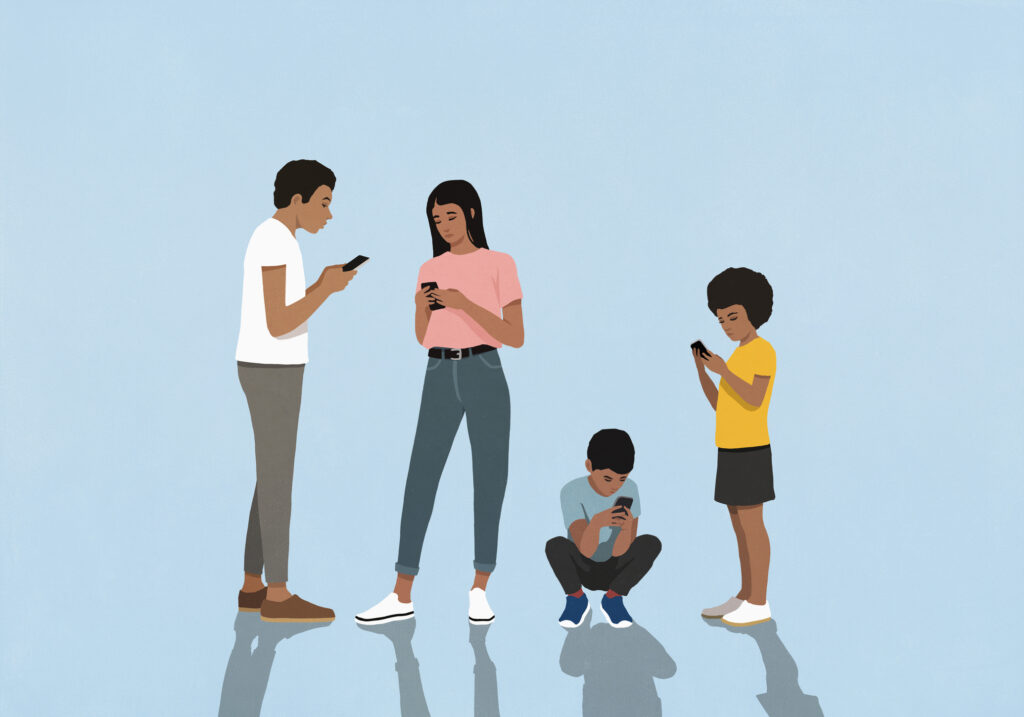
Phones Are Ruining Family Conversations… and It’s Not Just the Kids

Trying to have a heart-to-heart with your kid these days is damn-near impossible, since you’re competing with TikTok, Snapchat, and whatever’s trending on YouTube.

A new survey found that kids under 18 are holding a phone 52% of the time their parents are trying to talk to them. That’s right… half your valuable wisdom is probably getting drowned out by memes and cat videos.

And before you roll your eyes at “these kids today,” let’s be real: parents aren’t much better. The same survey says partners are glued to their phones 58% of the time during conversations. So basically, everyone’s ignoring everyone.

But at least we’re ignoring each other together.

Only 74% of parents could say they’d had a real, device-free conversation with their kid in the past week. Which means a quarter of families haven’t gone even seven days without someone scrolling mid-sentence. No wonder 78% of parents are worried about losing face-to-face time with their kids.

Some households are trying to fight back with “no phone zones” during dinner, family outings, or movie night. You know, those rare times when you actually want to see each other’s faces instead of the glow of a screen. But enforcing those rules is easier said than done.

So yes, the internet is winning. But the silver lining? At least when your teen pretends to listen while glued to their phone, they can say they “learned it from watching you!” (Gen X’ers will get that reference, if they’re even listening to me.)

“Clocked It”: Why Your Teen Keeps Saying It (And What It Means)

The slang term has been gaining traction online and in schools. Now Google says searches for it are at an all-time high.

So, what does it mean? Technically, “to clock” something means to notice it. Simple enough, right? But Gen Z has taken that idea and run with it, applying it to everything from compliments to gossip to petty shade.

A TikTok mom recently went viral for explaining the many ways she’s heard her kids use it. For example, if your outfit looks particularly fresh, they might nod and say, “That outfit slays. Clocked it.” Or if someone spills the latest drama, it’s “Clocked that tea.” It’s basically a casual, sometimes smug way of saying, “I see it, I get it, I’m taking note.”

Hey, kids. It’s not really a new term.

While it may feel like brand-new slang to teens and tweens, using the word “clock” like this isn’t really new at all. According to Merriam-Webster, people have been “clocking” stuff since at least 1929. (It also has roots in trans culture. As in, “I think they clocked me [as trans].”)

Why is it suddenly so popular?

“Sudden” might be a strong word. It’s been going around the internet for the good part of a year, if not longer. The reason more people (parents and kids) are googling it likely has more to do with the new school year than anything else. Teens are using it in class, more parents are hearing it in car rides, and more people are googling it in confusion.

So if your kid tells you they “clocked” something, don’t worry. They’re not tracking time, and they definitely don’t mean they punched someone in the face. They’re just letting you know they noticed. Whether it’s your outfit, your mood, or that eye roll you thought they didn’t see… they clocked it.

@mamateaches711

Replying to @Sonya Russell we did the homework and have found out (sort of) the meaning of “clocked it.” Guess we should get rid of the 👏🏼 emoji. The new kids say we don’t do that anymore 😂. CLOCKED IT. #teacher #teachermama #elementaryschool #middleschool #highschool #teachertok #parent

♬ original sound – Jessica | Teacher•Mama
Exit mobile version