March Madness Rules: What NCAA Players Can and Can’t Do During the Tournament

March Madness rules, NCAA basketball restrictions, and tournament guidelines are about more than just what happens on the court. While fans focus on buzzer-beaters and busted brackets, players have to follow a surprisingly detailed rulebook that covers everything from fingernails to fashion choices.

Yes, really.

Every year, NCAA athletes competing in the tournament are expected to stick to strict guidelines that keep the games fair, safe, and, apparently, free of long nails and dangling jewelry.

Some of the rules make total sense. Others might leave you doing a double take.

For starters, players are allowed to fill out their own March Madness brackets, just like the rest of us. The catch, no money can be involved. Betting on games is strictly off-limits, and breaking that rule could come with serious consequences. So if you thought your office pool was stressful, imagine risking your eligibility over it.

When it comes to appearance, the NCAA keeps things pretty locked down. Jewelry is a no-go during games, and headwear is limited to specific types of headbands. Even small accessories like barrettes and bobby pins are not allowed, likely to prevent injuries during play.

Uniform rules also differ slightly between men’s and women’s teams. Men are required to tuck in their jerseys, while women typically are not, mostly because their jerseys are designed shorter.

Then there is the fingernail rule, which might be one of the more unexpected ones. Players have to keep their nails trimmed and not “excessively long.” They can still paint them, so there is some room for personal style, but length is where officials draw the line.

Some rules are more about gameplay and sportsmanship. Players are not allowed to lift or carry teammates, which sounds obvious until you picture a celebratory moment getting a little out of hand. There is also a strong emphasis on respectful behavior. Poor sportsmanship can lead to penalties, so keeping emotions in check is part of the job.

And finally, tobacco use is completely prohibited. No exceptions.

At the end of the day, these rules might seem quirky, but they are all part of maintaining fairness and safety during one of the biggest sporting events of the year. So while fans argue over brackets and Cinderella stories, players are busy making sure their jerseys are tucked, their nails are trimmed, and their focus stays on the game.

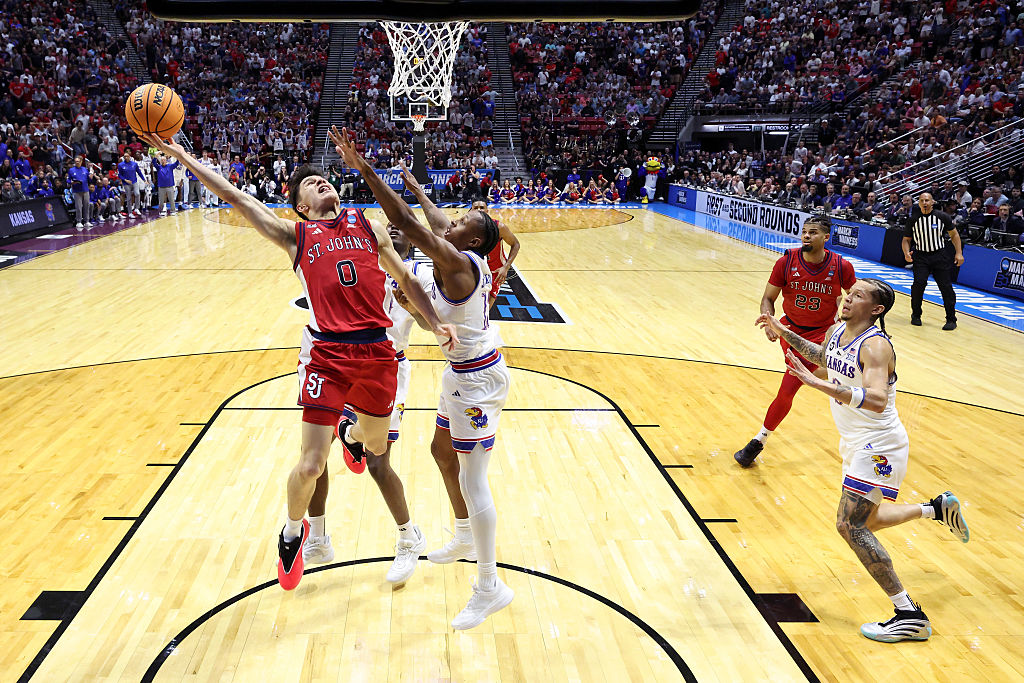
SAN DIEGO, CALIFORNIA – MARCH 22: Dylan Darling #0 of the St. John’s Red Storm shoots the ball against Elmarko Jackson #13 and Flory Bidunga #40 of the Kansas Jayhawks during the second half in the second round of the 2026 NCAA Men’s Basketball Tournament at Viejas Arena at San Diego State University on March 22, 2026 in San Diego, California. (Photo by Sean M. Haffey/Getty Images)

The 10 Longest Oscar Speeches in Academy Awards History

When it comes to the Academy Awards, acceptance speeches are supposed to be quick, heartfelt, and ideally under 45 seconds. But every once in a while, someone grabs that Oscar, steps up to the mic, and completely ignores the clock.

With the Oscars airing in March, it’s the perfect time to look back at the longest Oscar speeches in history. You know, the ones that had orchestra conductors sweating and viewers checking the time.

Topping the list is Adrien Brody, who now officially holds the record for the longest Oscar speech ever. At last year’s Academy Awards, Brody spoke for a whopping 5 minutes and 40 seconds. That easily puts him at number one, and comfortably ahead of some legendary Hollywood moments.

Right behind him is Greer Garson, whose 1943 Best Actress speech clocked in at 5 minutes and 30 seconds. Considering this was decades before producers aggressively cut to music or reaction shots, Garson had plenty of room to really settle in and enjoy the moment.

Coming in third is Will Smith at the 2022 Oscars with a 5 minute and 20 second speech. Yes, this was the same night as THE SLAP, which somehow made his lengthy, emotional speech even more surreal. Between apologies, explanations, and raw emotion, it was a moment no one is forgetting anytime soon.

Here’s the full list of the longest Oscar speeches in Academy Awards history:

  1. Adrien Brody (2025): 5 minutes, 40 seconds
  2. Greer Garson (1943): 5 minutes, 30 seconds
  3. Will Smith (2022): 5 minutes, 20 seconds
  4. Halle Berry (2002): 4 minutes
  5. Julia Roberts (2001): 4 minutes
  6. Al Pacino (1993): 3 minutes, 50 seconds
  7. Joaquin Phoenix (2020): 3 minutes, 30 seconds
  8. Cate Blanchett (2014): 3 minutes, 15 seconds
  9. Matthew McConaughey (2014): 3 minutes, 10 seconds
  10. Tom Hanks (1994): 3 minutes

Some of these speeches are remembered fondly for their emotion, others for their awkwardness, and a few for how long they seemed to go on forever. But all of them are now officially part of Oscar history.

The big question is whether anyone will crack this list during the 98th Academy Awards. The show airs Sunday, March 15th at 7:00 p.m. Eastern on ABC, Hulu, and Disney+, with Conan O’Brien returning as host. If the music starts playing and someone just keeps talking, history might be about to repeat itself.

The Funniest Movie Insults of All Time

If you have ever won an argument by quoting a movie, congratulations, you are among your people. Movie insults are timeless, endlessly reusable, and often way funnier than anything we could come up with on our own.

That is why the internet just delivered a gift we did not know we needed, a list of the 49 funniest movie insults of all time, pulled straight from some of the most quotable films ever made.

These are the kind of lines that live rent-free in our brains. They are sharp, ridiculous, and often devastating in the politest, or least polite, way possible. Even better, many of them are still totally usable today, at least in theory and at least off the air.

The list spans decades and genres, proving that great insults are truly universal. Here are some of the best:

  1. “Does Barry Manilow know that you raid his wardrobe?”“The Breakfast Club” (1985)
  2. “If staying here means working within 10 yards of you, frankly, I’d rather have a job wiping Saddam Hussein’s arse.”“Bridget Jones’s Diary” (2001)
  3. “From what I hear, you couldn’t hit water if you fell out of an effing boat.”“Bull Durham” (1988)
  4. “You’re somewhere between a cockroach and that white stuff that accumulates at the corner of your mouth when you’re really thirsty.”“Con Air” (1997)
  5. “That’s all you got, lady, two wrong feet and effing ugly shoes.”“Erin Brockovich” (2000)
  6. “You look like a badger.”“The Favourite” (2018)
  7. “To call you stupid would be an insult to stupid people.”“A Fish Called Wanda” (1988)
  8. “You are literally too stupid to insult.”“The Hangover” (2009)
  9. “You’re what the French call, ‘les incompetents.’”“Home Alone” (1990)
  10. “Your face looks like Robin Williams’ knuckles.”“Knocked Up” (2007)
  11. “Your mummy is a twit!”“Matilda” (1996)
  12. “The day I need a friend like you, I’ll just have myself a little squat and poop one out.”“The Mist” (2007)
  13. “Your mother was a hamster and your father smelt of elderberries.”“Monty Python and the Holy Grail” (1975)
  14. “I wouldn’t live with you if the world were flooded with pee and you lived in a tree.”“Parenthood” (1989)
  15. “I’ll explain and I’ll use small words so that you’ll be sure to understand, you warthog-faced buffoon.”“The Princess Bride” (1987)
  16. “If you guys know so much about women, how come you’re here on a Saturday night completely alone drinking beers with no women anywhere?” “Say Anything” (1989)
  17. “You’re tacky and I hate you.”“School of Rock” (2004)
  18. “To everyone here who matters, you’re spam. You’re vapour. A waste of perfectly good yearbook space.”“She’s All That” (1999)
  19. “You dense, irritating, miniature beast of burden.”“Shrek” (2000)
  20. “You dirt-eating piece of slime. You scum-sucking pig. You son of a motherless goat.”“Three Amigos” (1986)
  21. “You are a sad, strange little man, and you have my pity.”“Toy Story” (1995)

Some of these lines are clever. Some are mean. Some are so over the top they circle back to being brilliant. All of them remind us why movies are still one of the best places to steal a perfectly crafted put-down. Just maybe save them for the right moment, or at least for someone who appreciates a good quote.

The Most Annoying Disney Sidekicks of All Time

Every Disney movie needs a sidekick. It’s basically the law.

The sidekick is supposed to lighten the mood, crack jokes, and keep kids entertained while the parents quietly question their life choices. Most of the time, it works. Other times, the sidekick talks too much, screams too loud, or completely derails the emotional tone of the movie.

Over the years, Disney has given us some absolute legends. They have also given us characters that made audiences mutter, please stop talking, under their breath.

With some modern additions stirred in, here’s a look at the most annoying Disney sidekicks ever:

  1. Gurgi from “The Black Cauldron” (1985) still sits comfortably at the top. The voice, the whining, the third-person speaking, it was a lot. Even by ’80s standards, Gurgi tested patience.
  2. The gargoyles from “The Hunchback of Notre Dame” (1996) are next. Voiced by Charles Kimbrough, Jason Alexander, and Mary Wickes, they felt wildly out of place in a movie about isolation, faith, and tragedy. The tonal whiplash was real.
  3. Koda from “Brother Bear” (2003) means well, but his nonstop chatter wore thin fast, especially in a movie already heavy on emotional themes.
  4. B.E.N. from “Treasure Planet” (2002), voiced by Martin Short, is chaos in robot form. Loud, frantic, and relentless, he is either hilarious or unbearable depending on your tolerance level.
  5. Zini from “Dinosaur” (2000) brought constant sarcasm to a movie about extinction. That choice still confuses people.
  6. Phil from “Hercules” (1997), voiced by Danny DeVito, is beloved by many, but his gruff humor and endless yelling pushed him into annoying territory for others.
  7. Terk from “Tarzan” (1999), voiced by Rosie O’Donnell, leaned hard into late-90s comedy that hasn’t aged especially well.
  8. Mushu from “Mulan” (1998), voiced by Eddie Murphy, is iconic but polarizing. Loud, fast-talking, and always on, he either made the movie for you or drove you nuts.
  9. Hei Hei from “Moana” (2016) earns a special mention. He barely speaks, yet somehow manages to be exhausting. His entire joke is that he should not be alive, and Disney commits to that bit hard.
  10. Olaf in “Frozen 2” (2019) pushed his quirky charm to its limits with extended monologues and existential rambling.
  11. Sisu from “Raya and the Last Dragon” (2021), voiced by Awkwafina, divided audiences with modern humor that clashed with the movie’s epic tone.
  12. Valentino from “Wish” (2023), voiced by Alan Tudyk, brought fast-talking animal sidekick energy that felt very familiar, and for some viewers, very tiring.

Love them or hate them, these sidekicks did their job. They were memorable. Just not always for the reasons Disney probably intended.

Comedy Movies That Are Actually Horror

We love comedies because they are comforting, funny, and familiar. But every once in a while, someone explains the actual plot out loud and you realize, wait a second, this is terrifying.

Strip away the jokes, the soundtrack, and the charming actors, and some of our favorite comedy movies start sounding a lot more like psychological thrillers or straight-up horror films.

A recent list rounded up comedies whose basic premises feel unsettling once you stop laughing, and it is hard to unsee it after that:

  1. “Bruce Almighty”: A woman dates a man who suddenly has godlike powers, alters reality on a whim, messes with her body without permission, and triggers natural disasters to deal with his own insecurities.
  2. “Willy Wonka and the Chocolate Factory”: A reclusive factory owner lures children inside, employs unsettling workers, and watches as kids disappear in disturbing accidents until only one survives.
  3. “You’ve Got Mail”: A man secretly catfishes a woman online while actively sabotaging her business in real life, then reveals the truth after she has emotionally bonded with him.
  4. “Mrs. Doubtfire”: A divorced father creates an elaborate disguise to infiltrate his ex-wife’s home, violating boundaries and identities while hiding in plain sight. The prosthetics alone are nightmare fuel.
  5. “Never Been Kissed”: A reporter goes undercover as a high school student, and a teacher develops romantic feelings for her before knowing her true age. The timing makes it deeply uncomfortable.
  6. “Scott Pilgrim vs. the World”: Dating someone requires physically fighting and defeating all of their exes one by one, with real violence and life-or-death stakes treated as casual obstacles.
  7. “The Hangover”: A group of friends wake up with no memory, a missing person, signs of violence, and a trail of criminal behavior they slowly uncover piece by piece.
  8. “Freaky Friday” and “The Hot Chick”: Characters wake up trapped in someone else’s body, losing their identity, autonomy, and control over their own lives overnight.
  9. “Airplane!”: An entire flight crew and most passengers become violently ill from food poisoning mid-flight, leaving an incapacitated plane hurtling through the air.
  10. “Sleepless in Seattle”: A woman becomes obsessed with a stranger she has never met, tracks him across the country, and inserts herself into his life without his knowledge.

Still funny? Absolutely. Slightly horrifying once you spell it out? Also yes.

Science Explains Why You Think New Music Is Terrible

If you’ve ever heard a new hit song and immediately thought, “This is… fine, I guess,” science says you’re not broken. You’re just aging exactly as expected.

A study digging into Spotify listening data found that our music tastes get locked in way earlier than most of us realize. Basically, the songs and styles you loved in middle school and high school end up shaping your preferences for the rest of your life. That explains why your playlists still lean heavily on throwbacks and why today’s chart-toppers might sound confusing, or downright annoying.

According to research, women tend to cement their musical tastes between the ages of 11 and 14. For men, that window stretches a bit later, usually between 13 and 16.

During those years, the music you hear hits differently because your brain is still forming strong emotional connections. Songs get tied to friendships, first crushes, road trips, bad haircuts, and all the other formative moments of growing up.

There is a small second chance for musical growth in your early 20s, but it’s not nearly as powerful.

Researchers found that this later period is only about half as influential as those teenage years. After that, your music taste is pretty much set in stone. You might still discover a song or two you like, but wholesale genre changes are rare.

That’s why new music often feels harder to connect with as you get older. It’s not that artists suddenly got worse, it’s that your brain already decided what “good music” sounds like a long time ago.

So if you’re baffled by why everyone seems obsessed with a new pop star, take comfort in this. Your brain is just loyal to the soundtrack of your youth. And honestly, there are worse things than believing music peaked when you were 15.

Go ahead and keep blasting your old favorites. Science says you earned it.

Are These the Best Rock Love Songs?

Valentine’s Day is the perfect excuse to argue about music rankings, and Billboard gave rock fans plenty to debate.

The magazine’s editorial staff released its list of the 50 Best Rock Love Songs of All Time, pulling from six decades of music and covering everything from classic rock staples to modern favorites.

If you are building the ultimate love song playlist, or just looking for an excuse to revisit some legendary tracks, this list has you covered.

Taking the top spot is David Bowie’s “Heroes” from 1977. Billboard’s staff crowned it the best rock love song ever, praising its emotional weight and larger than life feel. It is a love song that feels hopeful, defiant, and cinematic all at once, which is probably why it still hits just as hard today.

Right behind it at #2 is “Maps” by the Yeah Yeah Yeahs from 2003. It is raw, vulnerable, and painfully honest, showing that love songs do not need to be polished to be powerful. Coming in at #3 is The Beatles’ “Something”, released in 1969, a track often described as one of the most sincere and beautiful love songs ever written.

Here are the Top 25:

  1. “Heroes”, David Bowie (1977)
  2. “Maps”, Yeah Yeah Yeahs (2003)
  3. “Something”, The Beatles (1969)
  4. “Just Like Heaven”, The Cure (1987)
  5. “In Your Eyes”, Peter Gabriel (1986)
  6. “Your Song”, Elton John (1970)
  7. “Still Into You”, Paramore (2013)
  8. “Because the Night”, Patti Smith (1978)
  9. “Sweet Child O’ Mine”, Guns N’ Roses (1987)
  10. “Can’t Help Falling in Love”, Elvis Presley (1961)
  11. “This Must Be the Place (Naive Melody)”, Talking Heads (1983)
  12. “I’ll Stand By You”, The Pretenders (1994)
  13. “Maybe I’m Amazed”, Paul McCartney (1970)
  14. “Happy Together”, The Turtles (1967)
  15. “Come to My Window”, Melissa Etheridge (1993)
  16. “All the Small Things”, Blink-182 (1999)
  17. “Harvest Moon”, Neil Young (1992)
  18. “Never Tear Us Apart”, INXS (1987)
  19. “I Want to Know What Love Is”, Foreigner (1984)
  20. “There Is a Light That Never Goes Out”, The Smiths (1986)
  21. “May This Be Love”, Jimi Hendrix (1967)
  22. “Eres”, Café Tacvba (2003)
  23. “Just the Way You Are”, Billy Joel (1977)
  24. “Lovesong”, The Cure (1989)
  25. “You Make Loving Fun”, Fleetwood Mac (1977)

The list jumps across eras and subgenres, from classic rock and new wave to pop punk and alternative. It is a reminder that rock love songs are not just slow dances and power ballads. They can be joyful, heartbreaking, awkward, or explosive, sometimes all in the same track.

If you are building a Valentine’s Day playlist or just looking for an excuse to revisit some all time greats, Billboard’s ranking makes a strong case that rock music has never been short on love.

15 Horror Movies to Watch This Valentine’s Day If Rom-Coms Aren’t Your Thing

If Valentine’s Day usually means dodging rom-coms and pretending you’re “busy,” this list is for you. Here are 15 horror movies that still count as love stories, just with more blood, trauma, and extremely questionable relationship choices.

  1. “Bones and All” (2022)
    A tender road-trip romance where the couple connects emotionally, spiritually, and occasionally through cannibalism.
  2. “Bram Stoker’s Dracula” (1992)
    The most dramatic vampire love story ever made, featuring tragic passion, flowing hair, and a man who desperately needs a blood alternative.
  3. “Bride of Chucky” (1998)
    Two killer dolls on a road trip somehow manage better communication than most movie couples.
  4. “Crimson Peak” (2015)
    A gorgeous gothic romance set in a haunted house that is very clearly trying to warn everyone to leave.
  5. “The Fly” (1986)
    Love, science, and the slow realization that your boyfriend is becoming a full-on nightmare bug.
  6. “Lisa Frankenstein” (2024)
    A teen girl reanimates a corpse and decides he’s boyfriend material, which honestly feels on-brand for high school.
  7. “Mandy” (2018)
    A breakup movie turned revenge nightmare, starring grief, chainsaws, and Nicolas Cage losing his mind in spectacular fashion.
  8. “Misery” (1990)
    What happens when your biggest fan loves you so much she absolutely refuses to let you go home.
  9. “My Bloody Valentine” (1981), plus the 2009 remake
    A Valentine’s Day slasher that proves chocolate and murder have always gone hand in hand.
  10. “Possession” (1981)
    A marriage falling apart so violently it somehow involves subway breakdowns and something truly unholy.
  11. “Spring” (2014)
    A vacation romance gets complicated when one person turns out to have an extremely intense personal secret.
  12. “The Strangers” (2008)
    A couple enjoys a quiet night in until random people decide to emotionally destroy them for no clear reason.
  13. “Valentine” (2001)
    A group of friends learns that being awful in high school can come back later with a knife.
  14. “Nosferatu” (2024)
    A moody, gothic nightmare about obsession and dread, and why some crushes should absolutely stay unreturned.
  15. “Heart Eyes” (2025)
    A Valentine’s-themed slasher where couples are literally the target, making staying single feel like a survival strategy.

Red Hot Chili Peppers Producer Says Anthony Kiedis Was Tone Deaf

Is it possible for a Rock and Roll Hall of Fame band to have a tone deaf singer? According to a former Red Hot Chili Peppers producer, the answer is a very casual, very confident YES.

A music producer named Michael Beinhorn, who worked on the Red Hot Chili Peppers’ third and fourth albums (1987’s “The Uplift Mofo Party Plan” and 1989’s “Mother’s Milk”) just dropped a surprising bit of trivia about frontman Anthony Kiedis, and it came straight from a Reddit “Ask Me Anything” session.

When a fan asked why guitarist John Frusciante handled lead vocals, or at least dominated the mix, on the song “Knock Me Down”, the producer did not sugarcoat his response.

According to him, the reason was simple. The song was melodic, and Anthony Kiedis was, and still is, tone deaf. His exact explanation was that Kiedis “can’t hear pitch,” which made Frusciante the better choice to carry the melody vocally.

If that sounds shocking at first, it somehow makes more sense the longer you sit with it. The Red Hot Chili Peppers have never been known as a band built around pristine vocals or technical perfection. Their sound has always leaned more on raw energy, rhythm, personality, and attitude. Kiedis’ talk-singing, rhythmic delivery, and chaotic charisma have been part of the band’s DNA from the very beginning.

The producer also pointed out that Frusciante essentially wrote “Knock Me Down,” including the melody, which made it feel less awkward for him to sing it. In other words, this was not a case of pushing Kiedis aside. It was more about playing to everyone’s strengths, even if one of those strengths was knowing when not to sing.

Over the years, fans have debated Kiedis’ vocal abilities endlessly. Some love his unconventional style, others joke that the band succeeds in spite of it. This revelation feels less like an insult and more like confirmation of something longtime listeners already suspected. The Chili Peppers were never about hitting perfect notes. They were about vibes, funk, chaos, and somehow making it all work.

And clearly, it did work. The band has had massive success, countless hit songs, and a permanent place in rock history. Tone deaf or not, Anthony Kiedis remains one of the most recognizable frontmen of his era.

Netflix Is Making Movies for Distracted Viewers

If you have ever hit play on a Netflix movie and immediately picked up your phone, congratulations, you are officially part of the problem.

According to Matt Damon, Netflix knows a huge chunk of its audience is half-watching movies while scrolling social media, and the company is now shaping films around that reality.

Damon recently talked about how Netflix movies are being adjusted to keep distracted viewers locked in. One big change, he says, is pushing filmmakers to open with a major action scene almost immediately. The idea is simple, grab people’s attention in the first five minutes before they drift off to Instagram or TikTok.

But that is not all. Damon says Netflix has also suggested repeating key plot points several times throughout the movie. Not once. Not twice. Three or four times. Why? Because executives assume viewers might miss important details while checking texts or doomscrolling.

Damon quoted Netflix as saying it would not be terrible if characters reiterated the plot multiple times in the dialogue since people are often on their phones. That suggestion did not exactly thrill him. He said this approach is starting to infringe on how stories are told, and that it can affect the creative process in a big way.

This is not exactly shocking news, but hearing it spelled out so bluntly feels a little wild.

Movies used to assume you were actually watching them. Now they are apparently being designed for an audience that might look up every few minutes and ask, “Wait, who is that again?”

Damon knows this world well right now. He and longtime collaborator Ben Affleck just made a new movie for Netflix called “The Rip”, which is currently streaming. While he did not say Netflix forced those changes into that specific film, his comments make it clear that this kind of feedback is becoming more common.

The bigger takeaway here is how streaming has reshaped storytelling. Movies made for theaters assume a dark room, a big screen, and zero distractions. Movies made for streaming assume your couch, your phone, maybe a snack run, and possibly a group chat blowing up at the same time.

For viewers, this might explain why some Netflix movies feel like they spell everything out. For filmmakers, it sounds like a frustrating compromise between art and reality.

So next time a character explains the plan for the fourth time, just know it might not be lazy writing. It might be Netflix politely assuming you were busy liking memes instead of watching the movie.

Exit mobile version