Starbucks’ Most Expensive Order Costs $45 and Will Probably Kill You

For most of us, “splurging” at Starbucks might mean opting for oat milk or adding a shot of espresso. But one TikTok user recently redefined indulgence—and perhaps common sense—by constructing what might be the most expensive single Starbucks drink ever, ringing up at an astonishing $45.

The viral stunt didn’t involve secret ingredients or off-menu magic. Instead, it was all done through the Starbucks app, where the user maxed out every customization option available. The drink? A Frankenstein-esque version of a Venti Matcha Crème Frappuccino, with caffeine levels that would make a cardiologist flinch.

Here’s what went into the $45 creation:

Base: Venti Matcha Crème Frappuccino – $6.25

Espresso shots: 12 standard + 12 affogato-style – $30

Sauces & toppings: Mocha, dark caramel, caramel drizzle, caramel crunch, chai, Frappuccino chips – $3.70

Powders: Four scoops each of vanilla bean and chocolate malt – $1.00

Whipped cream: Free (mercifully)

Grand total: $41.55 before tax—easily crossing the $45 mark depending on your location.

To be clear, this drink was never actually consumed. According to the creator, the experiment was meant to test how high the app’s customization feature could push a drink’s cost. Still, it’s a jarring reminder that with great customizability comes great responsibility—or at least a sense of financial and physiological caution.

Let’s break this down: 24 shots of espresso in a single beverage isn’t so much a drink as it is a full-blown dare. The FDA recommends no more than 400 milligrams of caffeine per day. This drink clocks in at roughly 1,500 mg—nearly four times the daily limit for an adult.

While it might sound absurd, there’s little doubt someone will eventually take the challenge, if they haven’t already.

The “Human Dog Food” Diet Is Going Viral—But Should You Try It?

Another day, another TikTok trend—this time, it’s the “human dog food” diet, and yes, it’s exactly as unappetizing as it sounds. But before you assume someone’s raiding their pup’s bowl, rest assured: no actual pet food is involved.

The trend kicked off when a TikTok user went viral for showcasing his minimalist meal prep: a hearty mix of chicken, tofu, chopped veggies, and rice, all cooked into a soft, beige mash that he eats for every meal. The look? More “canine cuisine” than culinary masterpiece. The nickname “human kibble” stuck, not because of what’s in it—but because of its repetitive, utilitarian nature.

Despite its dog dish aesthetic, some viewers are eating it up. Fans praise the simplicity and efficiency of the diet, claiming it streamlines their routine, cuts down decision fatigue, and helps them stay on track with healthy eating.

One meal, one prep session, minimal thought required. But health experts are less enthused.

Nutritionists warn that the diet’s biggest flaw may be the very thing that makes it appealing: its monotony. Eating the same thing every day can quickly sap enjoyment from meals, making it harder to stick to in the long run. Even worse, a lack of variety can create nutritional blind spots. Over time, even a “balanced” mix of protein, grains, and vegetables might fall short on certain vitamins and minerals your body needs.

“There’s value in routine,” says one dietitian, “but your body thrives on variety.”

That doesn’t mean the concept is entirely off-base. Batch-cooking nutritious meals is a smart strategy for anyone trying to eat healthier with less effort. The key, experts say, is to use the “kibble” model as a baseline—maybe for lunch—and then inject more diversity at breakfast and dinner to keep both your body and brain engaged.

As for whether humans should eat like dogs? That depends on the goal. Simplicity and consistency can be powerful tools, but unlike dogs, we’re wired to crave variety and flavor. So if your weekday lunch resembles something from a pet aisle, fine. But your body—and your taste buds—will thank you for mixing it up occasionally.

Pro Tip: Apply Sunblock Before You Start Drinking

Is homeownership right for you? We break down the pros and cons, along with tips for first-time buyers.

As warmer weather rolls in, so does sunburn season — and if you’re heading outdoors with a drink in hand, here’s a tip you’ll want to remember: apply your sunscreen before you start drinking.

A new study out of Florida Atlantic University sheds light on why alcohol and sunburn often go hand in hand. 

Researchers surveyed people who had recently gotten sunburned, and the results were eye-opening:

About one in five — 22% — admitted that alcohol played a role.

The reasons are as obvious as they are relatable. Once you’ve had a few drinks, you’re less likely to remember sunscreen, you may underestimate how long you’ve been outside, and you could even end up dozing off under the sun’s rays. 

That’s a perfect recipe for a painful burn. But drinking isn’t the only sunburn risk. The study also found that 11% of burns happened while people were working outdoors, 10% while swimming, and 7% during exercise.

The biggest danger zone, however, was multitasking

A whopping 43% of respondents said they were doing more than one outdoor activity when they got burned.

This research highlights something many of us forget as soon as the patio drinks and beach days arrive: sun protection is easiest to manage before you get distracted. 

That means slathering on sunscreen before you hit the lawn games, the pool, or the backyard barbecue — and reapplying every couple of hours.

As temperatures climb and social calendars fill up, a little planning can spare you a lot of discomfort. So the next time you head out for a day in the sun, make sunscreen the first item on your checklist. 

Your future self (and your skin) will thank you.

Beavers Announce Their Presence with Farts

(Who knew I was part-beaver?)

A beaver in Cornwall recently achieved unexpected internet fame—not for building a dam or swimming in a stream, but for farting on camera.

The moment, captured on a night vision wildlife cam at Helman Tor Nature Reserve near St Austell, quickly turned heads.

But according to experts, the noisy toot may serve a more serious purpose in the beaver world.

Lauren Jasper, a beaver officer with the Cornwall Wildlife Trust, explained that the flatulence might be linked to scent-marking behavior. Beavers possess a gland near their tails that secretes castoreum, an oily substance used to mark territory. Jasper believes the expulsion of gas could have accompanied this scent-marking process, helping the beaver communicate its presence to others in the area.

“We set out camera traps hoping to catch footage of their natural behaviors—things like grooming, swimming, and dam-building,” Jasper told What’s The Jam.

“But what really stood out was the sound of a beaver breaking wind. It gave us all a good laugh.”

Beavers, once extinct in the UK, have been gradually reintroduced to the wild as part of ongoing conservation efforts. Their impact on ecosystems is significant—they’re considered “ecosystem engineers” for good reason. By constructing dams and creating wetlands, they help manage water flow, reduce the risk of flooding, and provide vital habitats for other wildlife.

“The wild release of beavers is a huge step toward restoring natural landscapes,” Jasper said. “They improve water quality and create diverse habitats. Their return marks a major milestone for nature’s recovery.”

While the viral video might elicit chuckles, it also draws attention to the critical role beavers play in rewilding efforts across the UK. Conservationists hope their return will support a more sustainable, biodiverse future.

In the meantime, the Cornwall Wildlife Trust can add “beaver fart caught on camera” to their growing list of footage showcasing the quirky charm—and ecological importance—of these once-vanished mammals.

This Mom Counted Every Screen in Her House—and the Total Is Wild

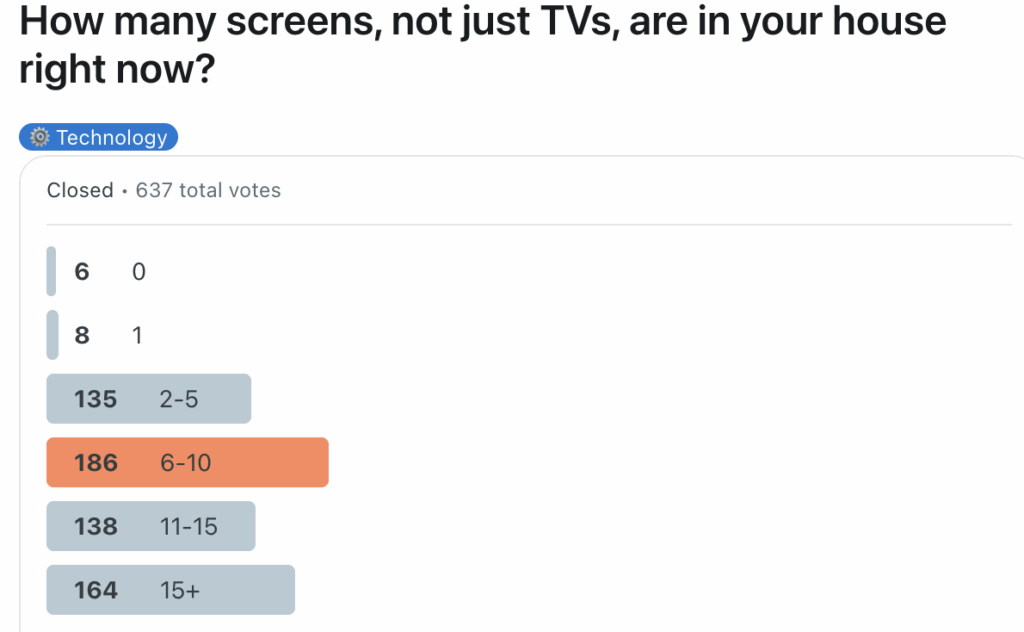
How many screens are in your home right now? You might want to sit down before you start counting—because one mom on TikTok did the math, and her household total has the internet rethinking their own digital habits.

The mom, who shares snippets of family life online, recently went viral after revealing her family owns 24 different screens. Yes, 24.

She and her husband have four kids, aged two to 10, and every member of the household—toddler included—has multiple devices.

In a breakdown that feels more like an electronics store inventory, she included everything with a screen: TVs, tablets, phones, computers, even smartwatches. Shockingly, nine of the 24 screens are televisions. (That’s more TVs than people in the house.)

Then there are the tablets—seven in total. Each family member has their own iPad, and her five-year-old has a second one specifically for speech therapy. Add in three iPhones, two Apple Watches, two computers, and a Nintendo Switch, and you’ve got a fully loaded digital household.

Some outlets tried to bump the number to 27 by including game consoles like PlayStations and Xboxes. But the mom clarified: if it doesn’t have a screen, it didn’t make the list. Naturally, the video sparked conversation. Some commenters were amazed, others horrified.

“No wonder nobody plays outside anymore,” one viewer quipped.

Others admitted their own families weren’t far off—with one user tallying up 30 screens between six people.

The video taps into a growing cultural moment where many families are trying to navigate screen time limits, digital burnout, and device dependency. According to a 2023 Pew study, the average U.S. household has more than 10 connected devices—and with smart homes on the rise, that number is only climbing.

Whether you’re screen-rich or just screen-aware, this mom’s viral moment is a good reminder: maybe it’s time for a quick digital audit of your own. (And maybe—just maybe—some fresh air.)

Texas Officer Rescues Snake Stuck in Tree—Adopts It

A nearly five-foot-long boa constrictor found itself high and helpless in a Texas tree last week—until one animal control officer stepped in to help.

The snake, a domesticated pet, had somehow ended up outdoors and clinging to a limb, unable to survive on its own in the wild.

After being safely removed by the responding officer, the story could have ended there. But instead of handing the boa off to a shelter or rescue organization, animal control officer David Davis took a more personal route. He adopted her and named her Ruby.

“She needed a good home,” he told reporters. “And I felt like me and my son and my wife could give her one.”

While it’s still unclear how Ruby got loose in the first place, her rescue and adoption highlight a growing concern in animal control communities. What happens when exotic pets escape or are abandoned?

Boa constrictors, native to Central and South America, are non-venomous but can reach impressive lengths and require specific care. They’re popular in the pet trade, but ownership comes with responsibilities that aren’t always fully understood until it’s too late. Left in the wild, they pose risks not only to themselves but to local ecosystems.

Fortunately for Ruby, her story ends on a happy note—safely indoors, in the hands of someone trained to care for her, and now part of a family who stepped up to help.

Honestly, how could you not adopt that cutie? I mean… just look at her face. 👀

You Shouldn’t Give 100% at Work… a Solid 85% Is Plenty

If you’re constantly being told to give 100% — or worse, 110% — at work, it might be time to hit the brakes. According to a concept called the “85% rule,” putting in just enough effort could actually make you better at your job.

The idea? Stop overexerting yourself. Instead of running on all cylinders every minute of the day, aim to give about 85% effort. It sounds counterintuitive, especially in hustle culture, but there’s science — and Olympic gold — behind it.

The rule was popularized by none other than track legend Carl Lewis.

The Olympic sprinter was known for starting races at a seemingly relaxed pace, only to surge past competitors in the final stretch.

Why? Because he wasn’t tensed up and burning out in the first half — he was running at about 85%, saving the rest for when it really counted.

In a work setting, the same logic applies. Operating just below your maximum capacity can actually help you:

  • Stay mentally flexible
  • Be more present and aware
  • Boost your creativity
  • Avoid burnout

By contrast, always pushing yourself to the limit can leave you drained, scattered, and ironically, less productive.

Think of it like trying to drive a car with your foot glued to the gas pedal — you’re going to burn through your fuel fast and probably miss your turns.

Of course, this doesn’t mean slacking off. The 85% rule isn’t about doing the bare minimum — it’s about working smart, not just hard. It’s a reminder that peak performance often comes when we dial it back just enough to stay sharp, steady, and sustainable.

So the next time someone tells you to give 110%, just smile and give them your well-balanced 85. Carl Lewis would approve.

Friendly Reminder: Unwrap Your Tamales Before Eating Them

Check out this couple having absolutely no idea how to eat a tamale.  Once they give it a “quick goog” they realize that you’re supposed to unwrap it first.

Here’s the video.

Racing Boat Goes Airborne in Dramatic 200 MPH Crash

What was meant to be a high-speed record attempt at the Desert Storm Shootout in Lake Havasu City turned into a heart-stopping moment on Saturday, when a racing boat – going nearly 200 mph – lost control mid-run, went airborne, and flipped multiple times before crashing back into the water.

The high-performance catamaran, Freedom One, was gunning for a new speed record when strong wind gusts—clocked at around 30 mph—lifted the vessel into the air. Video footage shows the nose of the boat tilting up before the entire craft somersaulted violently and crashed with tremendous force.

Ray Lee, publisher of Speedboat Magazine, was watching from the sidelines.

“They started out really well, nothing out of the ordinary,” he said. “Then it was about halfway, three-quarters of the way down the course when we saw the nose start to lift.”

The accident occurred on a closed and highly monitored course, with safety personnel and rescue divers already in place. Within 20 seconds of the crash, divers were in the water. Two people were onboard at the time of the incident. Miraculously, both survived—thanks in large part to their safety gear.

According to Freedom One Racing tech Ryan Olah, the boat’s design prioritized performance and safety. “We built this boat to be a record breaker pretty much everywhere we go,” Olah said. The Missouri-based team traveled to Arizona to compete in the Desert Storm Shootout, an annual speed competition where boats race solo through a radar-monitored, three-quarter-mile course.

Despite the spectacular nature of the crash, both occupants escaped with relatively minor injuries.

One suffered a broken collarbone and bruised ribs, the other a semi-fractured knee. “They’ve been in great spirits, joking around, a little bit sore and banged up,” Olah said. “The boat can be fixed—it’s just parts and time. We’re just glad nobody had any major injuries.”

The Mohave County Sheriff’s Office confirmed that no further investigation will take place, as the crash occurred during a sanctioned event on a closed course with emergency responders already in place.

As for Freedom One, the boat may be down for repairs, but the spirit of the team remains unshaken.

Bad Apple: Mom Late for ‘Thomas the Tank’ Event Hits 102 with Kid in Car

Thomas the Tank Engine is all about being useful, friendly, and on time—but also safe. Unfortunately, one New York mom took the “on time” part a little too seriously.

Police in Putnam County say 37-year-old Danielle DaSilva was clocked driving at a staggering 102 miles per hour early Sunday morning on I-95 near Madison, Connecticut.

Even more alarming: she had a two-year-old child in the back seat of her SUV!

When officers pulled her over and asked why she was driving so dangerously, her explanation was unexpected—and very specific. She said she was late for a “Thomas the Train” event.

DaSilva now faces multiple charges, including reckless driving, second-degree reckless endangerment, risk of injury to a minor, and failure to stop on the right side of the road. She was released later that day on a $500 bond.

Thankfully, no one was hurt.

But the story serves as a wild reminder that no event –– not even one starring your kid’s favorite TV character –– is worth putting lives at risk.

Thomas may always be on time, but he never hits triple digits to get there.

Exit mobile version