You Shouldn’t Give 100% at Work… a Solid 85% Is Plenty

If you’re constantly being told to give 100% — or worse, 110% — at work, it might be time to hit the brakes. According to a concept called the “85% rule,” putting in just enough effort could actually make you better at your job.

The idea? Stop overexerting yourself. Instead of running on all cylinders every minute of the day, aim to give about 85% effort. It sounds counterintuitive, especially in hustle culture, but there’s science — and Olympic gold — behind it.

The rule was popularized by none other than track legend Carl Lewis.

The Olympic sprinter was known for starting races at a seemingly relaxed pace, only to surge past competitors in the final stretch.

Why? Because he wasn’t tensed up and burning out in the first half — he was running at about 85%, saving the rest for when it really counted.

In a work setting, the same logic applies. Operating just below your maximum capacity can actually help you:

  • Stay mentally flexible
  • Be more present and aware
  • Boost your creativity
  • Avoid burnout

By contrast, always pushing yourself to the limit can leave you drained, scattered, and ironically, less productive.

Think of it like trying to drive a car with your foot glued to the gas pedal — you’re going to burn through your fuel fast and probably miss your turns.

Of course, this doesn’t mean slacking off. The 85% rule isn’t about doing the bare minimum — it’s about working smart, not just hard. It’s a reminder that peak performance often comes when we dial it back just enough to stay sharp, steady, and sustainable.

So the next time someone tells you to give 110%, just smile and give them your well-balanced 85. Carl Lewis would approve.

Skipping Lunch Is Hurting Your Brain!

If you’re someone who regularly powers through your lunch break, you’re not alone — and the toll it takes on your mental health may be bigger than you realize. A recent study out of Australia found that nearly 80% of workers occasionally skip their lunch break, with most reporting that it negatively affects their mental well-being.

It’s easy to see how it happens. A looming deadline, a project in full swing, or just the inertia of being “in the zone” can make lunch feel like something you can push off or skip altogether. But experts warn that this habit, while common, comes at a cost.

According to a workplace psychologist quoted in News.com.au, skipping lunch doesn’t make us more productive — it actually does the opposite.

“We think that not taking breaks is making us more productive,” she explains, “but the trade-off is we’re not giving our brains a chance to rest.”

Over time, that leads to burnout, stress, and a decline in overall productivity.

One practical solution gaining attention is setting a “lunch alarm.” By scheduling a reminder on your phone or smartwatch, you create a simple but powerful nudge to step away and recharge. It’s a proactive strategy that encourages you to reclaim your break, even on the busiest days.

This small habit shift aligns with a growing awareness about the importance of mental health in the workplace. Globally, companies are recognizing the role that breaks and downtime play in preventing burnout.

From “no meeting” lunch hours to designated wellness rooms, many employers are looking for ways to support their staff’s well-being.

But even if your company isn’t there yet, a personal lunch alarm is something you can control.

Of course, the reminder only works if you don’t ignore it. So, as the psychologist advises, “putting strategies in place to prevent burnout is the best approach.” Translation: don’t just hit snooze twelve times — respect the break as a critical part of your day.

In an always-on culture, pausing for lunch may feel like a luxury, but it’s increasingly clear that it’s a necessity. A simple midday alarm could be the gentle push you need to protect your mental health and, ultimately, perform at your best.

Which States Drive the Least—and Who’s Racking Up the Miles?

Are you a highway warrior or a hometown cruiser? According to stats from the Federal Highway Administration, the average American drives a whopping 14,263 miles per year.

But depending on where you live, that number can vary wildly. States with sprawling rural areas tend to top the list, while those with dense cities and strong public transit systems drive much less.

Top 5 States Where People Drive the Most:

  1. Wyoming – 24,069 miles/year
  2. Mississippi – 19,966 miles/year
  3. New Mexico – 19,157 miles/year
  4. Missouri – 18,521 miles/year
  5. Georgia – 18,334 miles/year

No big surprises here. These states are known for wide-open spaces and fewer public transportation options, meaning longer drives for work, errands, and everything in between.

Top 5 States Where People Drive the Least:

  1. Rhode Island – 9,961 miles/year
  2. New York – 10,167 miles/year
  3. Washington – 10,949 miles/year
  4. Alaska – 11,111 miles/year
  5. Pennsylvania – 11,445 miles/year

Fun fact: You can fit 430 Rhode Islands inside Alaska, but somehow, people in both states drive a similar number of miles per year. (You’ve got to love that paradox.)

A Few More Fascinating Driving Facts:

  • The U.S. boasts 8.7 million miles of roadway.
  • Men drive about 6,000 more miles per year than women.
  • In total, Americans clock 3.2 trillion miles annually—that’s more than enough for 6 million round trips to the Moon.

So, how do you stack up? Are you cruising past the national average, or letting someone else do the driving? Either way, you’re part of one of the most car-dependent cultures on Earth. Buckle up.

T-Shirt Cannon Guy Tops List of Most Attractive Jobs — If Salary Didn’t Matter

If money were no object, what job would you choose? Social media users have been weighing in on what they believe are the “most attractive” occupations—assuming salary isn’t part of the equation. And while there were plenty of romanticized dream jobs, the top response took an unexpectedly playful turn: the person operating the t-shirt cannon at sporting events.

The viral post sparked a fun debate—what makes a job “attractive”? Is it about impressing potential partners, or simply chasing a gig you’d love to do? Judging by the responses, it’s a mix of both.

Here are some of the most popular—and delightfully random—picks:

  • Traveling food critic – Jet-setting from city to city to eat for a living? Hard to beat.
  • Forest ranger – A peaceful life outdoors, surrounded by nature.
  • Freelance musician – For those who dream of making music on their own terms.
  • Hammock tester – Yes, someone actually suggested quality-testing hammocks.
  • Pro bono veterinarian – Helping animals for free hits that wholesome sweet spot.
  • Comic book store employee – A dream for the pop culture-obsessed.
  • Animal rescue worker or baby animal cuddler – Just try to picture a more serotonin-filled job.
  • Baker – Because who wouldn’t want to start their day with the smell of fresh bread?
  • Artist – One person even got specific with “Lego artist.”
  • Writer – No surprises here, just plenty of dreamers with laptops.
  • Freelance software engineer – Not for the six-figure income, but for the freedom to create.
  • Paleontologist – Dinosaurs: still cool.
  • Teacher – Often underpaid, but highly valued in this fantasy job market.
  • Librarian – Peaceful, book-filled days? Yes, please.
  • Pizza delivery driver – The logic here is unclear, but the passion is real.

While the list is eclectic, it’s also revealing. Many of the “most attractive” jobs involve creativity, community, and connection—things often lost in more corporate or high-stress careers. And even though some answers are clearly tongue-in-cheek, the message is consistent: If we didn’t have to worry about money, a lot more of us would be chasing joy instead of just a paycheck.

The Exact Time Most Office Workers Are at Their Peak Productivity

If you’re convinced you hit your work groove sometime after lunch, this might sting a little. According to a recent poll, the average office worker is most productive at precisely 10:22 a.m., and from there, it is basically a slow slide toward the couch.

The survey looked at daily productivity patterns and found that late morning is when people feel the sharpest, most focused, and most capable of knocking things off their to-do list. After that peak, things start to unravel. The first major slump hits at 1:27 p.m., right when lunch regret and food comas start to overlap. Then, just for fun, there’s another dip at 2:06 p.m., because apparently one afternoon crash is not enough.

As for the toughest days of the week, Mondays and Fridays take the crown.

Mondays come with the emotional hangover of the weekend ending, while on Fridays we’re mentally checked out before we even check in. We are physically present, spiritually gone.

The poll also dug into what drains people the most during a typical workday. Topping the list is spending too much time in front of a computer, which feels painfully obvious. Close behind are constant interruptions from coworkers and, ironically, not taking enough breaks. Yes, the thing that might help productivity is the thing we feel guilty doing.

When it comes to where we work best, opinions are split.

About 38% of people say they are more productive working in an office, while 22% feel they get more done at home. Everyone else says it does not really make much difference either way. So the great work-from-home debate continues, with no clear winner.

That said, offices are not without their annoyances. Noise levels and not being able to control the thermostat rank high on the list of things people dislike most about office life. One person’s “comfortable” is another person’s arctic tundra.

Still, the office has one big advantage. Two-thirds of workers agree the best part of being there is simply being around coworkers. Collaboration, social interaction, and casual conversations still matter, even in a digital world.

And the best part of working from home? Let’s be honest. Every day is pants-optional, and that might be the most productive feeling of all.

The #1 Thing Americans Are Experts on Is Pretty Pathetic

Forget coding, investing, or, you know, actual job skills. America’s passions these days lie elsewhere.

According to a new poll, the average American’s top area of expertise is now… reality TV.

Out of 2,000 people surveyed, respondents rated themselves on various topics using a 1 to 10 scale. And “reality TV show drama” came out on top with an average self-rating of 6.4 out of 10.

Coming in just behind reality TV were social media trends and DIY projects, both clocking in at 6.0. Trending music scored a 5.9.

But the real surprise? Interest rates – yes, the thing that determines what your mortgage costs – scored a 5.7. Either people are more financially literate than we thought, or everyone’s just been doomscrolling too much news about the Fed. (The study was commissioned by Lending Club, so that might have had something to do with it too.)

How our collective “expertise” shakes out:

  • Obscure movie and TV trivia (5.6)
  • Reality TV show drama (6.4)
  • Social media trends (6.0)
  • Home improvement/DIY projects (6.0)
  • Trending music (5.9)
  • Interest rates (5.7)
  • Obscure facts about movies and TV shows (5.6)
  • General trivia (5.4)
  • History (5.3) (Sounds impressive until you realize “I watched Hamilton” might’ve factored in there.)
  • Health and fitness (4.8)
  • Saving money (3.9)

There’s definitely something to unpack here about how our media consumption shapes our knowledge base. But at least w’ere experts on something, right? Sure, you don’t know how compound interest works. But you can list every feud in Real Housewives of New Jersey in order.

At the very least, it proves one thing: The average American may not be qualified to manage their 401(k), or even know how a basic light bulb works… but you want them on your team for that pop culture trivia night.

The Top “Soft Skills” That Could Land You a Job

If you’re planning to job-hunt in 2026, polish up that resume – but don’t forget to brush up on your people skills too.

ResumeTemplates.com polled over 1,000 hiring managers and found that “soft skills” are no longer just a nice bonus. Even if you’re overqualified on paper, they could make or break your chances of landing that next gig.

While “hard skills” refer to job-specific knowledge, soft skills include traits like teamwork, communication, and time management. And in today’s workplace, they matter. A lot. In fact, 62% of managers say hard and soft skills are equally important, and 24% go even further – saying soft skills now outweigh the rest.

So, what should you work on if you want to boost your hireability? According to the survey, here are the top 10 soft skills hiring managers are most drawn to:

  1. Good communication: This includes being clear and concise in emails, listening well, and generally not sounding like you’re typing with oven mitts on.
  2. Professionalism: Yes, this is still a thing – apparently, some younger applicants have never heard of it. One expert noted that Gen Z’s “more laid-back attitude” could be the reason professionalism ranks so high now.
  3. Time management: Can you actually meet a deadline without five reminder emails and a last-minute panic attack?
  4. Accountability: Own your wins and your losses.
  5. Resilience: The ability to bounce back when things go sideways.
  6. Problem-solving: Can you troubleshoot without spiraling into existential dread?
  7. Critical thinking: This one’s about thinking beyond the obvious, and also knowing when an idea is just plain bad.
  8. Attention to detail: Because “teh best condidate” probably isn’t the best candidate.
  9. Collaboration: Work well with others or risk becoming the office cautionary tale.
  10. Adaptability: Roll with the changes, especially with AI shaking up just about every industry. Leaning in and learning to use it well could be your secret weapon.

Bottom line? Your resume might say you can code in 12 languages. But if you can’t play nice in the digital sandbox, that job might go to someone who can.

So start practicing now – and maybe don’t begin that concise email with “per my last message…”

IRS Agents Told to Start Watching Porn at Work

Here’s a new job title that’s sure to get some raised eyebrows: “Government Porn Watcher.”

Thanks to a recent tax law passed by Congress, IRS agents will start reviewing content on OnlyFans to determine if it qualifies as “pornographic activity” – because if it is, the taxman still gets his cut.

“No Tax on Tips,” But Still Tax on T*ts

The bizarre-sounding assignment comes courtesy of the “No Tax on Tips” law passed over the summer. The law is meant to make things easier on workers who earn tips – and probably weren’t reporting most of them anyway – but it includes one glaring exception: tips for pornographic activity are still taxable. So now, to figure out whether a creator’s tips are tax-free or not, agents are literally being asked to watch the content.

What Counts as “Porn”?

It’s a trickier question than you’d think, because there still isn’t an official definition for what counts as “porn” in this context. So agents might be forced to fall back on the classic line uttered by Supreme Court Justice Potter Stewart in 1964: “I know it when I see it.” More of a shrug than a legal standard.

OnlyFans Isn’t Just Porn

Not everything on OnlyFans is adult content. There are celebrities, fitness influencers, chefs, and others using the platform without getting naked. But with almost five million creators in the mix, and no clear breakdown of how many are based in the U.S. or posting R-rated material, the IRS has their work cut out for them.

Perfect Job for Perverts?

This strange new responsibility has been making the rounds online, with people joking that the government has officially found a way to turn being a perv into a pension-eligible career.

So if you were thinking your job was weird today, just know there’s someone out there filling out a government form after binge-watching NSFW content for tax purposes.

Half of Us Have “Revenge Quit” a Job

If you’ve ever fantasized about telling your boss to shove it and walking out mid-shift, you’re not alone – and many of us have actually done it.

According to a new poll from Monster, revenge quitting – quitting without notice as an act of frustration or vengeance – is surprisingly common.

Almost half of us have done it before

47% of workers say they’ve done it at some point in their life. And it’s not just a personal rebellion; 57% say they’ve witnessed a coworker do it too.

Why we “revenge quit”

The top reason people gave for going full scorched-earth on their job? A toxic work environment. Poor management and feeling undervalued were also high on the list. Basically, if your office feels like a daily test of patience, you’re more likely to bail without a heads-up. (aka, no two-weeks notice)

Bad bosses partly to blame

Interestingly, nearly half (46%) of those who revenge quit said they might have stuck it out if they’d had a different boss. So yes, a good boss really can make or break a workplace.

But while revenge quitting might sound like something out of a workplace comedy, it’s often more calculated than it seems. Over half of the people surveyed admitted they mentally checked out at least six months before making their exit. One in five people said they’d fantasized about quitting for over two years before they finally pulled the plug.

In contrast to rage quitting, which is often an in-the-moment emotional explosion, revenge quitting can simmer in the background for months (or years) before someone finally walks out.

Either way, flipping the bird on your way out the door sure sounds fun, right?

An illustration of group of business people towards giant exit word

Literally Half Your Workday Is Busywork

If you’ve ever ended the day wondering what you actually accomplished, here’s your answer: about half what you could.

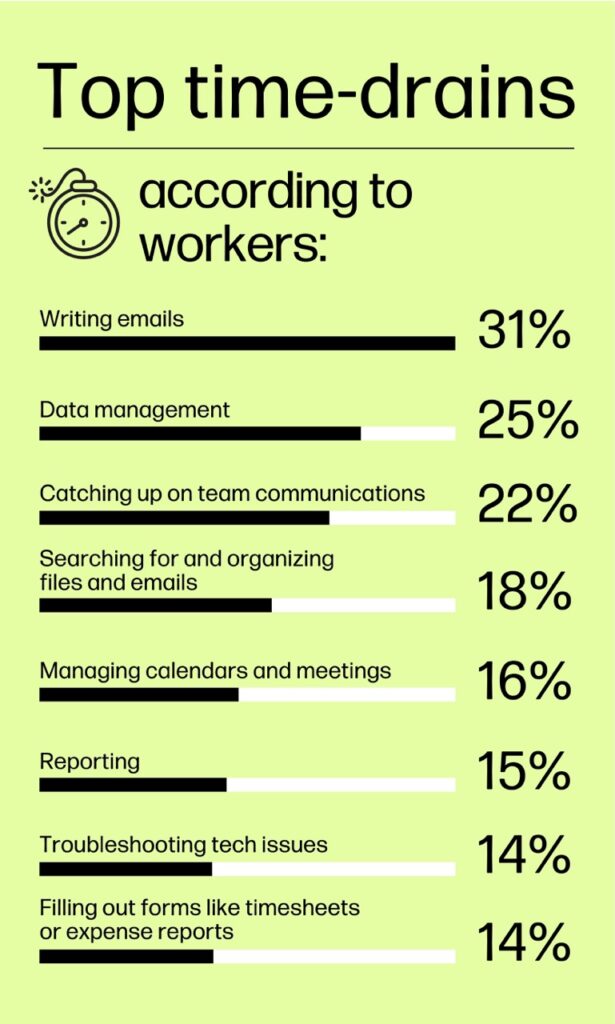
A new survey says American office workers spend half their day (literally, 51%) doing nonsense busywork like writing emails, digging through files, and copy/pasting. Basically, it’s admin Groundhog Day.

That’s not all the annoyance we have to deal with either. The survey found 1 in 3 people have considered quitting because of bad or outdated tech, and 85% blame repetitive tasks for their burnout.

The Top 3 Biggest Time Sucks

The poll found the biggest time suck of them all is email, followed by data entry, and then catching up on team messages. So basically, you spend half your day talking about work instead of doing it.

Even IT folks admit things are out of hand. They say employees waste way too much time on menial junk, and not even 4 in 10 workers feel like they’ve got the right tools to do their best work.

Will A.I. save us?

The “good” news? Companies say they’re rolling out A.I. tools to save us from all that busywork. The bad news? If history’s any clue, those tools will come with training videos, logins, and new ways to “streamline” the same stuff we already hate.

The dream is simple: less typing, fewer tabs, and eventually a workday that feels like work instead of a never-ending email marathon.

For now, we’ll just keep dreaming.

Talker Research
Exit mobile version